



Housework
My grandmother comes to visit, forty years after her death. Her blazing grin I remember from photographs. This is Nonny in the period of her cheerful decline, post-Poppy’s demise—his after a long period of wasting and seriousness, during which he quizzed six-year-old me about my plans for the future. I gave the wrong answer—ballerina—or no answer: impatient leg-swinging on the stiff chair between his bed and dresser.
Nonny-of-the-cheerful-decline is the only grandmother I know, a slightly different version—one leg lost to diabetes—of her earlier self: the one who made and sold loaves of bread from her home on Gregory Street; who laundered the collars and cuffs of Yale students, delivered to her in a basket by the Russian launderess’s husband; who beamed at the camera and saved family snapshots in a tin box; who crocheted bureau scarves, bedspreads and pillow shams, taught her daughters—the three amassing drawers of ropey landscapes depicting ponies, hearts, bees, and diamonds; who baked hard boiled eggs into twists of shining dough; who gardened, cleaned, ironed and cooked; who raised four children during the Great Depression, who saw two sons off to war and two daughters off to nursing school; who cradled her first grandson’s encephalitic head in the crook of her elbow while her granddaughters, wearing flower crowns, flanked her in bed. Through it all, her shattering smile.
I stay in bed late, scrolling. Sometimes I bake, squinting at a hand-written recipe Nonny had mailed to my mother before I was an idea. Mostly, instead of ironing, cooking, and cleaning, I write. I uncover (ransack), explore (scrutinize)—unmake one thing (the past) to form another. All this backward glancing: Where did I learn it? My grandmother’s life is testament to the present, to her virtuosity at creating—and swimming in—the current that sustained her family. The presence of the present in my life—that is, the now that I would swim in? Barely enough for face-washing.
Now, at 4 a.m., she beams at me from her wheelchair at the head of my dining room table. She is as cheerful in death as she was in life. Furniture needs polishing; the veneer on the sideboard shows arid patches—wisdom spots, my dermatologist would say. Nonny has plenty of these.
I’m not a ballerina, though sometimes I dream of hippos. That doesn’t matter. This does: Make one thing better. Then the next. And the next.
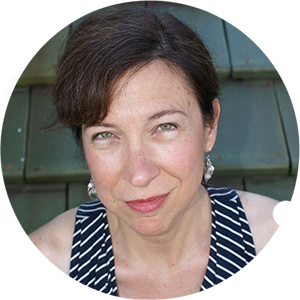
Margaret Luongo is the author of two story collections—If the Heart is Lean and History of Art. Her work has appeared in The Cincinnati Review, Granta, Consequence Magazine, MicroLit, Hippocampus, DIAGRAM, the Pushcart Prize anthology and elsewhere. Recipient of the Walter E. Dakin Fellowship, Hawthornden Fellowship, and Ohio Arts Council grant, she teaches creative writing at Miami University. She lives with her husband, artist Billy Simms, and their feline companions.
Recommended
Wig

Strike

Lapsus Calami