


Once and Future Kingdoms
Real Histories Meet Sci-Fi Apocalypse at Michael Heizer’s City
An afternoon’s viewing of Michael Heizer’s mega-sculpture, City—under construction since 1972 and now open to limited public viewing—is the closest you can get to a real-life desert sci-fi experience. Walking around inside an abstract cityscape that’s almost two miles long by a half-mile wide, tucked away in remote south-central Nevada, you think of Dune’s Arrakis. You listen for the revving engines of a Mad Max motorcycle posse. You suspect the busted Statue of Liberty might appear around the next corner, Charleton Heston pounding sand as he realizes the Planet of the Apes is Earth. For a human of the Cold War generation, Heizer’s City is framing familiar conceptual territory. I’ve been imagining cities like this since I was little. Civilization in ruins, a bleak desert landscape remains.
But City also exists as a real human expression of our time. While the sculpture vibes with the quaintly insane ambitions of a Bond villain’s futuristic lair, imperative histories put their hands in the air like honors students in seminar. Mesoamerican apocalypses and histories of the continent’s native people resonate, even as the price tag for the work skyrockets and the land use considerations engender controversy. Within the art world, the sculpture is a massive “earthwork”—a late addition to one of the previous century’s noteworthy art movements, and one that’s driven by personal relationships that include some envy and shit-talking—there’s some Real Housewives energy in the story of City. The friction among these conceptual frameworks throws off sparks, and any thoughtful engagement with City will be complicated.
For myself, I’d spent half my life fan-boying about Heizer’s “mystery in the desert.”2 A hard-living cowboy in a flat-brimmed hat, building a mad desert city? Sign me up! I spent decades sleuthing around the mythos—reading everything I could find, scouring books and periodicals and eventually the internet for any photos that might trickle out of the secretive site. After thirty years down the rabbit hole, I came to accept that I’d never personally lay eyes on Michael Heizer’s City. And then suddenly it opened. The federal government made a deal with Heizer to protect the work and its surrounding land, and one of the requirements of that protection was that the site had to open. I immediately applied for tickets, got them, rounded up a crew and made the pilgrimage. It was really going to happen!
But when I got there, I only felt partially welcome. While Heizer wants City to make its mark in art history, he’s also built City for a post-human future. City is looking past the contemporary viewer, and that presents a challenging assignment: transcend your humanity at the cliff’s edge of end times. Take as premise that the cultural structures shaping your consciousness and supporting your lifestyle are dissolving into history. From that starting point, become a last, lost mystic, projecting yourself toward a future consciousness. In your moment, you may possess frameworks for understanding City as an extension of architectural, artistic, and political histories—and those are interesting—but you should also strive to see City from a future perspective that’s broken decisively from our own. That intention, the artist’s projection into deep time, is tangible in the work. As an Earthling of the cold war generation, I drew on the sci-fi, and tried to find my inner astronaut stumbling from a crashed escape pod. What’s this? The ruins of an elapsed civilization? It looks like … some kind of … City.
“People complain that no one will see these works because they are too far away, but people go all the way to Paris, down a street, in a room, down the hallway up some stairs to another room to look at the Mona Lisa.”
Our crew of intrepid astronauts consisted of myself, my wife Kari, our kids Claire (23) and Carter (20), plus our friends David and Tryn. We boarded our escape pod, cleverly disguised as a Ford Bronco, in a small parking lot on the west edge of Alamo, Nevada, a desert outpost ninety miles north of Las Vegas that houses the Triple Aught Foundation, overseer of the operations of Michael Heizer’s City. Foundation representative Ed Higbee would drive us another ninety minutes north and west from there, mostly off-pavement. Tall, lean and mild-mannered, Ed is a native of rural Nevada, and he knows that desert travel requires respectful preparation. In addition to a large cooler of water bottles and enough snacks to sustain us in case of an unexpected break-down, the Bronco featured two full-sized spare tires—one mounted conventionally on the back and the other strapped ingeniously to the roof of the vehicle.
“Why two spare tires?” I asked.
“Well,” said Ed, “three flat tires would be extremely bad luck.”
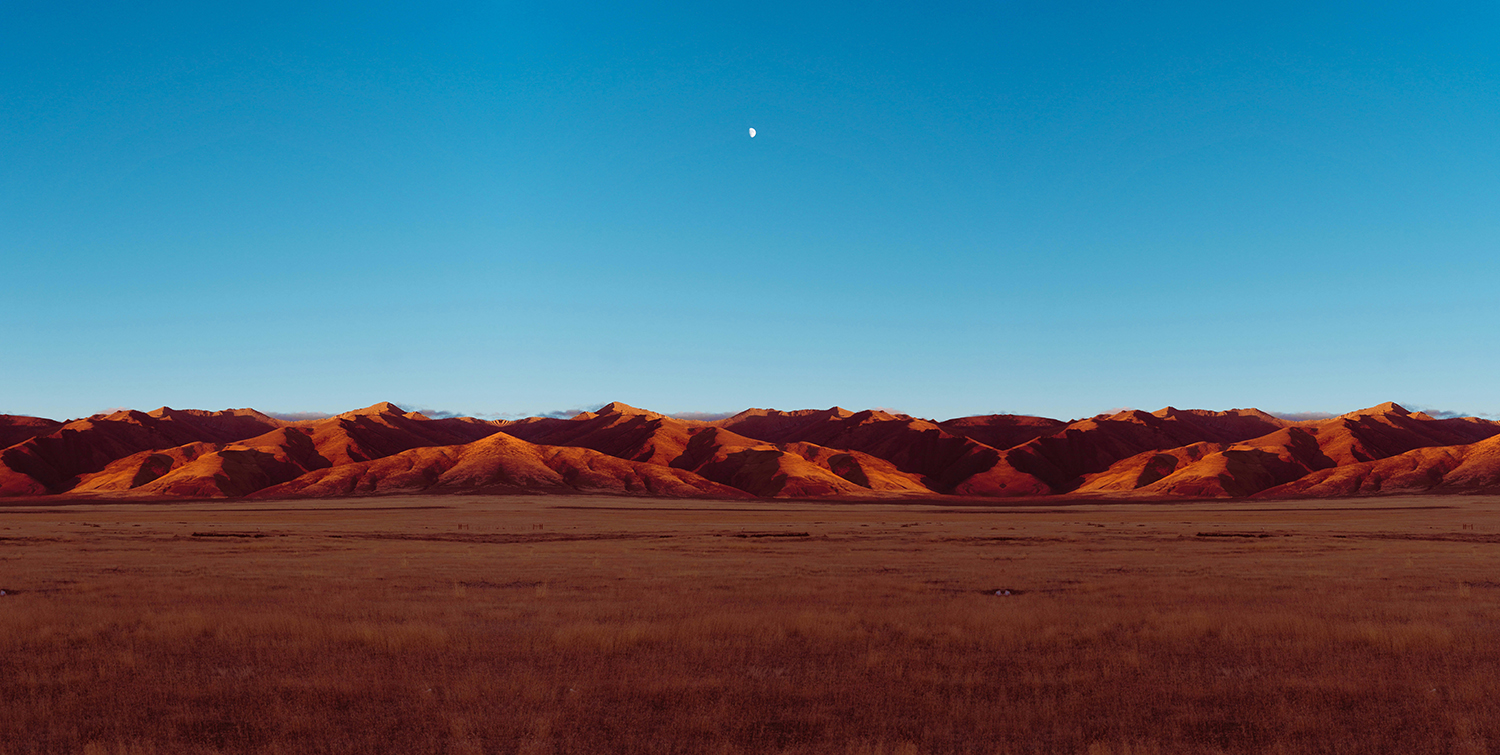
A comfortable storyteller, Ed was not going to be our art critic. “I won’t say much about City,” he said. “That’s for you to see. But if there’s anything else you want to know about this place, I can probably tell you.” The route covers rough terrain, and the vehicle lurched across rutted, rocky tracks. The views, though, were hypnotizing: sage-covered foothills, bare rock faces in sun and shadow, slate browns and grays against crisp blue sky. To the West, the high wall of the Sierra Nevada Mountains marks both the California border and the western edge of the inland sink known as the Great Basin. In early US mapping of the region, an Army corpsman flashed a mirror signal “from that highest point right over there”—Ed pointed through the windshield in the direction of Troy Peak—and that historic flash of reflected sunlight was visible from Wheeler Peak, three hundred-some miles east on the Nevada-Utah border.
Such an extraordinary perception, engineered with a seemingly simple redirection of solar energy, but imagine the perspective of the region’s indigenous Paiute people: a conquering army, equipped with advanced technology, redirected the power of a star to reckon a territory they prospected for “settlement.” They couldn’t possibly have fathomed the futuristic spectacles to come. Huge explosions and nuclear fallout would ripple from the Nevada Test Site. The skies would fill with airborne vehicles transporting these new humans from every corner of the world to the glittering recreational metropolis of Las Vegas, Sin City. What had been land, home, the constitutive element from which people are formed, becomes a jangling, flashing machine of commerce and war, spidering through the valleys.
Sometimes the only thing that keeps stories from being sci-fi is that they’re real.
But, taking a slow roll in a comfortable vehicle through big country feels, to me, like one of the undeniable pleasures to be experienced in this era of fossil fuel extraction, and my anticipation was building as we got closer to City. When we arrived, I would strive to view the sculpture with mindfulness, but I was excited for what felt like a personal culmination. I wasn’t going to let history ruin my day.
We finally rounded the northern shoulder of a low mountain pass and saw in the middle distance a simple two-story house surrounded by a few trees and a shockingly green field of alfalfa. “There it is,” said Ed, and it took me a moment to recognize, just west of that ranch house, a clean line cut across the fuzzy texture of the valley floor. That’s the top edge of City, which is cut down into the desert, below grade, so that its main features are hidden from surface view.
“I decided to make the city visible only from the inside,” pronounced Heizer, like some mad King of Human Perception, in his 1984 interview with Julia Brown. It’s a text I’ve obsessed over: architect of earth-based art gestures on a massive scale, Heizer articulates his ambitions—aesthetic, historical and metaphysical—elegantly, even in conversation. “It is interesting to build a sculpture that attempts to create an atmosphere of awe,” Heizer says. “Awe is a state of mind equivalent to religious experience. I think if people feel commitment, they feel something has been transcended.” At moments, Heizer seems to believe that the huge rock and dirt gestures that constitute his slightly bonkers oeuvre could be deeply meaningful, even transformative, for their viewers. But Heizer’s pessimistic assessment of humanity as a species on the brink of extinction tends to throw shade on any mirage of optimism in his work: “The insecurity of society, the frailty of its systems … . My sensibility was based on a feeling that we were coming close to the end of the world.”
Straining for views out the driver’s side windows, we drove past the sculpture and then circled back to approach it from the west, past an airstrip built for the artist and his financial supporters3 to come and go. Finally, Ed followed a gravel road leading inside the 1.75-mile-long artwork. On a surface of gray and white crushed rock between two concretized mounds of about thirty feet in height, Ed stopped the vehicle and gave us our instructions. We had three hours. We could return to the vehicle any time if we needed a rest. Don’t let the clouds fool you. Wear a hat and sunscreen. And, last but not least, no photos. Each of us had already signed an agreement swearing to take no photos. But Ed reminded us again, as an agent of the foundation: no photos. All rights to all images of the sculpture belong to Heizer and the foundation (another reason to build the sculpture below grade? so no one can photograph it without paying?). We owned our experience at the sculpture, and that would have to be enough.
And then we were in. We’d arrived. We just walked into City, and the crazy futuristic sculpture in the desert that I’d been imagining for most of my adult life turned out, in fact, to be real.
“I was interested in massive objects as well as the absence of objects.”
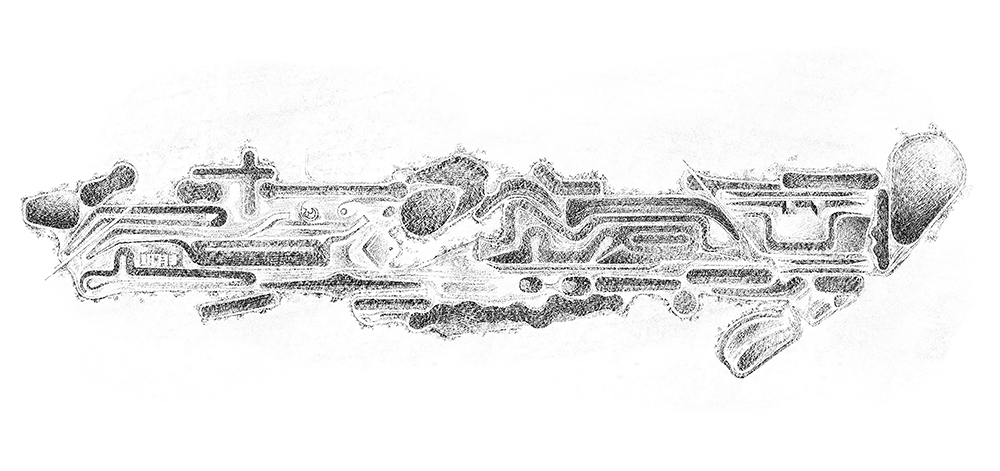
The main body of City consists of a series of large, figurative mounds and corresponding terraced depressions fluidly connected within a slash cut into the desert floor at a northwest to southeast angle. The positive assertions of above-ground structures are paired with below-grade spaces, elegantly leveled, architectural. Cast in the grays and tans of its native materials, City’s sensuous, curvaceous recesses are the source of the material for the sculpture’s elevated structures, rising like abstract burial monuments or effigy mounds. Take material from below to build up above—a simple binary, but one that, on this massive scale, immerses the viewer in the artwork.
City features curbs, exactly like the street curbs that real cities have used to designate transit spaces since at least the 1800s. “It’s a real city, see? It even has curbs!” We laughed. This element felt like an uncharacteristic wink from an artist not generally known for his buoyant sense of humor, but the curbs help define your experience at City, outlining forms for consideration, and showing you where to walk. Aesthetically, the curbs provide a sense of artistic line, like you might describe in a painting. It’s a surprisingly familiar visual sensation, but the scalar relationship is reversed from that of most artistic encounters. Ordinarily, a viewer appreciates the line of a painting that is smaller, or in the case of a mural or very large canvas, slightly larger than their own physical body. The line of City dwarfs a human form—these lines wrap around you literally for miles. All the same, City’s abstract and surprisingly aggressive deployment of these curb lines reminded me almost immediately of another famous American artistic cowboy, Jackson Pollock.
“The history of American art in a way begins with Jackson Pollock and his big paintings.”4
In the late 1990s, the Bellagio Hotel & Casino briefly housed a gallery of modernist art works. I visited as a young person, excited to see my first Jackson Pollock painting. I had seen reproductions in books. I had watched the famous Hans Namuth film, shot from under a glass that Pollock was painting. I learned about Pollock saying “I am nature” and how action painting is an effort to fully embody moments of creation, a theory that frames the work itself as a trace of the artist’s creative energy. A new resident of Nevada, I’d connected those ideas to the feeling I had when I was outside at night on desert playas. With zero light pollution and high elevation, I experienced a new perspective on the physical galaxy. I could see it. Tiny spectator standing on the surface of a planet, looking out through the spiral arm of a disc-shaped assembly of stars circling a black hole, I’d had the thought: being in the Milky Way is a little like being inside a Pollock.
That day in the Bellagio, I stood about ten feet in front of a horizontal Pollock drip painting, trying to purely look, empty my mind and be in the encounter with the work. Busy gallery. People everywhere. But I posted up in front of that Pollock, trying to have a metaphysical experience. That’s when I noticed the foreign object. This Pollock was three-dimensional in that paint was piled on the canvas so that the work had topography as well as height and width, and in its depths I saw an item tucked in behind a curl of white and red pigment. I waited for some people to pass, and then I took two steps forward. Was it? I leaned in closer, tilted my head to the left, trying to get an angle, and then … I felt a hand firmly grasp my shoulder.
“Move along, sir,” said the guard—not a docent but a beefy guy in a police-y looking uniform.
“I just”—I stammered, flushed. “Is that a cigarette butt in there?”
“I don’t know, sir.” He applied pressure to my shoulder and the painting receded into my past.
“I thought I saw a cigarette butt in there.”
“That’s wonderful, sir. Move along.”
When you walk into Heizer’s City, it’s kind of like you’re the cigarette butt tucked inside the Jackson Pollock.
“I isolate elements from nature. It can be fully logical, physical truth: three planes that describe physical force and limits.”
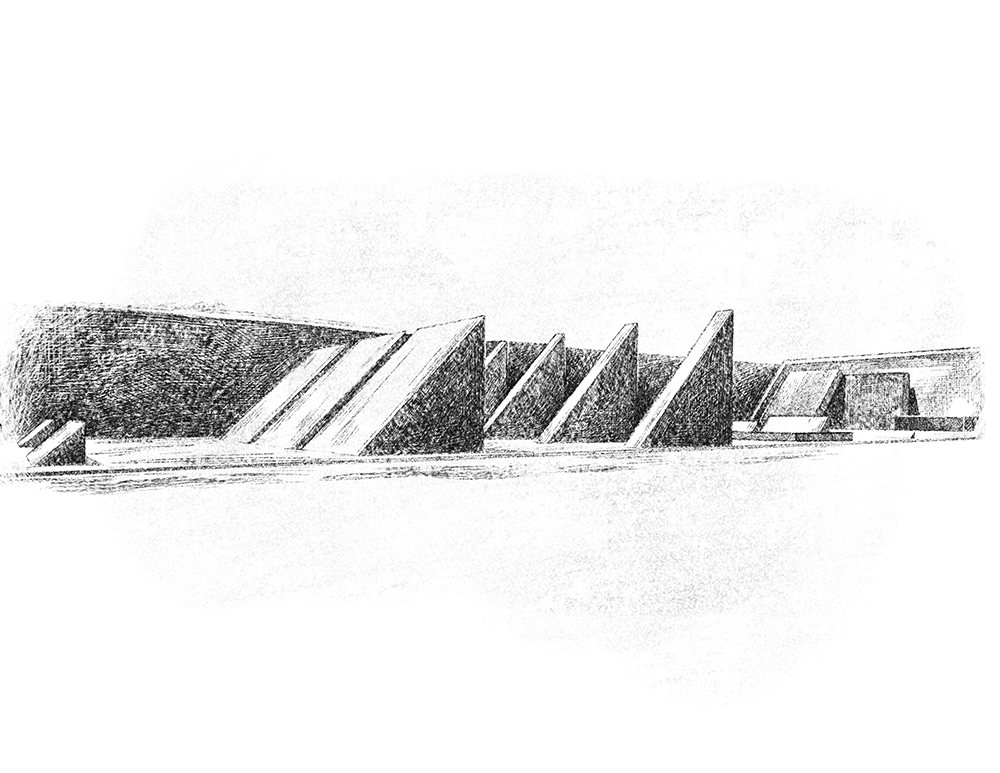
The layout of City funnels viewers from their entry point toward the first of three significant, stand-alone set-pieces situated within the larger work. Called 45°, 90°, 180°, this arrangement of geometrical concrete shapes stands on a flat bed of concrete, roughly thirty yards long by ten yards wide. For those not used to visual perception in large physical environments with low humidity, the sculpture might appear to be just a hundred yards from the gravel platform where Ed Higbee dropped you off, but it’s half a mile away. A compelling singularity within the ambient mound-and-recess structure of the larger piece, 45°, 90°, 180°, draws the eye, and it feels very natural to walk toward it as a first move in exploring City.
I had seen pictures of 45°, 90°, 180°, so I understood that it was made up of three rows of triangular and rectangular concrete shapes, almost like blocks or game pieces, symmetrically aligned on the work’s concrete base. Walking toward it, the play of light and shadow from the piece is beautiful, and my viewing perspective continued to improve as we got closer and more directly in front of the piece. At a distance of about a quarter mile, the walkway toward 45°, 90°, 180° widens into a viewing area, like a scenic overview from a highway. Arriving there, I experienced the first trick of visual perception that Heizer constructed into City. Viewed from straight on, all of the individual shapes that make up 45°, 90°, 180° become indistinguishable. The triangles slot in between the rectangles, and … click! the sculpture’s details vanish into what looks like a flat, two-dimensional concrete square, facing the viewer like a monochromatic gray painting on a gallery wall. It’s a stunning effect. You can no longer discern at all the outlines of the sculpture’s major shapes, though you’ve been looking at them as you walk, and you know they’re quite large forms. They just vanish into the gray square that kind of hovers, there. As soon as you continue walking—as soon as you gain any angle on the piece so that you’re not looking directly at it—that trick of perspective dissolves, and the sculpture’s constitutive forms come back into view. You can stand there going back and forth. Couple steps in either direction, dimensions appear. Step back to the center, gray square again.
Within the sweeping, curvilinear context of the larger sculpture that is City, itself, 45°, 90°, 180° is surprisingly math-y. Its forms are crisp and geometric, and this trick of perception clearly involves precise calculation. With this combination of curve and angle, City might be said to synthesize a couple of important ideas of twentieth-century painting—geometric minimalism and more expressive, emotional abstraction. Seeing 45°, 90°, 180° within the larger context of City is like seeing a symmetrical shape from a Kazimir Malevich painting pasted into one of Georgia O’Keefe’s sensuous gestures.
But the significance of the visual vanishing act reaches beyond art history. In fact, it reaches beyond humanity. The strongest feeling I had as I approached 45°, 90°, 180° was that I’d found a key that turns a tumbler (the jagged forms look a little like the teeth of a key) or a switch that is flipped on-off. When the structure’s features clicked into place, a mechanism was activated, an intention was communicated. Heizer had engineered the viewer’s experience in a way that the viewer could recognize. Given his statements about the piece’s post-human audience, Heizer must’ve imagined a future viewer that might understand that this is a structure created by a being capable of manipulating basic forms in complex ways. 45°, 90°, 180° indicates the presence of intelligent life, once upon a time, on this planet.
“The history of sculpture consists mostly of remains and fragments.”
Though it just opened, some parts of City are fifty years old, and it shows its age in some places. The surface plaster that provides the illusory smoothness and visible-from-a-distance sheen of 45°, 90°, 180 is cracking in several spots. Both crows and bats have made homes in the concrete corners of the sculpture’s highest point. The sagebrush twigs that make up the crows’ nest and the guano pile below the bat roost both foreshadow the future of City: a gradual absorption back into the landscape that is inevitable in geological time.
It’s taken a long time, in human terms, to complete City, in part because it’s a work of unprecedented size and complexity, and in part because there were substantial delays related to Heizer’s health. The intense physical demands of work on the project, coupled with decades of heavy smoking and drinking, eventually led to chronic neuropathy. Subsequent medical interventions got him back to work, but resulted in a morphine addiction that set him back again.
I’ve been fascinated by the psychological profile of an artist who could carry out a work of this magnitude in this place. Encountering City in person, my questions about its creator were more amplified than answered. If a Pollock canvas is a trace of the solar flare of a painter’s creativity, that process occurs in discrete, observable gestures over seconds, minutes, hours. When you’re talking about City, you’re talking about a creative fire that’s burned hot through five decades, exercised by engineering processes more related to mining and architecture than to any traditional idea of gallery art. Oh, and to engineer the piece, you have to live and work in a remote location in a harsh climate. What fuels that kind of flame?
As a youngster, Heizer was “a hopeless student,” unlike his siblings and his father, the well-known archaeologist, Robert Heizer. Were there early feelings of inadequacy? If so, these were offset by opportunities; instead of school, Heizer traveled as his father’s assistant. The elder Heizer specialized in the study of early American cultures, including ones that moved massive stones for artistic or ceremonial purposes. Young Michael saw monumental stone work in Mexico, Peru, and Guatemala, absorbing structural ideas and a sense of how civilizations rise and elapse, leaving ruins behind. In his twenties, Heizer broke from his Western family to pursue a more conventional path toward artistic glory: a New York career as a gallery-based painter. His paintings had success, and his artistic dialogue with abstract expressionism carries over to his large, land-based works, but Heizer never took to the New York scene. “I didn’t know much about the east and I didn’t like what I saw,” he told Brown. “It looked like it was degenerating.” It wasn’t long before Heizer returned west and began making the land-based art for which he’s best known.
In New York, Heizer met a New Jersey artist, Robert Smithson, and it’s this relationship, I believe, that most fuels Heizer’s drive to perfect City.
Heizer became friends with Smithson and his wife, the artist Nancy Holt. In 1968, the trio travelled through the west and collaborated on an art-buddy-road-trip film called Mono Lake (1968), which provides a charming, informal glimpse of an exciting friendship, fueled by shared artistic vision.5 Around that time, Smithson scouted a site near the Great Salt Lake, where he would construct his signature work, an organization of rocks on the northern edge of the Great Salt Lake called Spiral Jetty. He built the work in 1970, a year after Heizer had completed his conceptual excavation, Double Negative, in central Nevada. Both works became noteworthy, but Spiral Jetty became the emblem of the Earthworks movement, surpassing Heizer’s body of work. The native Nevadan didn’t take it well. “Competitive, volcanic, megalomaniacal,” Heizer seethed, and the friendship soured. Even after Smithson died tragically in a plane crash while scouting a Texas work site, Heizer besmirched the artist as a “tinhorn” and “complete phony.” City is the masterwork designed to return the Earthworks crown to its rightful king, Michael Heizer.
To me, a comparison between Spiral Jetty and City reveals something about ego and generosity in art. At Spiral Jetty, I had an integrated experience of the human with the cosmic. Inscribed in rock on lake bed, Smithson’s elegant spiral—large, but not compared to Heizer’s mega-work—evoked inner and outer spaces. The form’s echo of our spiral galaxy spun me toward interstellar distances, even as it suggested inward spirals toward the bottom limits of matter explored by subatomic physics. The brackish, mineral-red water of the Great Salt Lake evoked the fluid content of my body and, by extension, the aqueous solution of minerals central to all life. Like the best kind of partner—smart, attractive, confident—Smithson’s sculpture wasn’t at all possessive. Situated within the broad panorama of the Utah landscape, Spiral Jetty seemed happy to share my attention with its contexts.
By comparison, City is a jealous lover. If you want to see Heizer’s masterwork, you have to go down into it, and suspend contact with the outer world. The action is the art itself, inside the recessed structure, which blocks the landscape from view. Forget those irrelevant mountains and valleys, the piece seems to be saying. “It becomes more effective visually,” according to Heizer, “because you don’t see a tree, you don’t see a hill, you don’t see a cow walking around. You see nothing except the art.” Look here, Heizer’s work is saying. Look at me.
If Spiral Jetty felt more generous, warmer in the traditional sense of human contact conducted through art, that doesn’t necessarily make it more impactful. At City, Heizer’s looming authority—the scowling visage of the maniacal mastermind superimposed over my whole experience there—feels like an earnest manifestation of important energies of our time. Pointing, posing, and pronouncing, Heizer’s presence brings to bear egomaniacal energies that drive post-industrial societies to the brink. Closed-off, xenophobic, demanding allegiance, City speaks from an important nexus of our mass psychology. We’re insecure. Our egos are delicate. We want to be loved, but we want people to think we’re tough. Above all, we don’t want to die. If we can’t live forever, we’ll try to build something that will. City, the biggest sculpture ever—fifty years in the making, out in the middle of the desert—is an honest gesture of unhinged ego, as well as an incredible achievement of vision, skill and commitment. It’s the best and worst of us.
“Complex One uses a mastaba form, which was the form of the original mound over the burial vault of Zoser at Saqqara. The concrete banding that defines the exterior rectangular plane is related to the serpent motif that covers the walls and structures at Chichen Itza in Mexico.”
After viewing 45°, 90°, 180° on my own, I re-connected with Kari for the rest of our tour. Our kids had gone the other direction, toward the sculpture’s southeastern end, and we weren’t sure where David and Tryn had gotten off to, but there was no need to worry. One nice thing about this kind of City is that you weren’t going to get hit by a bus. It felt good to connect with Kari. Exploring the sculpture alone might feel like an experience on the edge of sanity. The booming voice of Heizer, with its scowling ambitions, can feel a little relentless. I was happy to walk and hold hands and share perceptions with a partner, to remember the value of human connection as a buffer against Heizer’s grim appraisals.
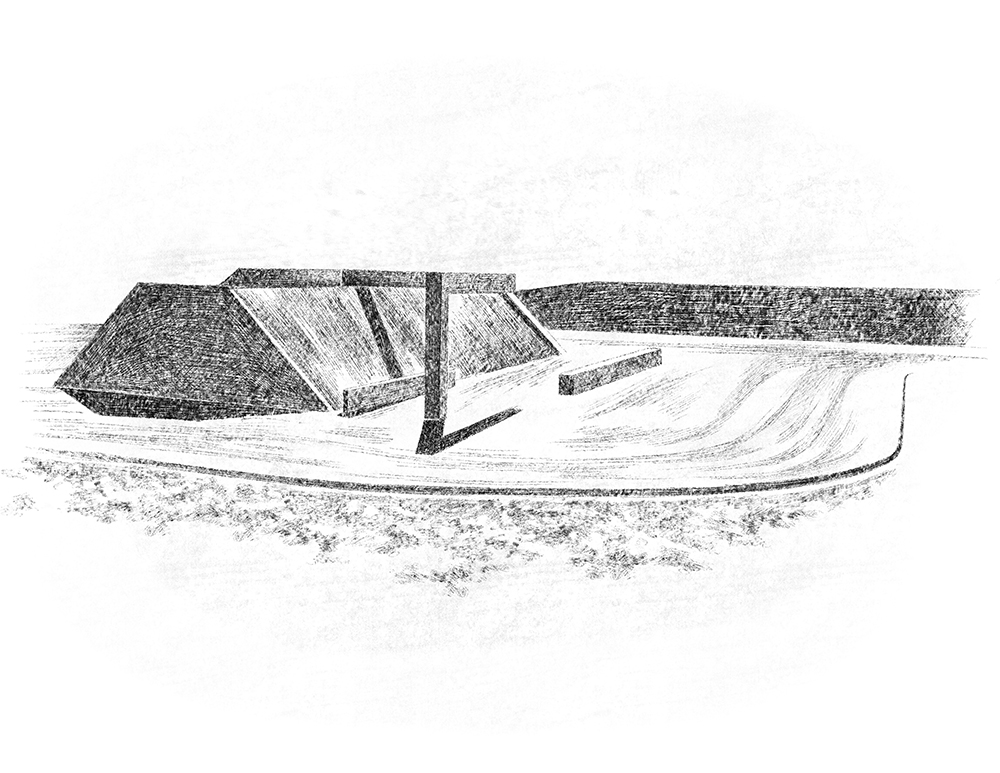
Together, we walked the length of City toward the sculpture’s other stand-alone elements, Complex One and Complex Two, at the southeastern end of the work. As we walked, the two pieces ducked in and out of view—the side-wall slabs of Complex Two, three huge rock panels marked by slashes evoking a basic code of signification and then the blunt rectangular mastaba of Complex One, with three linear bands extended like arms in front of it. In all of my anticipatory reading and image-sleuthing over these last decades, Complex One has always been my favorite stand-alone feature of City. I love the form itself, and its connection to Chichen Itza, which Kari and I had visited, and where my sense of the mysteries of human civilization had deepened. Approaching it felt personal, familiar, but when we came into the plaza in front of the sculpture, that familiar piece surprised me with another orchestrated trick of visual perception.
About a quarter-mile from the work, Kari and I reached a staging platform similar to the one in front of 45°, 90°, 180°. Looking straight at the inward-facing side of Complex One, a viewer sees the three angular bands surrounding the mastaba click into place as a frame outlining the rectangle. In late afternoon sun, the finish on those beams has a sheen to it, and the framed mastaba almost looks like a dimensional gateway, à la 1994’s sci-fi blockbuster, Stargate. It’s another stunning perceptual effect, another controlled phenomenon, engineered by Heizer.
They’re clever, these gestures. At each end of the length of City, the structure offers the viewer a moment of contact with the engineering prowess of its creator—the King of Perception tossing trinkets down from his royal balcony. From a wider-angle lens—the post-human lens that Heizer overtly directs us toward—these gestures indicate the presence of a complex intelligence behind the structures at the site.
From that viewing platform, we circled down toward an open plaza directly in front of both Complex One and Complex Two, which face inward at a ninety-degree angle to each other. I moved close to the structure of Complex One. I had read that Heizer cast the piece in concrete designed to withstand a nuclear blast from the Nevada Test Site, just a few miles to our southwest. Standing there with my wife, I wondered how well the sculpture would protect us. Like the doomed humans in that old painting of the biblical flood, Gustave Dore’s The Deluge, we would cling to Heizer’s concrete berm as those ancients clung to the last outcropping of land above the risen tide of an angry god’s judgement. Waves of shock and fire would pass over us in the doom-scape. The idea that this block would protect us struck me as ridiculous, even offensive to the memory of those who died in Hiroshima and Nagasaki, as well as the generations of “downwinders” in Utah further east, who suffered from the radiation that those “tests” put into the atmosphere. Even after aboveground tests were discontinued, underground tests continued until 1992, twenty years after Heizer began work on City.6 So Heizer’s nuclear considerations were not speculative fictions. They were very real.
“The idea of living in the nuclear age informed everything, the clock was ticking.”
Soon after moving to Nevada in my twenties, I saw Nevada filmmaker Peter Goin’s documentary, Nuclear Monsters, which illustrated the ways that campy sci-fi films of the mid-twentieth century expressed cultural anxieties of the Cold War. A giant blob or mutated spider was a titillating way for a nation to process feelings about its out-of-control military technologies. When an A-bomb was “tested” near a “Doom Town,” military engineers would study the effects of the bomb on domestic structures. When artist Robert Beckman created large stills from the “Doom Town” videos of a house in stages of being blown away, I bought the exhibition catalog, cut out the pictures, and hung them in my office, in thrall to a destructive power that had hung over every aspect of my lifetime.
As a teenager, I attended a “youth summit” on nuclear peace in Washington D.C. In a lecture hall, I stood among my peers and, with the sweet naivete of a human who still believed in the nobility of our species, asked a United States Senator directly why the US and Russia couldn’t agree to “stop the madness.” How did he answer? I only remember the blue suit and red tie.
In classrooms, we ducked and covered. We imagined the windows of our building shattering and spraying us with fiery daggers. When we learned in a high school history class about the US bombings of Hiroshima and Nagasaki, our teacher explained that those explosions ended a war that might’ve gone on much longer, costing even more lives—American lives.
My main outlet for feelings about impending doom was science fiction. I couldn’t have been much more than ten when I saw the Twilight Zone episode “Time Enough at Last,” in which the sole survivor of nuclear war is happy to sit alone at the library and read the classics. Unfortunately, he breaks his glasses. Womp womp.
Along with millions of Americans, I watched the network television movie event, The Day After, which presented a vision of life after all-out nuclear war—sores on the skin of survivors. Nuclear winter. The ruins of Kansas City haunted by the suffering face of Jason Robards.
When you grow up with nuclear doom on the brain, a B-movie like Beneath the Planet of the Apes can hold a disproportionate space in your imagination. In it, a sect of pale, irradiated monks worship a nuclear missile on a future Earth controlled by talking primates. In the film’s final scene, the freaky monk leader sets off the bomb and the screen goes white, indicating the destruction of the planet. Just to drive the point home, the film provides a dramatic voiceover: “In one of the countless billions of galaxies in the universe lies a medium-sized star, and one of its satellites, a green and insignificant planet, is now dead.”
The doom is in there, already, for people like me—all the post-nuclear, post-human anxiety, depression, fear, and shame.
And all of those feelings opened up easily, for me, inside the bleak future ruin of Michael Heizer’s City. As an artwork that’s “pointed toward the future,” as Heizer has said, all of City’s codes and significationa—blocks and slashes suggesting rudimentary language, perceptual tricks asserting transformative intellect, presence and absence appearing and receding in a sensually binary dance—are intended for some future being. Michael Heizer didn’t spend fifty years building this art complex for the purpose of triggering Gen X reflections on Planet of the Apes. The structures and designs of City commemorate the presence on this planet of a species capable of complex systematic manipulations. Did that species destroy itself with those manipulations? Sure. But one guy used them to make a big crazy complex of symbolic monuments out in the desert.
Perhaps no work meets Heizer’s mega-sculpture more directly than Percy Bysshe Shelley’s 1818 poem, “Ozymandias”: a traveler from a distant land tells of a colossal statue of a king left in ruins on the desert floor. “Look on my works, ye Mighty, and despair!” reads the pedastal’s inscription. “Round the decay / Of that colossal Wreck, boundless and bare / The lone and level sands stretch far away.”
“A piece of rock can be a sculpture. You don’t have to make the sculpture. You don’t have to design it. Find something with power. It’s not killed off quite as much.”
Heizer has complained that City is not finished, and that it shouldn’t be seen, but part of the deal that created Basin and Range National Monument, a 700,000-acre parcel surrounding City that now federally protects the sculpture from various possible incursions, stipulated that City must open to the public. While I’m happy to have been able to see it, I agree that it feels unfinished. This may be hubris on my part, but I have a proposal for finishing it.
Heizer’s works featuring raw boulders, such as Seattle’s Adjacent, Against, Upon or the bombastic Levitated Mass at the Los Angeles County Museum of Art, have been described by critics as “Theoliths.” God-stones.7 I love the way Heizer describes the unique effect of these quarried works—works that feature raw boulders—as if the rocks themselves are the ones who possess life: “they have their spirit, not mine … . I try to leave the spirit in the rock.”
Seeing these works, I’ve felt something like the generosity of Smithson’s Spiral Jetty—art as an expression of planetary life. We live in rock. On rock. Tiny rocks circulate through our bodies and much larger rocks surround us, spread through the body of the cosmos. Heizer’s “Theolithic” works, raw as they are—huge rocks quarried and transported and positioned as artworks—feel the most engaged, to me, and the most hopeful. All gestures of manipulation point to the abiding material of the universe, and Heizer’s boulder works have the power to connect a viewer to that material in an experience of transcendent awe. We humans may be mucking it up on the planet, but rocks will carry on assuming form.
The cleverness of both Complex One and 45°, 90°, 180° might communicate something about the nature of humanity’s intelligence to a future explorer of this planet. And when you see the overhead image of City on Google Earth, the curvaceous mounds and recesses that dwarf you on the ground look like signifying figures in 2D—another unlocked image that clicks into place, and one that might be particularly relevant if future visitors discover the sculpture from an overhead perspective, like the astronauts in Ridley Scott’s Prometheus, who recognize terraforming activity from their spacecraft, as they survey the planet where “the engineers” created humanity.
I have loved my experience of City. Decades of it. Reading and looking at photos. Talking with friends. Seeing and feeling echoes of Heizer’s ideas in my experiences with art and life. Finally, after living so much of my life in its company, arriving at City was a wonderful completion of a cycle, for me. But while I was inside City, I didn’t feel any spirit of any rock. I admired the techne of it all, but the sculpture felt like a massive undertaking of intellect and will.
And herein lies my proposal. I think City should include a gesture from the heart of Heizer’s vocabulary: a central, massive, “Theolithic” gesture, a huge boulder work symbolizing humanity’s relationship to matter itself.
Near the center of City now, there’s a large area where sagebrush grows into the sculpture in a structured way. Why not finish City with a “Theolith” along the edge of that “central park” of City. A viewer would experience it as a gesture of reverence toward the material reality of this universe, while for Heizer, it could stand as a further gesture of individual dominance. Michael Heizer, the greatest Earthwork artist of all, put this piece of our planet right here, for you to see. Whoever you might be—or whatever, and whenever—know that Michael Heizer was king.
Postscript: “The reason why you make a work of art, if it’s a true work of art, is that it’s a proposal for a way to see.”
Nearing the end of our three hours, our group naturally migrated back to the middle of City. We exchanged somewhat dumbfounded responses—overwhelmed by the intensity of the artistic experience that was still unfolding around and inside us. We were missing Carter. No one had seen our twenty-year-old son for a while, but we weren’t too worried. There were still fifteen minutes before Ed would begin expecting us back, and it’s not like he’d missed a train or gotten mugged or something.
Sure enough, we soon saw him emerge, running at a fast jog from the far northwestern end of City, beyond 45°, 90°, 180°, where the sculpture meets the surrounding sagebrush. He’s a tall and athletic young man, fit from years of playing competitive hockey. And he was really running. He must’ve been worried that he was late and holding up the group.
We watched him get closer and closer, stride by stride, from a half mile off. Despite all of the reading and thinking I’d done about City as an artwork, Carter running is the image I see the most clearly in memory. A real city is a space defined by humans through shared use—residence for a community, a culture. Void of human presence, Heizer’s City presents abstract forms separated from social function. To watch someone run through it, though … . To watch the beautiful human gesture of one’s own beloved child running on human legs down one of the gravel concourses Michael Heizer maniacally constructed to represent something about human capability and ultimate doom … . It was both a poignant and visually arresting experience—like a sci-fi hologram representing a destroyed civilization, except with a live emotional connection. With love.
In the final moments of Blade Runner, we see Roy Batty, leader of the renegade android “replicants,” as his programmed lifetime runs out.8 In his final moments, Batty is so alive—“more human than human”—but his time runs out on an LA rooftop, and as he accepts his fate, he exalts and eulogizes the fleeting experience that he also calls “life” in the classic “tears in rain” monologue: “I’ve seen things you people wouldn’t believe. Attack ships on fire off the shoulder of Orion. I watched C-beams glitter in the dark near the Tannhäuser Gate. All those moments will be lost in time, like tears in rain.”
It’s moments that matter, not monuments. Life is not preservable. It elapses, and we are beautiful, powerful, tragic—we are everything we are—because we elapse. If life went on forever, no individual moment would matter at all.
Finally, Carter arrived and all five of us just beamed at him. We’d enjoyed watching him run so much! He put his hands on his knees and sucked oxygen. He’d been out of hockey for a year, so maybe the cardio wasn’t what it used to be. Finally, he caught his breath and spoke.
“Rattlesnake,” he said. “I just ran.”
I put my hand on his shoulder. “You okay?” For a brief moment, I imagined the nightmare scenario where he’d been bitten and then had immediately run a half mile, elevating his heart rate, distributing the poison through his body. But he nodded, stood up straight. I saw his gaze take in our group and then expand to survey the wider landscape of City. He smiled.
“Yeah,” he said. “I’m good.”
And then our spirit guide, Ed Higbee, came around the “corner” of the huge concrete structure where he’d parked our nearly-space-age vehicle. Our time was up. Our encounter with the master artist’s apocalyptic vision was history. We re-entered the interior capsule of the Bronco for the first leg of our journey back to Las Vegas. It would be dark when we arrived back in that desert metropolis, so we would have the full futuristic experience of seeing its lit-up sprawl across the geological valley. On the way, Carter would tell us about how he and his distant cousin Rattlesnake said a startled hello to each other along the desert edge of the masterpiece of our time.
1. Except where otherwise indicated, section headings are lightly adapted quotes from Michael Heizer’s interview with Julia Brown, in: Brown, Julia, ed. Michael Heizer: Sculpture in Reverse. Los Angeles: Museum of Contemporary Art, 1984, p. 8-43. No words are added, but sometimes ellipses are excluded for concision.
2. The apt title of Michael Kimmelman’s New York Times article announcing the long-awaited opening of City in late 2022.
3. Estimates consistently place the cost of City at around $40 million, though the price tag must continue to rise steadily due to continuing maintenance costs.
4. Heizer, quoted in Finkel, Jori. “Michael Heizer’s calling is set in stone.” The Los Angeles Times. 25 May 2012.
5. See the Holt/Smithson foundation at https://holtsmithsonfoundation.org/ for comprehensive info on both Holt and Smithson.
6. In Michael Kimmelman’s 2005 New York Times piece on City, Heizer discusses the high Geiger Counter readings at the site.
7. Heizer biographer and critic, William Fox relates Levitated Mass to the stone-moving works of ancient cultures, which Heizer studied with his father, the notable archeologist, Robert Heizer. Beyond the grand gesture that is Levitated Mass itself, the film chronicling the transportation of the boulder from a quarry in Riverside to Los Angeles is amazing.
8. It would be irresponsible not to acknowledge that Blade Runner is based on Philip K. Dick’s novel, Do Androids Dream of Electric Sheep? and to fail to mention that Batty is performed brilliantly by Rutger Hauer.
Thanks to Tamara Dean, Kyle Constalie, Matt Cashion, David Krump, and Claire Stobb for feedback on drafts of this piece.
William Stobb is the author of six poetry collections, including a National Poetry Series selection, and two volumes in the Penguin Poets Series. He works as an at Conduit, and a Professor at the University of Wisconsin-La Crosse.
Drawings of City by Liv Sinshack
Listen to William Stobb read “Once and Future Kingdoms.”
Recommended

Wig

Strike
Lapsus Calami