


311.2 Summer 2026
Buy this Issue
Never miss
a thing.
Subscribe
today.
We publish all
forms of creativity.
We like stories that start quickly
and have a strong narrative.
We appreciate when an essay
moves beyond the personal to
tell us something new about
the world.
Subscribe
FROM THE EDITORS
John Adams collapsed in the morning in his favorite chair in his upstairs study. The mood was grave but expectant in the old house at Peace field, his estate in Quincy, Massachusetts. His heart was failing. He was ninety years old and frail, bedridden, drifting in and out of consciousness. The day was hot and sultry, the sky clear. He would die in a matter of hours. It was July 4, 1826. He’d held on until Independence Day, the semicentennial of the Declaration of Independence. A parade in town would mark the occasion, and a public reading of Adams’s own toast: “Independence forever!” Fifty years earlier, he’d been prudent enough to assign Thomas Jefferson the task of writing the Declaration. Maybe that’s why he roused around noon just long enough to utter his last words, “Jefferson still lives,” before tumbling back into the oblivion of unconsciousness. Adams did not know that at Monticello earlier that morning Jefferson—his rival, his enemy, his friend—had died already.
Writing for the North American Review during the nation’s sesquicentennial in 1926, legal scholar Francis N. Thorpe comments on this coincidence, describing the continued prominence of Jefferson and the relative obscurity of Adams in the public imagination. Indeed, he asserts that Adams’s dying words “have proved prophetic”: Jefferson still lives, even now.
To be sure, the deaths of these two Founding Fathers and former presidents on such a momentous anniversary have been noted as an intriguing curiosity, if not a resonant synchronicity. What to make of it but mere chance? Adams and Jefferson energized two poles of politics in the United States, the former representing order, balance, and central authority, the latter liberty, individualism, and decentralization. That simple divide, however, has been scrambled many times over the years. We live in the mess of such a scramble today.
The United States now celebrates 250 years of independence. Say it with me: semisesquicentennial. The North American Review has grown accustomed to marking such occasions. The magazine was established in 1815 by a circle of young elite gentlemen in New England who came of age after Adams’s generation. The sons of fathers who founded a nation, they would found … a periodical. No longer Federalists politically, they were still federalists culturally. They believed in a naturally hierarchical society, over which they would, naturally, rule. They understood themselves to be, in the words of John Jay, “the wise and the good,” whose self-appointed role as writers and editors was to discover, elevate, and shape a uniquely American literature. As such, it was their solemn responsibility to make wise decisions for the public good. Today, while Jeffersonian in our commitments to democracy, we remain Adamsian in our contributions to the greater community.
One such contribution is the Cedar Valley Youth Poet Laureate program, established three years ago by the NAR to give young people a platform for their voices to be heard. In April our laureate Daniel Umemezie competed at the finals in Omaha, Nebraska, and was named the tenth National Youth Poet Laureate of the United States. His remarkable winning poem “Two Nigerias” closes this issue. Keep an eye on Daniel. He is just getting started.
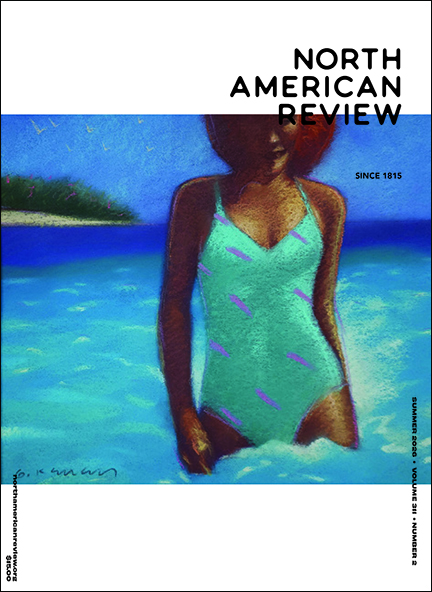
From a beginning to an end, and from happy news to sad, we remember the long and storied career of our acclaimed cover art editor Gary Kelley, who died in April at the age of eighty-one. For years, his work has given the NAR its distinct visual style. Our fall issue will be dedicated to Gary, and all of the artwork will be his. He is already missed greatly.
We’re pleased to present the winner of the Kurt Vonnegut Speculative Fiction Prize, Benjamin Hollo’s “RetroDate,” selected by final judge Rachel Yoder, who says, “This story has everything: a genuine (albeit very funny) emotional core, real and complex characters who we both hate and love, a richly imagined speculative world, societal resonance, nannybots, action (!), and a hell of an ending. I am obsessed, and I hope that you too will find yourself, if not obsessed, at least entertained.”
You are sure to be entertained by, if not obsessed with, the other fiction in this issue. “Frozen Sheets Crackling” by contributing editor Taylor Brorby is a heartbreaking story of both survival and loss set on the prairie during a blizzard. Clever, subtle, and deeply empathetic, Paul Griner’s “Little Sisters of the Poor” tells the story of a Nigerian mission school beset by the soldiers of Boko Haram. Paul is also a contributing editor to our sister publication Short Story, which in the fall will publish its first issue in a decade.
Yet another contributing editor, Stephanie Burt, is featured alongside Kristie Frederick Daugherty with a suite of poems for, about, and inspired by Taylor Swift, which will appear in their forthcoming collaborative chapbook from Sarabande Books Hits Different: Poems Not by Taylor Swift. Other familiar poets return to our pages: Hayan Charara’s poems will give you the only language left to speak when “Nothing in my life has prepared me / for the world as it is as it’s become”; George Kalamaras goes on a nighttime journey through the knobs and hills of southern Indiana into Kentucky; Jeffrey Skinner’s poems drift into the realm of spirit and dream; and Athena Kildegaard’s “Silent Butler” delves into personal memory: a child sweeping up cigarette butts and the detritus of her parents’ party from the night before. Like the shreds of history we inherit and must live and contend with, we wonder, too, whether “something had occurred to be regretted, something that clung / to the morning.” ⬤