



The Ave
sometimes the glimmer is so bright and I feel utterly alive
—adrienne maree brown
Maybe it was spring that made the strange boy try to kiss me on the street corner. Maybe he was just high. I was high: on spring, on light and wind and dandelions. Open like the blue sky. Until I had to push him with my hand to get away.
I ducked down a side street. He didn't follow. House Protected by Pirates read a sign in a window. The yard was full of people drinking whiskey and throwing knives at a teddy bear.
I like your sign, I called.
Come on up, they answered.
I threw the knives they put in my hand. I drank the whiskey. Mostly the knives bounced off, but sometimes they stuck like clunky darts in the belly of the teddy. Everyone yelled like they were happy. I walked home and never saw them again.
My life that spring was the dirty sidewalk and open sky. I was lonely, looking, uncertain where and when to draw lines. I was twenty-five, just out of grad school, working as a barista while I wrote my Great American Novel.
I lived with my sister and four other young people half a block off the Ave, that long strip of humanity and grime auxiliary to the University of Washington: Café Allegro in its alley, Thai Toms and Flowers, Magus Book’s dusty stacks, and the University Bookstore where an ex-professor kissed my ear in a book-signing line. Woolly Mammoth Shoes, which sold Birkenstocks when Birkenstocks were out of style. The futon store, the pregnancy counseling center. Copy stores several in a block.
Street kids and glossy-haired students swam by each other in pure schools, passing without mixing. Someone was always gesticulating to empty air, stumbling into traffic. Someone was always spilling out of the Irish pub in a polo shirt. I walked through crowds invisible and alone in my sober sanity.
As if happiness were a kind of moral weakness, an ostentatiousness of the soul.
Every day, I sat on a folded blanket on the floor with my computer on a crate in front of me, writing my novel. I owned three pieces of furniture: the crate, a dresser, a futon bed. My bicycle, leaning on the bedroom wall, left gray puddle marks on the floor. Rarely alone in that house, I was nearly always lonely. The smell of other people’s laundry detergent saturated my room. I looked out the window at my neighbor’s driveway, his hot tub, the street trees, the low wall where I once saw people smoke crack in the sunshine. I ate oatmeal with sunflower seeds, sandwiches on day-old bread, apples sticky with tahini, bulk chocolate chips by the handful. Periodically, I cried. I kept a glass juice bottle full of water by my bed. If anyone ever climbed in my window, I’d knock them over the head with the bottle like I lived in a jump rope rhyme: I went out as they went in and I hit them on the head with a rolling pin. I knew even then that it wasn’t a good plan.
Move, said my friend Will, but I was too lost to move. Where would I go?
What I wanted was a cow. I figured I could keep it in the little yard; nothing else was growing there. I’d walk it to Ravenna Park in the mornings and let it graze while I sat nearby and read or wrote. I had that kind of time in those days. I doubted Seattle had bothered to make cows illegal. I’d heard that San Francisco never had. But I had no cash, and little initiative. I lived like a perched bird afraid of her own wings.
Instead of a cow, I bought seeds at the drugstore, the cheapest brand. I started them in egg cartons on the windowsill. Sunflowers, tomatoes. Alley rats came through the walls and ate the sunflower sprouts. We were the first renters, but the remodel was already coming undone. I Elmer’s-glued construction site scraps over the cabinet cracks and stuffed rags in the gap around the toilet to keep the rats out. I collected buckets and tubs to transplant the tomatoes. A man walked by with a ferret in his sleeve; one or the other of them was named Rainbow. I told him about my project and he left me an old wire wastepaper bin. I planted my most hopeful tomato in it. I saw him once after that, swinging aboard a bus, his ferret invisible and him too far away to thank.
All around me: living. People walked their dogs, shot up in the public bathroom, walked home from the farmer’s market with baskets of beets and kale. A young woman in a short black skirt got out of one car and waited for another, proud rage metallic around her. Bikers pedaled by in bright rain coats. Drunk kids yelled in the alley. They peed on my recycling bin. The crows and gulls kept up their perpetual feud. I sided with the crows.
I watched and talked to everyone, but remained somehow unseen. Who was I in the world? A writer, but that was still a private thing. Beloved, but by whom? My brightness then was a secret brightness, hidden even from me.
***
What would you like? This question was my work. Tall triple shot one percent vanilla latte. Grande decaf Americano with an inch of room. Never just: some coffee. Never: whatever you’ve got. To be that particular—to need something that perfect—as if it mattered, one percent, two percent. Wasn’t just a decent warm drink enough? I was righteous about enough. Not about satisfaction, but about getting by. I could survive on a crate, a juice bottle. Could I even have stated what I desired in all its particulars? Decent warm drink could be a hundred things.
What did I even desire? I went on a date with a man from Craigslist. I got bubble tea with a peppy Christian from Marysville. I would have kissed a gentle math grad student except for the runny nose he did not wipe. When a crush came by before moving to Hawaii, I took him to get tacos at Agua Verde on the lake. Everything glittered and glowed. I cried at him on the telephone the next day.
Depressed, was I depressed? Sure maybe what’s the definition anyhow. Depressed. I sat on the floor with my computer on the crate, staring and writing while Neko Case sang and spring came blue and clean but I was dingy broken asphalt. My heart like hers saved itself for strangers.
On St. Patrick’s Day my boss made an extravaganza of corned beef, but who goes to a coffeeshop on St. Patrick’s Day? I left with a cabbage. On the dark street, some teenagers flocked me, Are we still in Seattle? They were drunk and enthralled by their lostness on NE 65th. I gave them my cabbage. They cradled it like a baby and waited for a bus while I went home invisible in the dark and wind. Why would I be happier in another house, another job, I wondered. I was too privileged for my discontent to count. I was after all, choosing this life out of many lives, choosing art and time over money, choosing to be a writer, and a person didn’t choose to be unhappy, did they?
Around me, the world spilled with flowers, but I was a living Jenga game, can you stand without this piece? Without this? And why? I was loved. I was fed. I was sober. I rode through petal-strewn backstreets to make coffee in a warm bakery. I wrote the novel I burned to write. I was living my dream, living in my dream. Looking back, it seems like a willful abnegation, as if my own good luck embarrassed me. As if happiness were a kind of moral weakness, an ostentatiousness of the soul.
***
At work, I microwaved bacon. I steamed milk. It was human interaction, one person to another. My coworker Cathy, a dreadlocked eighteen year old who called everyone hon, never asked the service questions. Hello, she’d say at the register. How are you? If they wanted something, they could ask for it. We played cards behind the counter. We ate broken pieces of cake. We’d be the only humans some customers would talk to all day. Just looking them in the eye meant something.
One regular wrote a poem every day about Auschwitz. He was a gentile grandfather who drank Americanos heavy on cream out of a Space Needle mug he brought himself (just fill it to the needle, as if we would forget). I asked him if he ever wrote about anything else. I can write about anything, he said, even the moles on your chest. And he did. The poem, handwritten, fell out of my pocket that afternoon, but I remember that it described me supine on my bed, depressed about my moles, and ended with him saying my moles were one more reason I’m glad I’m not blind. Even through the old-man weirdness of it, a shiver of wonder: I’d been seen.
My moles did not depress me, but my clothes did. I’d wander the boutiques on the Ave for college girls whose parents gave them money. Mostly, I tried things on, loved them, and took them off again. I made $1,100 a month. I thought cheese was too expensive. At Goodwill-by-the-Pound I rummaged in the mail bins among silent hunters and came home with a blue crewneck cashmere sweater. I mended its moth holes but couldn’t get the sad smell out. I wore it anyway, its neckline tight and hiding.
Pleasure is a process, happiness a continual attunement.
Why did I wear that sweater? I hated how it hid me. But cashmere is very nice. It had been very cheap. Wasn’t that enough? No, I wanted to be seen.
I wanted to be seen, but to do so would have been like standing unshrinking in a terrifying angelic brilliance, would have been like being a terrifying angelic brilliance. I was raised to be heard but not looked at: to be smart and kind and strong, but not pretty. The feminism of my childhood saw being beautiful, or worse attractive, as being silenced. The residue of generations of harm made other people’s desire dangerous. Sexy would have been a dirty word in my family, if it were a word at all.
The residue of generations of harm, but my own life had been so gentle. I lived in the lee of others’ heroic work to break deep cycles of abuse. They had done this work in my benefit. Who was I to be unhappy? The residue in my nerves and bones and urges was still unnamed. I did not yet understand how could I carry the mark of harm I had been spared. That was all I knew: I had been spared.
But surviving itself becomes a way of life, a culture you pass down. I grew up in an inherited permeability and habitual invisibility. The need to not name need. That permeable invisibility is good for a fox in a forest, but the Ave was a gauntlet of grime and sudden unbearable beauty that bled and blurred into me. It was so hard to say where my pain ended and the world’s began. Separateness is and is not real and mine then was just the thinnest scrim. So I walked down the Ave, a sad vagueness in motheaten blue cashmere.
But something quiet and fierce within me demanded better. Thrival, not survival, it whispered, pleased by its own cheesy rhyme.
***
I write this from a satellite of Seattle, in a house with coffee-ice-cream-colored walls, during the late winter/early spring of myself after getting divorced. My worst fear, I remember expounding amidst the daisies in the park a few blocks off the Ave that long ago spring, is beige. Suburbia, a whole life in suburban beige. Now, the beige walls don’t offend me; color is easy to add. I am unafraid of many things that used to scare me. But at thirty-nine I find myself again in the hunching habits of survival. I am remembering again how to have what I need, the kind of enough that is not settling, but satisfaction.
I find that to be satisfied, I must be visible to myself. I must let myself see myself and act on what I see. That’s what it was, I think, that got me out of my U District funk—the decision to attune to a power inside myself and act from it. To witness myself, even my most wincing tenderness, with respect and truthfulness. This power, and it is a power, is what Audre Lorde calls the erotic.
Thrival, not survival! I repeated to myself as spring turned into summer and I prepared to move on. I left that house, left the whole neighborhood. Goodwilled the blue cashmere. In my next house I lay on my futon with my knees up and tilted my hips forward and back, tremulously present with the feelings I found there. I curled in my threadbare red armchair and cried. I leaned late in kitchen counter conversation, tea grown cold, opinions and laughter sparking through the old-sponge-and-cumin scented air. I bought cute clothes and went dancing. I fell in love. But most importantly I began to ask myself a new question. Not Can I do this and sort of be OK? but Will this help me thrive? It was a conscious change made of the delineation of a hundred yes and no’s.
Now I walk my dog along the river trail as the cottonwoods break out in buds, then leaves, then lazy puffs of fluffy cotton, the ospreys return and the mergansers hatch merganserlings. I once again feel for my own satisfaction. This time around, I more easily know what I want. I have more respect for my subtle needs: to wear my new yellow wool coat and walk down my small town streets as if I am someone, some place. To sweat daily, to feel pleasure, to write, to go to bed with a clean house. And to be seen. When I’m not busy looking for myself in my own blur of invisibility, I’m not the introvert I thought I was, and I find—though I cannot speak for everyone here—that my invisibility was a self-erasure, a calcified and obsolete protection, an abnegation of erotic power that I can no longer allow. My happiness is a shining made to be seen.
And happiness, my happiness, is as fierce in its brilliance as a lion. It suffers no fools. Audre Lorde writes, the knowledge of my capacity for joy comes to demand from all my life that it be lived within the knowledge that such satisfaction is possible. If her joy is anything like mine, she does not use the word demand lightly. My happiness wants what it wants: snort-laughing with a dear friend, my daughter’s little hands on my face, the skip of sunlight on the river, biting into the sweet red deep of a homegrown strawberry, the thrill of stepping into a swirl of people on a happening street, the breathless yes of a good poem or a good kiss. That’s how thriving feels.
Yet so often these days nothing seems to glimmer except tin and I’m pacing my house, my town, dull even to the river, and anything better feels like it would require an act of impossible proportions. Sunny days whine with mowers and blowers, weed whackers and saws. When it rains, I wipe the muddy floor. My dog barks the fence line. My toddler flings our belongings across the floor. I check my phone, but the man I like still has not texted. I have an essay to show him. I have a poem. Two crows fly by together with their mouths full of cottonwood fluff and I find myself crying. The peony is budding, crumpled white skirt, and I have not spoken to an adult all day. I know this is normal. But I also know I can linger too long with less than I need. I’m good at scraping the jar.
My happiness’s tail switches. It does not break its gaze.
Move back into the city, says my happiness. For a year I tell it, Be reasonable, the words in my mother's voice. But the longing won’t shut up. Finally, finally, I respect my discontent. In the late revisions of this essay, I sell my house to move back to the city. It’s easier than I thought.
And my happiness was right. Not because the city is perfect, but because it feels good to live in alignment with myself.
Anyway, the longing, the following, the listening—that’s the satisfaction itself. It’s a way of moving, an avenue more than an arrival. Pleasure is a process, happiness a continual attunement. When I headed out down the Ave on those blue spring days—past the baby pigeon killed by a crow, the woosh of the woks at Thai Tom’s, the plastered posters of a plucked turkey smoking a cigarette, the bubble tea shop’s happy plastic light—I may have been lost but at least I was wandering. I’m still wandering, though I've come to believe more and more in the holy compass of my own satisfaction.
Sometimes I see something shining and realize it is myself.
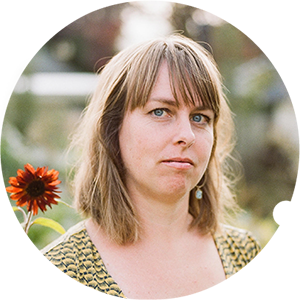
Becca Rose Hall runs Frog Hollow School, a children’s writing program in Seattle. She is a Jack Straw Writing Fellow and Artists Trust GAP Grant Awardee, and her work has appeared in Pacifica Literary Review, Third Coast, Orion, and elsewhere.
Recommended
Wig

Strike
Lapsus Calami