


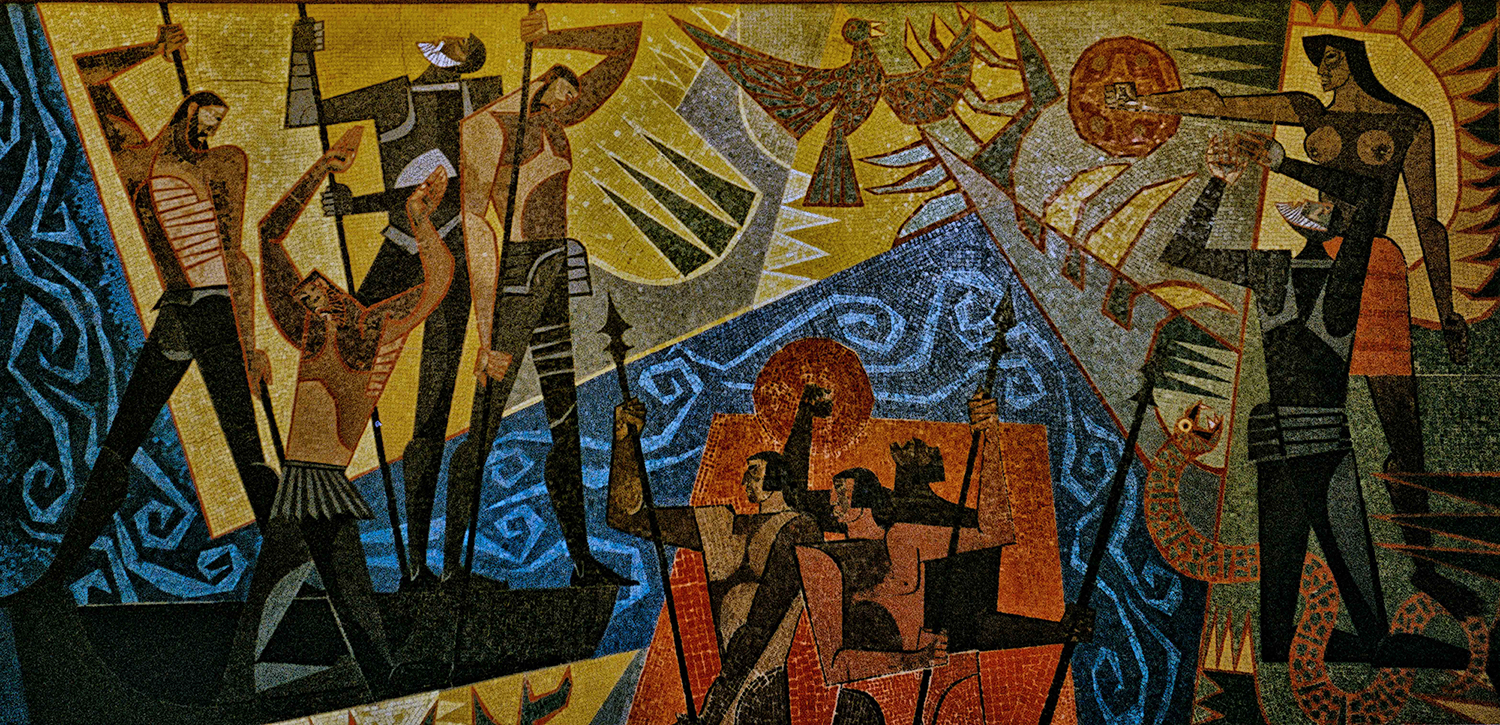
Le Grand Tango IV
—Palacio Carondelet, Quito, Ecuador
—La Libertadora del Libertador.
Anonymous Author and Painter of Portrait of Manuela Sáenz y Aizpuru
A plaque on the exterior terrace of the Palacio de Carondelet, where the president speaks to gatherings in the plaza, says that the Libertador, Simón Bolivar, arrived here for the first time in June 1822, for the Battle of Pichincha, when Ecuador would become sovereign from Spain. There’s no plaque for Manuela Sánez, who would have left her husband and met Bolivar that year. Another plaque says President Garcia Moreno was assassinated where my wife and I are now standing as tourists. Baskets with patches of red carnations hang from the columns. People swell the plaza, taxi horns, boleros, a whiff of palo santo, El Panecillo with the towering metal sculpture of the Virgin Mary in the distance, the chaos of the city reflecting off her surface. We take pictures with the Granaderos de Tarqui, soldiers in bright blue revolutionary coats and tall shielding helmets stiffed on perches like gothic statues in the shape of men, now masquerade as former liberators, too. Inside the palace there’s a tiled courtyard with a fountain and geraniums, a concert of yellow against the white precolonial walls. I played here as a child with my cousins while their father commanded a resolution for the recent coup and their mother designed the restoration of the basilica and its catacombs. With a guide, I’m a stranger in this former home, and my wife and I pass the mural of Guayasamín depicting the discovery of the Amazon River and the liberation story that was led by the indigenous and creole armies against the colonial foe. There are bullets still thrust in the bells and iron railings from France, gifts to the new republic, and as new spouses we’re declaring our infancy as a couple to the public below, displaying our attraction for the continent and liberation by kissing the ground like a drowning man firm ashore at last. We know with the confidence of new lovers that Manuelita y Simón would have done the same, sweeping their appetite for each other in the ballroom, no presidential portraits, yet, just their promises of holding tight to the revolution, lust, and a covenant with the people that their love affair would carry them all forward into a new millennium free from inescapable tyranny, a dark wound in relief.
Richard Boada is the author of three poetry collections: We Find Each Other in the Darkness (Texas Review Press), The Error of Nostalgia (Texas Review Press), and Archipelago Sinking (Finishing Line Press). He has been a finalist for the Mississippi Institute of Arts and Letters Poetry Book Prize and is a recipient of a Mississippi Arts Commission Poetry Fellowship. His poems appear in the Southern Poetry Anthology, Urban Voices: 51 Poets / 51 Poems, Crab Orchard Review, RHINO, Poetry East, Southern California Review, and North American Review, among others. He teaches at Lane College in Jackson, TN.
Recommended

Osmium
13 Images from the Dark Land: Crumb Vietnam Wordplay

With Regard