


Remembering COVID Now: What “This” Means
In March 2020, Doctor John Okrent of Tacoma, Washington, suddenly caring for an influx of desperately ill coronavirus patients in his community health clinic, came back home to a wife and toddler on those terrible days, stripped off all his contaminated clothes, showered, dressed, hugged them. And wrote poems. Eventually he published a remarkable crown of sonnets, This Costly Season, about that first spring, summer and fall of the COVID Era, just as he saw it, a physician and a family man.
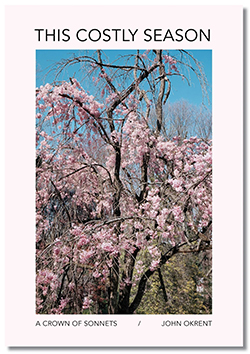
When I found his debut collection, I gripped it tightly. I hadn’t heard his name before. But like me he was writing about fear and death over the same historical period, the ominous year, 2020. I had been feeling alone, having been reading and writing for two years about ageism and dying in the nursing facilities when no other long-form writer had done so. In imagination I had been living with those older and disabled adults, mostly women about my age, almost all indigent, at a time when they were locked in and dying in staggering numbers.
Back in March 2020, far from appearing on the front line of care as Dr. Okrent was doing, I myself might have become a stricken patient like so many of them. I was quarantining, for the regulation two weeks, with my husband in our home in Massachusetts, anxious that I might have caught the coronavirus at a conference from which I had returned on March 11th, the very day the World Health Organization announced a pandemic.
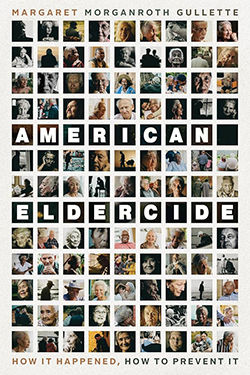
From that state of protracted, helpless self-absorption, I was torn away by reading the fresh hospital guidelines that excluded older adults from ICU ventilators if there was a scarcity. I myself was old! I was threatened and astonished and I was a cultural critic. Before March ended, I had published a first article, on lethal medical ageism. Monitoring the world inside the nursing homes and outside in the culture, writing articles—all that eventually flowed into my nonfiction book American Eldercide: How It Happened, How to Prevent It (2024, 2026).
Okrent never mentioned nursing home residents or the Centers for Medicare and Medicaid (one of my baleful targets), and his volume ended in September 2020 while mine swept on to the reformers of 2020-2024. He had one man’s view from Tacoma, while I ranged across the nation’s facilities and quoted hundreds of testimonies, from inmates and observers. He wrote openly out of personal life, as lyric poets do; I felt that anything about me needed to be subordinated to the greater woe (and was best if brief, rare, and parenthetical). Every poem was dated daily as Okrent wrote it, while he remained buried in that dangerous, doubtful situation, with no idea if COVID would ever end. I was writing as a historian with a sharp retrospect.
The virus was blowing in the air. We were desperate to protect ourselves from other people’s breath.
But none of those differences mattered. Once the structure of my book was fixed, from elegy to exposé to jeremiad to healthcare policy, I knew exactly where I needed certain experiences that Okrent had captured, powerfully and succinctly. Here, I want to say how the lines he created cast deep hooks into the comprehensive violence, the bitter, outraged stories my research had uncovered.
Okrent’s first sonnet, on March 17th, took only two half lines to describe the new look of people who were wearing personal protective equipment. No doubt he had seen surgeons walk into procedures hidden behind disposable oro-nasal covers, calm and prepared. This sight was utterly different.
Everyone’s eyes seemed wider
above their face masks
Now everyone was invoked. Everyone he saw in the clinic, to be sure. But beyond, I surmised, he imagined the eyes of the vast public from sea to sea. To me, those big eyes suggested the sudden surprise, amazement, shock, or terror of the US population as the news was slowly sinking in that we, so sure of American exceptionality, were no exception in a global pandemic. The virus was blowing in the air. We were desperate to protect ourselves from other people’s breath.
No one had good boundary-protection, back then. People had neither surgical masks nor anything like them. My husband and I found carpenters’ masks in the basement. All over, people were pulling dusty bandannas out of the closet; women were sewing masks from clean rags, crocheting or knitting them. Other Americans, however, were paying no attention. Trump refused to wear a mask until he got COVID; the result of his authoritarianism was that employees from top to bottom in the Centers for Medicare and Medicaid, the agency most responsible for care in our nursing facilities, followed suit, naked faced. And CMS made no attempt to provide personal protective equipment for the residents of nursing facilities either. “Eyes could be ‘wide shut,’” too. A culture war between safety and machismo began, which even the troubles of Long COVID have not ended.
In that same month in 2020, COVID infection rates could double in a day. On March 20, Dr. Okrent reported
The sharp curve of new cases
like a middle finger from a fist.
Okrent didn’t mean that only doctors and nurses felt fucked. In my book, those lines helped me convey—in lieu of a newspaper graph of mounting deaths—the panicky reactions to helplessness.
I connected those lines to political ideology inside the Trump administration, and the impotent anger that results when the most important people in the “free world” feel overwhelmed by an obscure and invisible power that is immeasurably greater than any they can wield. This was all the government we had to protect us; but they wanted to conduct business as usual, and they did; and they failed us. Piecing the evidence together, I knew the residents had been abandoned by the agencies, federal and state, that were responsible for them. Fear extended into most of the nursing facilities that I was writing about, where residents in lockdown waited like soldiers in trench warfare for an incoming bomb.
No social critic could say with certainty they understood the crazed array of public moods. But this poet got it. At a time when the pandemic had barely started, Okrent captured, in two brief lines, the urgent national impatience for it to end.
I can’t wait for a time when I say “this”
and you don’t know what I mean.
It was a desperate first-person statement to everyone who, he hoped then, would become as innocently blank to the past as if the COVID Era had never happened. To me, that was unbearable—understandable in 2020 no doubt, but intolerable as the coronavirus appeared to wane and more normalities returned. I chose to write a dogged book against forgetfulness instead.
Still, suppose he’s right. I too fear it: Posterity won’t know what “this” meant. The objective historian and psychologist in me foresees how quickly future readers will refuse the pain and stop attending to the healthcare failures that were so obvious when I first read This Costly Season.
Remembering can be hard. 2020 was a frightening and isolating time. No vaccine in sight. People had quickly tired of COVID restrictions—the lockdowns, the boredom, the six feet of separation, living in a separate room from the family, if you could, while you endured a bout of COVID that might end in hospitalization and death. People wanted the danger to be over. They expected it to be over. Trump said it would be over … by Easter 2020.
Millions are lodged in more and worse dangers. Now we see hostility plain.
Facing their own endless problems, with friends or colleagues drifting away, Americans fought anxiety and depression, cut back emotionally. They donated much less to philanthropies. They bought guns. When the popular hospital-based TV show Grey’s Anatomy opened its seventeenth season in 2020, 5.7 million viewers saw almost all the stressed-out doctors suffer breakdowns. Many people must have identified, feeling exhausted, at the end of their rope. And in March, April, May, of 2020, they hadn’t seen anything yet. The vaccine was perhaps being created but nobody knew if or when it would emerge from the corporate laboratories. The coronavirus was strange-looking and also invisible. It was abstract, nothing to attach hate to.
But impatience needed a scapegoat. Wuhan, the Chinese. Then, the Republicans saw an opening; they grew impatient about a US economy that had been closed for only two weeks. As a doctor, when Dr. Okrent heard “the economy, the economy,” he foresaw the dangers in terms of more cases, more suffering, more death. He wrote:
The country is creeping
Back open. Like a door in a horror movie.
To many people, as I was learning with dismay, older adults had come to symbolize the “this” that would not end and could not be evaded or forgotten. Older adults—by being the ones sickening and dying, and, in some minds, by being the pointless cause of economic closures—prevented “this” from ending. Human bodies had not changed in those few months of 2020. How the embodiment of older people was viewed—that changed. Apparently, the mortality count meant that “The Old” could not be saved. In fact, tens of thousands escaped illness wherever they were protected, and even those who caught the virus in their government-forsaken nursing facilities most often survived. They were more resilient than their cultural imaginary. Yet to community dwellers “The Old” seemed doomed to die. Ageism—which had come to mean feelings of avoidance, indifference, aversion—creepily clutched us. We became “the horror, the horror.”
Behind that creaking door, in fact, were Republican extremists, thinking first, as the faceless Old died, that their funerals would save taxpayers’ money on Medicare, Medicaid, Social Security. A professor of English and American Studies, an organizer, social critic and occasional poet, Joseph G. Ramsey, displays these intentions in his “Ode to DOGE.”
He’d Fund a gorgeous Tax Cut with those trillions,
Trimmed from sick, poor, loser, fat civilians.
“Waste” was rampant. “Fraud,” “abuse” systemic.
Just count the vaccines bought for the pandemic…
Or count the years the elderly were living
All those people “taking” and not “giving”:
Surely tens of billions could be saved
If retirees could have a few years … shaved.
Before 2024’s inauguration, perhaps only a few Americans could imagine that COVID ageism would lead more or less directly to the billionaires’ and MAGA attacks on the safety nets. Millions are lodged in more and worse dangers. Now we see hostility plain.
* * *
What “This” Means
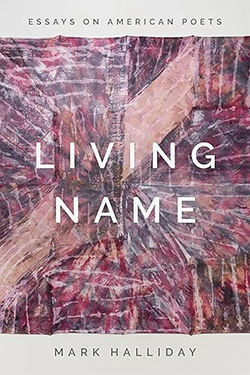
How does the recent history of a social, political, economic, and human crisis best get written? American Eldercide, recounting a perilous part of COVID Era history, needed Okrent’s poetry, as I have shown. My friend, the poet Mark Halliday, in his perceptive new book of literary criticism, Living Name, might be explaining why this was so, when he writes, “a sentence in a poem has a radiance, indeed, an ontological status different from the same sentence in prose.” Quoting Okrent was an homage to that radiant, radiating, power. Lines of poetry are granted space in the middle of a prose page, blankly white above and below. Okrent’s intuitions and observations not only fed into my analyses, they heightened attention to them. Whether elegy or jeremiad, nonfiction benefits from the pauses for thought that such white spaces and the poet’s strong sentences allow.
Prose has limits: It may not wander without being thought meandering or drift into metaphors without being blamed for perpetrating prose poetry. But, I want to assert, prose has its own ontological status. Henry David Thoreau in his journals described sentences he wanted to be known for: “which suggest far more than they can say, which have an atmosphere about them, which do not merely report an old, but make a new, impression … toward which so many volumes, so much life went; which lie like boulders on the page … ”
Eventually, history will require a whole panoply of voices to remember:
My book saluted the 200,000 lives that went before and gave the writing urgency. Sentences “toward which … so much life went.” Grieving, the book quoted many unheard voices.
Both linguistic forms can use the word love. (I find I use versions of it sixty times in American Eldercide.) A poet may indict political evil; the prose writer with interdisciplinary reach can investigate it; can draw in philosophers and historians to speculate about its causes. The two genres can both tell us about society, about overcoming grief and loss; about loving nature and human life—can imply the best ways to do so. Merging two genres—in this case, nonfiction and poetry—may offer the longest thoughts, sound the deepest depths.
The whole story of the COVID Era in the United States is still in the making—or at least one hopes so, because so far the record is neither long nor illuminating. The “smoking sixgun” I revealed in Chapter Two has been deep-sixed. One hopes the whole of “this” survives our willed oblivion, cowardice, laziness, everyday corruption—all the Era’s heightened enemies of truth and beauty and even the mortal lives prematurely taken.
Eventually, history will require a whole panoply of voices to remember: just to begin with, novelists (but I will praise only those who refuse to treat 2020 merely as a backdrop for their plots). There should be more heard from graphic novelists, researchers in public health and medicine, social and political scientists, psychologists, journalists, cultural historians, age critics and activists. And we’ll need remembrances, not only by such writers in all their moods and modes, but stammered, in half sentences, by all sorts of people who cannot forget.
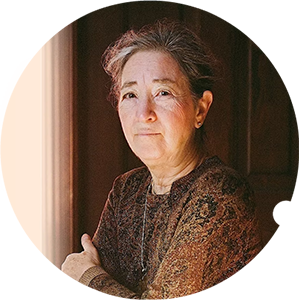
Margaret Morganroth Gullette is the author of six nonfiction books about age and ageism, many prize-winning. The most recent is American Eldercide: How It Happened, how to Prevent It (2024, 2026), which was nominated for a Pulitzer Prize and won a MASS Cultural Council Grant in Literature. Her essays are often cited as Notable in Best American Essays. She is a Contributing Editor to NAR.
Recommended

Wig

Strike
Lapsus Calami