


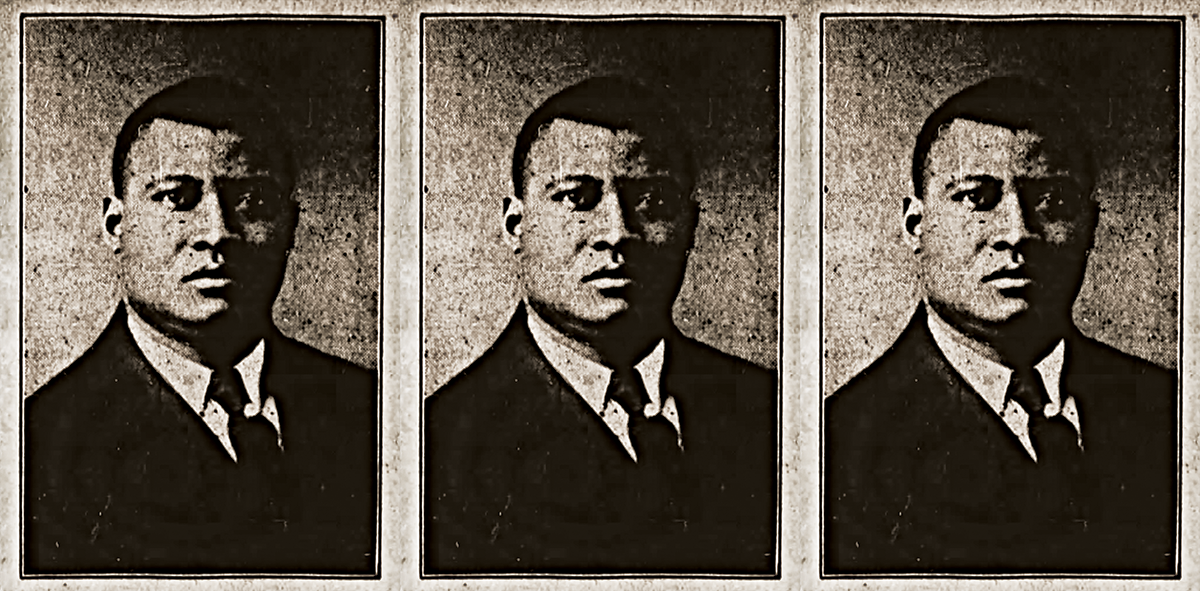
The Ballad of Ollie Jackson
One detail that somehow survives in all the different, desultory versions of the “Ollie Jackson” ballad is a reference either to Kansas City or to Kansas. Will Starks and the “old citizen” who performed the song for Nathan Young both call Jackson a “Kansas City coon.” In the Virginia variant, “Ollie’s father and his mother, / His sister and his bride, / Came down from Kansas City / To see poor Ollie tried.” Even in “Olive Jackson,” both the gambler and his family have come “all the way from Kansas.” Census and penitentiary records give his birthplace variously as Texas, Tennessee, and Missouri, but the songs must have been onto something, because when the police finally drove Ollie Jackson out of St. Louis in 1912, he settled in Kansas City, Kansas. He had quietly visited the town two years earlier to marry Marie Link, the white daughter of German immigrants; interracial marriage would remain illegal in Missouri until the Loving decision in 1967. The couple now took up residence with a live-in maid in a brick house on North 6th St. “From his large sums won in gambling Jackson has bedecked his white bride with thousands of dollars’ worth of jewelry,” the Kansas City Post reported in 1913.
He seems to have gone right back to being Ollie Jackson. Within a few years he was operating the Iroquois Club on the Missouri side of the state line, in Kansas City’s nascent jazz district. A 1919 article describes a police raid that found “negro women and white men … vigorously ‘stepping on the puppy’s tail’ to the tune of a jazz orchestra. Drinks were being sold generously, although the ‘club’ has no license. In the back room a gambling game was in full swing behind locked doors.” The raid netted thirty-eight high-steppers in “silk shirts” and “fancy spring suits of many colors and varied patterns,” who, after laughing off their $11 fines, left the police station “in limousines” and returned to the club.
Another pair of raids in 1923 revealed the ingenious—if not infallible—alarm systems Jackson used to secure his gambling operation. When police entered the club, an employee “walked casually to a certain spot on the floor,” causing an alarm bell to ring in the craps room; there were electric contacts concealed in the floor, and the man was wearing tin-soled shoes. A week later, an elderly employee of the club failed to trigger the same alarm because he was too absorbed in his whittling; he didn’t notice the police in time to press his knife blade against a pair of nail heads.
Jackson’s most effective defense against the police was his political pull. He appears in the Kansas City papers much less frequently than he did in those of St. Louis, suggesting that he enjoyed long periods of benign neglect from the authorities. Black saloon owners and gambling bosses often functioned as ward heelers, delivering blocs of votes to solicitous candidates in exchange for favors, including protection. At the time of the 1919 raid, the Kansas City papers described Jackson as “a political factor in his district” and “a leading figure in darktown politics.”
A reporter for the Kansas City Journal offered a glimpse of Jackson’s carrot-and-stick approach to police relations: In 1918, he had appeared at police headquarters and requested a private meeting with Chief Ghent, on whose desk he deposited “an armload of cigars.” Jackson wanted the chief’s blessing to re-open his club, shuttered since the previous spring under a blanket ban.
“If you open that joint, you’ll be in jail in thirty minutes,” the chief allegedly replied.
“Two weeks later,” according to the Journal, “Chief Ghent was reduced to a captain and the Jackson place opened immediately. Since then the club has been operating full force despite the orders of the police commissioners regarding gambling houses.” The same paper attributed Ghent’s demotion to “the fact that he was not allied with any political faction … . It has been known for some time that powerful influences were working to ‘get’ Chief Ghent as a result of his refusing to comply with the wishes of certain politicians.” Ghent’s successor may have chosen to give Jackson the protection he sought—if for no other reason than to avoid needing protection from him.
Jackson’s operation was all but unique in its freedom from police interference, according to the legendary gambler “Titanic Thompson.” In a 1988 biography, Thompson recalled an evening spent in “a colored club run by a man named Ollie Jackson, that provided plenty of action and no danger of the standard twenty-dollar fine that was levied by most constables who broke up games during this time.”
In a game of five-card stud that night, Thompson realized there was a “spotter” behind him who was eyeing his cards and signaling to Jackson. He used this knowledge and a four of spades that he had palmed to win a massive $1,500 pot, sending Jackson into a rage. “He hurried around the table and grabbed the stunned boy who had been spotting for him and began beating his head against the wall.” Thompson intervened, explaining what he’d done, at which point “the rage disappeared, replaced by thundering laughter. ‘Gawd awmighty, boy, I guess I gotta start getting up earlier in the mornings if I’m ever gonna fool you,’ Ollie said. ‘But it’s a good thing you told me, ’cause if you hadn’t, I just might have killed this here fool boy.’” Thompson was an incurable tall-tale teller, and he apparently dated this particular tale—which the biographer got secondhand—to 1910 or 1911, a couple of years before Jackson had even arrived in Kansas City. So a little skepticism is certainly in order. But it’s definitely an Ollie Jackson story, and no part of it is beyond belief.
Jackson’s final decades were comparatively quiet. Documents provided to me by two of Marie Jackson’s nieces, Eve and Gini Link, suggest that the couple’s fortunes dwindled over the years. In 1941, they took out a $2,500 mortgage on their house, and by 1950 they were renting out several of its rooms to boarders. There was marital trouble as well, evidently. Ollie doesn’t appear in the 1940 census—Marie is named as head of the house. And one of the boarders listed in 1950, Lazzeri Alexander, says that although she lived with Marie for two years, she never saw Ollie.
Now 97 and residing in West Springfield, Massachusetts, Alexander remembers Marie with great fondness—a “delightful little old lady” who took her to plays in the park and who kept a singing parrot that “sounded exactly like her.” She recalls a home full of lovely objects—lots of gold, silver, and amber.
Marie didn’t talk about her marriage or Ollie, and Alexander didn’t ask, although she always understood that he was still alive and was staying elsewhere. She was also aware, she says, of what marrying a Black man had cost Marie—most of her family. “Her mother was the only one who did not forsake her, who stood by her.” Alexander kept in touch with Marie after moving to Massachusetts and would even come back to visit her. “I loved her very much,” she says.
Ollie Jackson died of chronic heart inflammation on Christmas night 1959; his death certificate says he was eighty-four and a “Night Club Operator.” As uncanny death dates go, it’s hard to top Stagolee’s vanquished folkloric rival checking out on the anniversary of the Billy Lyons killing in the year “Stagger Lee” topped the pop charts. Ollie and Marie may have been reconciled by then; she’s the informant on the death certificate, and she gave the same home address for both of them—their longtime residence on North 6th.
Marie died six years later. Among the papers in her probate file is an appraisal of jewelry. The list includes a 1.7-carat diamond solitaire ring, a belt buckle containing fifty-seven diamonds, and a “Horse Shoe design Pin with 17 diamonds.” There are no dimensions given, but the jeweler valued the pin at $600—about $5,500 in today’s money. Impressive, no doubt, but probably not “big enough for a Shetland pony.” Like so many things, it had become larger in memory, or perhaps the man who wore it had become smaller.

Eric McHenry teaches at Washburn University and is a past poet laureate of Kansas. His book Original Gangster, about the historical origins of the “Stagger Lee” story and song tradition, is forthcoming from Oxford University Press.
Read his follow-up essay “A Picture of Stack Lee” in Open Space.
Recommended

Wig

Strike

Lapsus Calami