


Ghost Boat
She peered into the bright kitchen from her cover of darkness in the hallway, careful to stay hidden. Both girls were meant to be asleep, but the house was small. Only a few steps separated their rooms from the kitchen, so murmurs of a transaction drew them from bed.
“What are they doing?” she asked her sister, who stood a head above her right shoulder.
“Shhh!” the sister hissed directly into her ear. “They’ll hear you.”
Who was this man who came to their house after bedtime? Her parents didn’t invite guests often, and certainly never so late. Her father started for work at five o’clock each morning. Her mother rose with him to make the coffee and hand off his lunch in a paper bag, crinkled and spotted with oil, reused until it could not be reused again. No, they would not host company so late.
She watched as the man counted a stack of paper bills into her father’s hand, a working hand she would never forget. The sight of so much money electrified her.
“They can buy us toys!” she whisper-screamed to her sister, who by then receded down the hallway back to bed.
That money isn’t for toys, you nitwit. She didn’t know if her sister said these words out loud or her own brain generated them somewhere in that hallway, the glow from the kitchen dimming from gold to brass as she stood alone in the dark. She only knew this: In the morning, the fishing boat was gone from the driveway.
How many years passed, or maybe it was only hours or days, before her mother revealed their motivation? “Daddy sold the boat when you got sick,” she said, more than once so the girl knew it was true. Her mother never said, “Daddy had to sell the boat because you got sick,” for that invocation would have sounded cruel. The girl’s mother was unbalanced—erratic in her moods despite regular medication with lithium and Prozac, a standard prescription for bipolar disorder then—but she was not habitually cruel. Whether the expense her father could no longer afford was money or time did not matter, the girl drew a singular truth from her mother’s words: If she had not gotten cancer, her father could have kept his boat.
She must have ridden in it at some point or another, her mother said so, but she did not remember the wind in her hair or the spray of fresh wake across her squinting, suntanned cheeks on the boat she unofficially named The Blue Whale. Whenever she got the chance to ride a boat in later years, mostly at the summer camp she attended for children with cancer, she knew it somehow in her bones. Her father’s genes lit up inside her cells then, transcribing the same brand of neurotransmitters that animate the dog who hangs his head outside the window of a speeding car in summertime.
* * *
In the checkout line at the grocery store, her bald head gleamed at elbow-level with the other shoppers, shining between carts brimming with Cinnamon Life and Mop-N-Glo.
“She’s my miracle baby,” her mother crooned then, stroking her head and smiling down the women’s pity. “I say it all the time, ‘God, if you spare her, she’ll be a credit to your name.’ Don’t I say it all the time, honey? A credit to His name.”
* * *
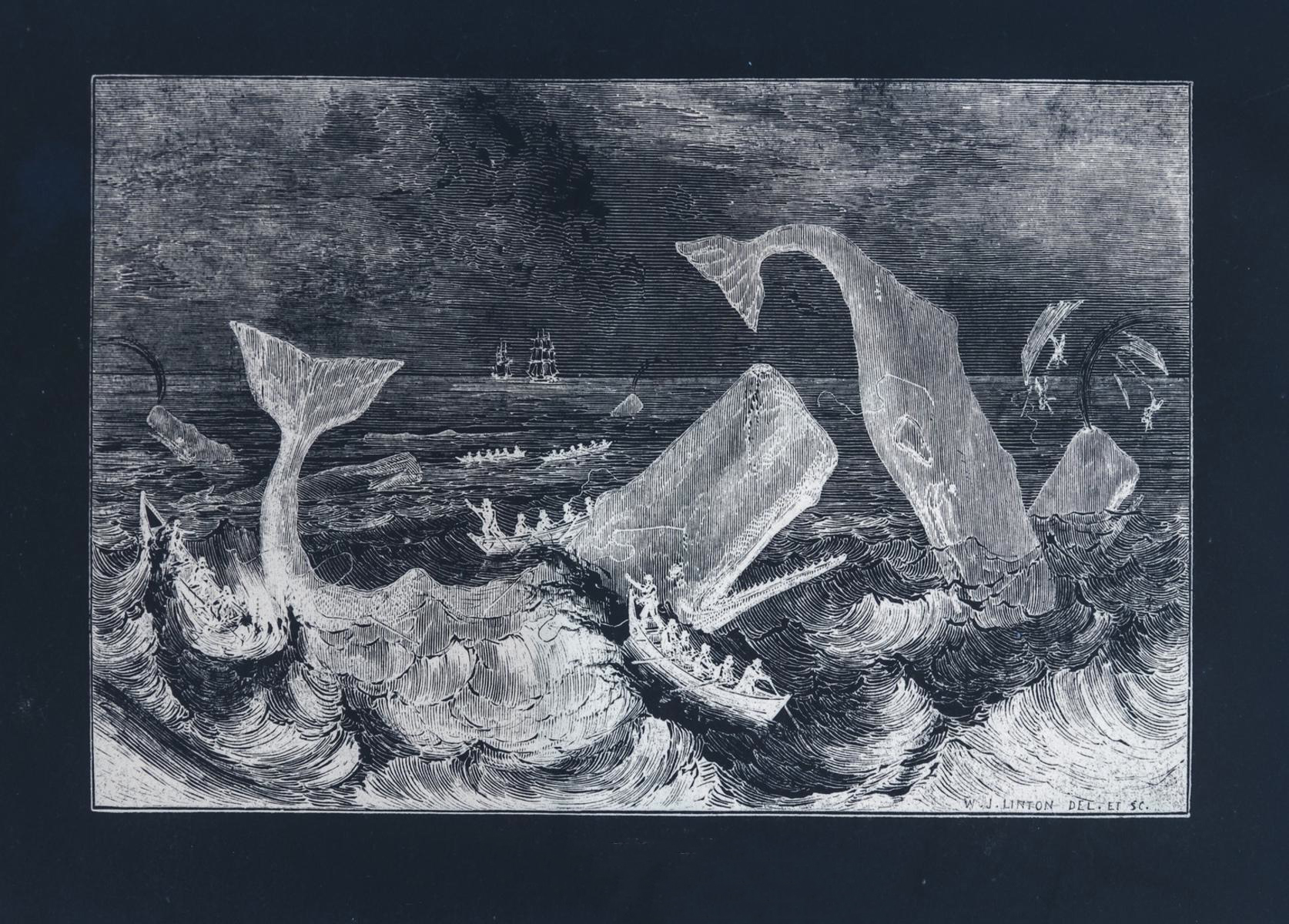
Years would pass before the girl read Moby Dick and examined the allegory of the whale. Poor captain Ahab, squandering his life on the impossible, risking it all for a fish who was not even a fish. Inside those six hundred pages, one word stood out to her: monomaniacal. The whale gave direction to Ahab’s mania, a purpose, a reason for his insanity. She would be the first doctor in her family. She would earn enough money to buy a boat to give back to her father. These motivations, childish and simple, drove her to build a life she could not understand.
There had to be a story there, a line to defend the injustice of pain and fear and death in the life of a first grader.
Did she belong there, in that medical school with the ivy-bound quadrangles? Could she pass during residency, a working-class kid among the New England glitterati? Was she smart enough? Good enough? Worthy enough? She was stubborn enough, that was true. She woke earlier and stayed later than the rest. Not from dedication, but from fear. Had she remained religious in any way, she might have considered her compulsion a calling. A credit to His name …
It all stuck in her somewhere—the residua of backyard Bible study, the guilt and confessing and vaguely sexualized baptism she underwent as a child, her mother’s singsong explanations of heaven repeated across a childhood filled with death—like stickpins in a voodoo doll. She might not have persisted otherwise. She was a sensitive soul, an artist, too tender for the grind of a medical life. But the stickpins prodded her onward, possessed.
One of her Boston classmates, a beautiful freckled thing with teeth for miles, confessed a fear that she didn’t belong, either. Some combination of Bryn Mawr and Yale had landed her there, after she captained for rowing crew and marched as valedictorian. This was not false modesty, the girl would later realize. The whole machine operated on self-doubt, a fuel feeding its jaws. Ambition demands conviction that something better lies ahead. Here, now, this, me—none of it is good enough.
She absorbed this notion through her pores.
* * *
She was still in medical school when her father began to lose his memory. Was it Alzheimer’s then, or just the effects of bypass surgery on his brain after a heart attack? He never recovered. He just slid down, down, down. By the time she finished all her classes and training and landed a job that earned enough money to pay the rent and the bills without defaulting on student loans or maxing out credit cards—the kind of money that might allow one to consider saving for something like a boat—her father had already died.
Before he stopped walking, she would lap the halls of the nursing home with him on Sundays if she was not on call. Watercolor paintings in pastel wash on pockmarked paper lined the walls. Gulls among cattails, seashells, flowers and fruit captured in still life behind dusty glass—none of these caught the old man’s attention. Only the picture of a trim blue boat, moored to a wooden dock by a slack rope, drew his shoulders square and his pale eyes into focus.
* * *
“Call me Ishmael,” he says, in what is perhaps the best first line of any novel ever. He survives the wreck, the reader knows this from the start. Queequeg’s coffin buoys him from the depths, a little boat that never serves its intended purpose.
Purpose (noun): the reason for which something is done or created or for which something exists
The girl always thought—for years beyond when she could reasonably be called girl—that becoming a doctor was her purpose, her reason for being. There must have been a reason that those cells in her vastus lateralis revolted against natural order to grow haywire and form a tumor larger than a grapefruit protruding from her left thigh. It could not have been random bad luck. There had to be a story there, a line to defend the injustice of pain and fear and death in the life of a first grader. The wretched continuous vomiting, the sores in her mouth, her cracked and bloodied lips, the scars in her veins—these were not for nothing. They could not be for nothing. They made her stronger, cultivated compassion for small suffering creatures.
When she found a bird tangled in twine, dangling by a mangled foot from a branch in her schoolyard, she alone tried to save it. Her classmates ran from it, gruesome and wild and already near death. When her trembling hands drew near it, the bird flapped and scared her away. She discovered her deep distaste for failure. She would not let it happen again.
Emaciated, her bones clanked against the porcelain at bathtime. Her mother lined the tub with terry cloth towels to pad the skeletal jangle and spiked the girl’s morning milk with wheat germ to fatten her. The chemotherapy was poison, derived from the same source as mustard gas. The drugs turned her skin yellow, turned her insides out. She limped like an outlaw and wore an ill-fitting department store wig. She was bookish and weird even if not bald and lame, so the teasing was relentless. But there was a point to her suffering. There had to be a point.
She hadn’t lost more of her mind (that she could tell) in those years so she concluded she probably didn’t have dementia after all. Not yet.
The point—the spear that she would aim at her guts like the tip of a hara-kiri sword, or drive into the flank of the leviathan she hunted—was that she would live to save lives. Her college admissions essay and her medical school personal statement centered on her cancer, her survivorship, her dedication to repay the debt she owed. She did not write about her father’s cracked hands lined with grease. She did not write about her mother’s addictions: alcohol, nicotine, food. She did not write that she feared she would never escape. Nobody wants to read about that stuff. It’s the hero’s tale that wins acceptance to fancy schools.
* * *
Herman Melville died a failure. Moby Dick was so weird in its day the book tanked his literary career. Was he writing fiction or nonfiction? Was his story autobiographical or allegorical or science reportage about the biology of whales? What is truth anyway? “A thing may be incredible and still be true,” he said. “Sometimes it is incredible because it is true.”
No, it was Mark Twain who said that.
When she moved back from Boston, she made an appointment with a famous memory specialist at a big academic hospital in the city. “I’m worried I might have Alzheimer’s,” she told him. “I forget things sometimes, and I have a hard time recognizing people’s faces.”
After taking a complete history, the neurologist performed a few basic tests. “Name as many words as you can that start with the letters I am about to give you,” he instructed. “Stop when you hear the timer. I will keep track of how many words you list inside a minute. Ready? A.”
She froze. Not a word came to mind. Vocabulary was her specialty, but her brain went blank. Finally, after several seconds she blurted, “aardvark.”
Not at. Ago. Anon. Anew. Allow. Accept. Address. Amend. Askance. Alter. Able. Apt. Adorn. Adore. Align. Even a. She said none of these words. Just aardvark, then silence. The timer rang as she muttered, “apple” at last.
She wanted to die.
The doctor’s summary stated she was “clearly very concerned about the possibility of a memory impairment to the point where this is resulting in overt dysphoria” and recommended a complete battery of neuropsychological tests to determine her cognitive baseline. She complied, underwent testing for eight hours, proved she was smart (if such a thing can be proven), and remembered the words aardvark and apple fifteen years later. She hadn’t lost more of her mind (that she could tell) in those years so she concluded she probably didn’t have dementia after all. Not yet.
* * *
In chapter 45 of Moby Dick, “The Affidavit” (an affirmation or oath made in writing, usually for use as evidence), Melville endeavors “to take away any incredulity which a profound ignorance of the entire subject may induce in some minds, as to the natural verity of the main points of this affair.” The ensuing passages include a true account of the Nantucket whaling ship Essex, Melville’s inspiration for his Pequod, citing the year the ship was attacked by a sperm whale, the ship’s real name, the real names of the captain and first mate, and an excerpt from the first mate’s diaries of the account in a footnote. A Smithsonian Magazine report confirms Melville’s story and further describes the horrors endured by survivors of the Essex wreckage, including cannibalism and descent into madness from dehydration and hypernatremia. Melville left those details aside.
The girl’s father never talked about his blue whale. He would entertain her questions about the boat whenever she asked, and laughed like he was in on the joke if she mentioned buying it back for him someday, but he didn’t speak of it otherwise. If he minded giving it up, he never let on.
There is a pizza place in Chicago called Pequod’s, and of course Starbucks invades everything. It is better to canonize Moby Dick with lattes and deep dish than to dwell on unsettled scores.

Catherine Humikowski is a pediatric intensive care physician in Chicago. She earned her undergraduate and medical degrees from the University of Chicago and holds an advanced graduate certificate in nonfiction from Northwestern University. Her writing has been published in The Chicago Tribune, The New England Journal of Medicine, Journal of the American Medical Association, River Teeth, and other outlets. Her first book, READ THIS BEFORE YOU DIE, examines death in the age of resuscitation, forthcoming with MIT Press.
Recommended

Wig

Strike

Lapsus Calami