


Everything You Always Wanted to Know About Line Breaks* (*But Were Afraid to Ask), and I Alone Survived to Tell Thee
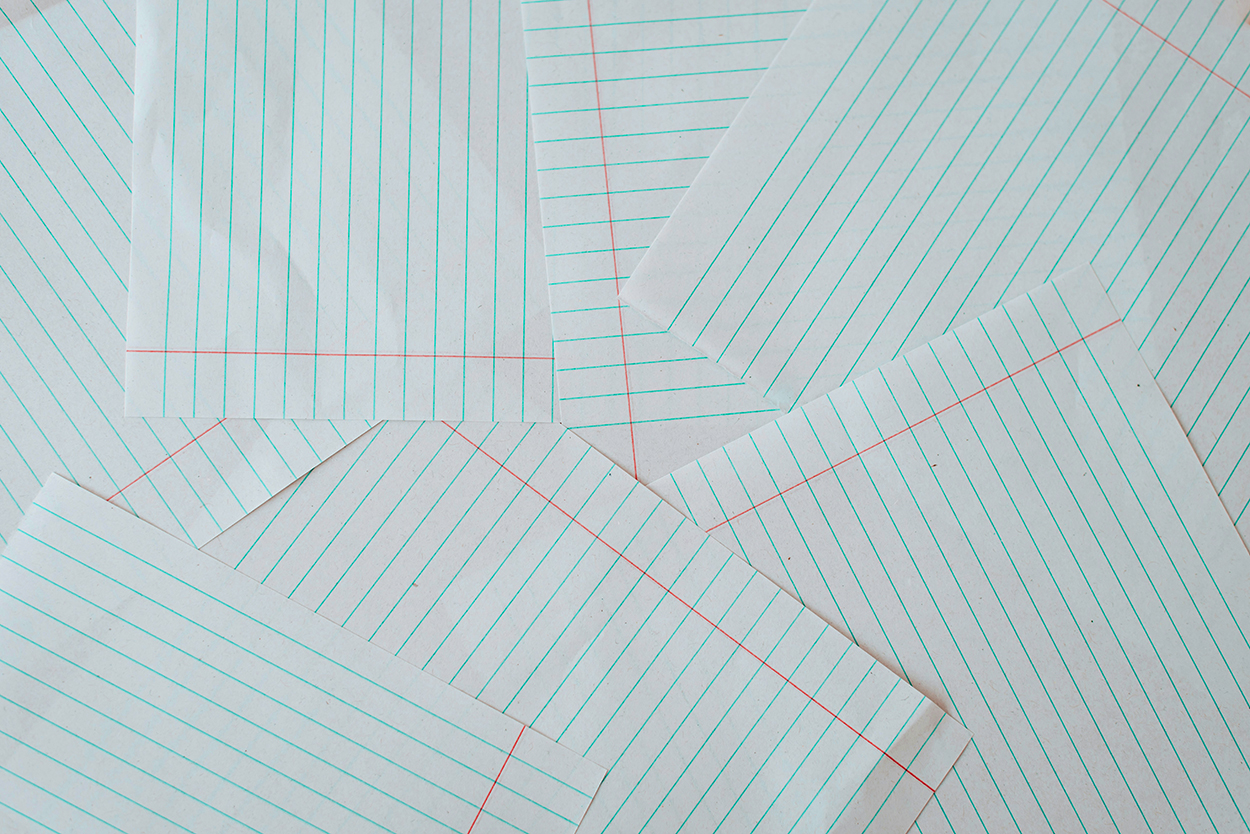
As a first-grader, absurdly thick pencil in fist, and tongue protruding studiously from the corner of my mouth while I labored to produce letters resembling those on the board, two oddities distracted me. First was the pink nub larger than the tip of my little finger that wagged through my vision as I drew lead across the page. Little did I know that the possibilities of revision that eraser promised would one day mean the world to me. Second was the three-hole-punched loose-leaf sheet spread before me in a broad, snowy vista, scored with a single vertical red line, a magnet constantly drawing me back to the left, and a field of blue lines in neat rows as promising as a newly-furrowed field.
Those lines, even, elegant, and effective, are called rules. Rules are guides to hand and head, only guides, at least on paper, and in that sense, I recount what I’ve learned about line breaks. Also, as a child, I fervently wanted to know the rules, since my household and neighborhood were dangerous without some, so I applied myself to carefully following the lines drawn for me.
My students always taught me more than I taught, so one day in an introductory college Creative Writing class, discussing the design, shape, and line breaks of Sharon Olds’ “I Go Back to May 1937,” I noted that one line ended with the article “the” and expressed my notion that a line should break on a significant word. One student waved a hand in the air, saying, “Hey, mister, so how do we know when to break a line?”
At a loss myself, the students and I created some rules—guides!—to break lines. After my comment on “the,” we determined some words were better for breaking lines than others. The class theorized that the last word in a sentence shone long and brightly in the minds of readers leaping back to the beginning of the next line, becoming a notion to grip tightly on the way back. Thus, that last word should be memorable and strong.
The students and I initiated a search for strong words versus weak for breaking lines. “Verbs,” shouted one. And another called, “Nouns.” For the sake of thoroughness, I listed all eight parts of speech on the board.
Using Sharon’s poem as a guide, we composed this list:
noun—yes
verb—yes
adjective—okay
adverb—maybe
conjunction—no
preposition—no
pronoun—never
interjection—yes
article—no
(Yes, that’s nine, but articles are a special case of adjectives and require extra attention.)
Following the list, we examined the last word of every line. “Colleges,” “hip,” “bricks,” “children,” and “body” received high praise because as one pointed out, readers can see what those words mean, and the image persists during the return journey to the margin.
Verbs were also popular: “bent,” “married,” “Stop,” “do,” “go” and “say.” We agreed that we wanted to carry those words to the next line and discover what followed.
Adjectives work because readers wish to see what the word modifies. What is “bent”? What is “female”? Adjectives spurred interest for more. Not many lines in the poem end with adjectives, and one student argued successfully for a determination of “okay,” meaning “allowed when especially effective.”
By ending only two lines with adverbs, Olds bolsters the case that such lines do not end well. Adverbs are often rare in poems since a verb incorporating any possible adverbial flair is usually better. The word “out” ending line two was not favored, but ending line twenty-seven with “together” works well, however, so maybe.
Line breaks are challenging, but no matter what word we choose to end a line, that word, as a result, receives extra stress, attention, and significance, all points to consider when composing poems.
Despite a natural inclination to join words, phrases, and clauses, conjunctions—coordinating, subordinating, correlative—seemed ineffective to end a line. Conjunctions leave readers at loose ends. Olds’ poem provided not a single example, which we took as good advice.
At a line break, prepositions are unsurprisingly tentative, leaving readers hanging, and Olds includes only a single instance in the antepenultimate (and how often can we use that word?) line: “to.” One student suggested ending the line there with “strike” so readers would be eager to discover what was struck. So prepositions were another “no.”
Pronouns were verba non grata in our poems because students grew extremely impatient with each other when references were confusing. One student once said to another, “There’s five dudes in this poem, and you say ‘he’ all the time. Jeez.” Worse, I’d made the “mistake” of noting that “poets are namers” and “images are nouns,” actual names of subjects and objects in the world, so pronouns, which replace nouns, are essentially anti-poetry. Olds did receive complaints for ending lines with “its” and “it,” even ending the poem with “it,” but one student presented a good case for breaking on “me” and “I” because both clearly refer to the narrator and “I” at the line break brings the narrator as daughter into remarkably tight focus just as the energetic bashing-together of paper dolls begins. “It,” however, with multiple referents in every direction, didn't work for most of us; even repeating a noun seemed better.
Breaking a line with an interjection is a surprise we agreed could work, especially after measuring the power in the line ending “Stop” (technically an imperative verb and sentence). We considered the shock of expletives ending lines another opportunity to be explored, and, indeed, they did.
Last and least, like conjunctions and prepositions, articles, those odd little adjectives “a,” “an,” and “the,” don’t work for line breaks. Olds’ third line, ending with “the” was unpopular although a suggestion to elevate “red” to break the line was approved (!) and judged a good example of why adjectives can end lines effectively. The final comment was “Well, she only did it once.”
Can we examine one poem so publicly and closely? Well, hell, yes, especially one as outstanding and meaningful as “I Go Back to May 1937.” I offer thanks and wish only the best to Sharon Olds and any admirers offended on her behalf. Feel free to do exactly this to any one of my poems and report your conclusions. Please! And if you haven’t yet read her brilliant poem, do.
Now, older and grayer, pencil again in hand over pages silvered with words, I still apply the ideas and insights of that class to guide me. Line breaks are challenging, but no matter what word we choose to end a line, that word, as a result, receives extra stress, attention, and significance, all points to consider when composing poems. Good luck to us all, and may our last words in every line shine.

Eric Paul Shaffer is author of ten poetry volumes, including Second Nature; Free Speech; and Green Leaves: Selected & New Poems. More than 650 poems are published in 300 national and international venues in Australia, Canada, the United Kingdom, New Zealand, the Netherlands, Nicaragua, and Japan. Shaffer lives with Veronica, Kona, Paka, and Miki, in the only state still growing.
Recommended

A Behind the Scenes Look at Art Selection and Cover Design for the NAR
“Doubling and the Intelligent Mistake in Georges Simenon’s Maigret’s Madwoman”
What the Birds Showed My Wounded Child, My Adaptive Adolescent, & My Wise Adult