

A Review of Woman, Life, Freedom: Poems for the Iranian Revolution, edited by Bänoo Zan and Cy Strom
Although the current situation in Iran has been altered drastically in the course of recent events, the strength of the work in this anthology continues to resonate—now, perhaps even more loudly.
At the sound of the starter’s gun, the athlete hits the ground running. In the case of this book, when news came that a woman named Mahsa Jina Amini had died as the result of a beating by Iran’s “morality police,” Toronto poet and activist Bänoo Zan did the same—she hit the ground running.
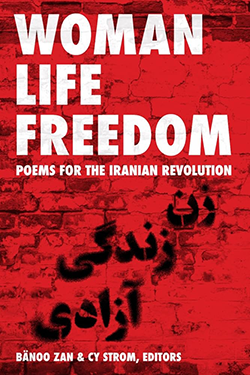
Bänoo Zan and Cy Strom, Guernica Editions, 2025
Less than two weeks after Amini’s death, Zan sent a proposal to Guernica Editions, outlining her goal for an anthology of poetry on the theme of Woman, Life, Freedom—the English translation of the chant protestors had been shouting, “Jin, Jiyan, Azadî!” Only a few days later, she received the go-ahead and put out a call for poems. Zan, whose name means Woman, was surely the right person to initiate this important project. Along with her editing partner, Cy Strom, the result is a powerful text, already into its second print run.
So, what kind of poetry anthology inspires its publisher to go into a second printing mere weeks after the book is released? Maybe it’s a book that champions a revolution led by women—women who know what it is to be arrested, imprisoned, and even tortured for breaking rules set out by men, because yes, that’s exactly what this book is.
Poems in the first section, Beginnings, help us recognize some long-entrenched beliefs about the inferiority of women. Two poems in particular remind us that beating a female is not only acceptable, but expected. Two excerpts, the first from Rasha Barrage’s “She reads a fairy tale”:
A [child] may be smacked, kicked, punched, and hurtled across a room, if
a [parent] commands it.
But. The [child] must not be a boy. Not a brother.
Such inequity is so ingrained, it appears again in a poem by Laura Sheahen called “Pashtun Marriage Contract,” a piece with the repeated refrain, “Flesh is for you / but the bones are mine.” In a note following the poem, we find this explanation—that the phrase was actually “included in some marriage agreements: a husband was permitted to beat his wife but not break her bones.” Small comfort for such wives, and while this is a concept that seems terribly out of place in what we now like to think of as enlightened times, sadly, it remains all too common—and not only in places we deem as ‘away’.
The remainder of the book is organized into four more sections—Defiance, Struggle, Witness, and Futures—each offering more in the way of powerful poems.
While I could cite many lines, the ones I have selected reflect the strength of the words on the page, and are by no means the only poems I might have quoted from.
Within the pages of ‘Defiance’ is a poem by Leila Farjami called “The Mouth.” It is constructed in several parts and outlines some of what happened to Mahsa Jina Amini by defining why she was arrested:
Indecent coverage in a public space
per Sharia Law—
a half-slipped veil on your head,
fully clothed.
Sentenced to eighty lashes
for defying the dress code, compulsory.
Your eyelid eclipsed,
jaw broken,
neck bruised.
After prison release
your body was a land, plundered,
heaped in amorphous blues,
purples.
To those of us in North America, it seems unthinkable that improper clothing (having a bit of hair slip out of its covering) could result in arrest, torture and death. And yet such actions aren’t the only “crimes” women can be held accountable for in Iran. Noor Jafari’s piece looks at love itself as a crime, as it considers “two girls [who] fall in love” and conjectures: “You wonder if, before they were caught, / the girls got a chance to hold hands, / to feel each other’s palm sweating.”
Summer Brenner’s poem, “Afterwards,” deals with yet another martyr-death wherein she describes the death of a family member whose corpse is left on the doorstep:
We will hold her hands of broken fingers
We will touch her face crushed on one side
We will stroke her mangled ear, her twisted mouth, her limp neck
I will bathe her white skin, her long black hair
I will sponge away the blood from the lips of her broken vagina
Later the official report will come, later the certificate of death will come
Later we will read she fell from a roof, we’ll read she was run over
By a train, we’ll read she took her own life.
Such disheartening accounts convince us to understand the depth of commitment behind the women’s revolution. It is something they must do, and if we are not able to actually go to the streets in protest, all of us must join at least as witness to what they are now demanding.
And this is not to suggest that this anthology is without hope. One of the brightest spots comes in the poem, “We felt like wearing orange sports caps” by Elana Wolff. At first such a splash of colour might seem almost irreverent, but that certainly isn’t the case here. The poem paints a portrait of two women “cycling up the mountainside / riding in our bright / green cotton shirts” who keep cycling while they observe “thousands gathered, ranting, chanting.” The vision prompts them to continue cycling:
two women, pledged to azadi / to freedom.
Up the mountain, resolute—
riding on our rightfulness, our colours,
& momentum.
This sense of momentum, of forward progression, encapsulates the strength and commitment suggested by the varied works in this anthology. The editors, whose call went out to writers everywhere, chose to ensure that submissions were all blind-judged. The resulting collection sees work from men as well as women, from writers from across the globe, from those who are unknown, with this as their first publication, to well-known poets, teachers, magazine editors, even former poets laureate.
“Reader, Whoever you are and wherever you come from, the enemy is your enemy—and the home is your home. Because all people are your own people.”
In his introduction editor Cy Strom refers to these poems as “works of plain defiance”—new anthems to unify us in opening our eyes and hearts to seeing and understanding what is going on in the Middle East, an area now feeling so fragile in the face of all that’s being hurled its way. Especially in light of the latest developments there, where reports suggest there have been over 30,000 deaths at the hands of the oppressors, this volume becomes day-by-day all the more relevant.
The book’s closing poem is by the anthology’s other editor, Bänoo Zan. Its power is magnified by reading it aloud for yourself—or, better yet, finding and listening to a recording of Zan reading it. It’s not a poem you are likely to easily forget.
In the Afterword she’s written, Zan calls all of us to task: “Reader, Whoever you are and wherever you come from, the enemy is your enemy—and the home is your home. Because all people are your own people.” After such a formidable reminder, it’s easy to understand why The Writers’ Union of Canada chose Zan as the winner of its 2025 Freedom to Read Award.
All I can add is my personal urging for you to buy/order/find this book and make it your own. Read its challenging words and be ready to the heed the call it presents: “Jin, Jiyan, Azadî!” / “Woman, Life, Freedom!”
Heidi Greco lives and writes on Territory of the Semiahmoo Nation, near Vancouver, British Columbia, Canada. Her work has been published in books, anthologies, magazines, and online.
Recommended
A Review of Convergence: Poetry on Environmental Impacts of War
A Review of Stolen Flower by Irma Pineda, translated by Wendy Call