


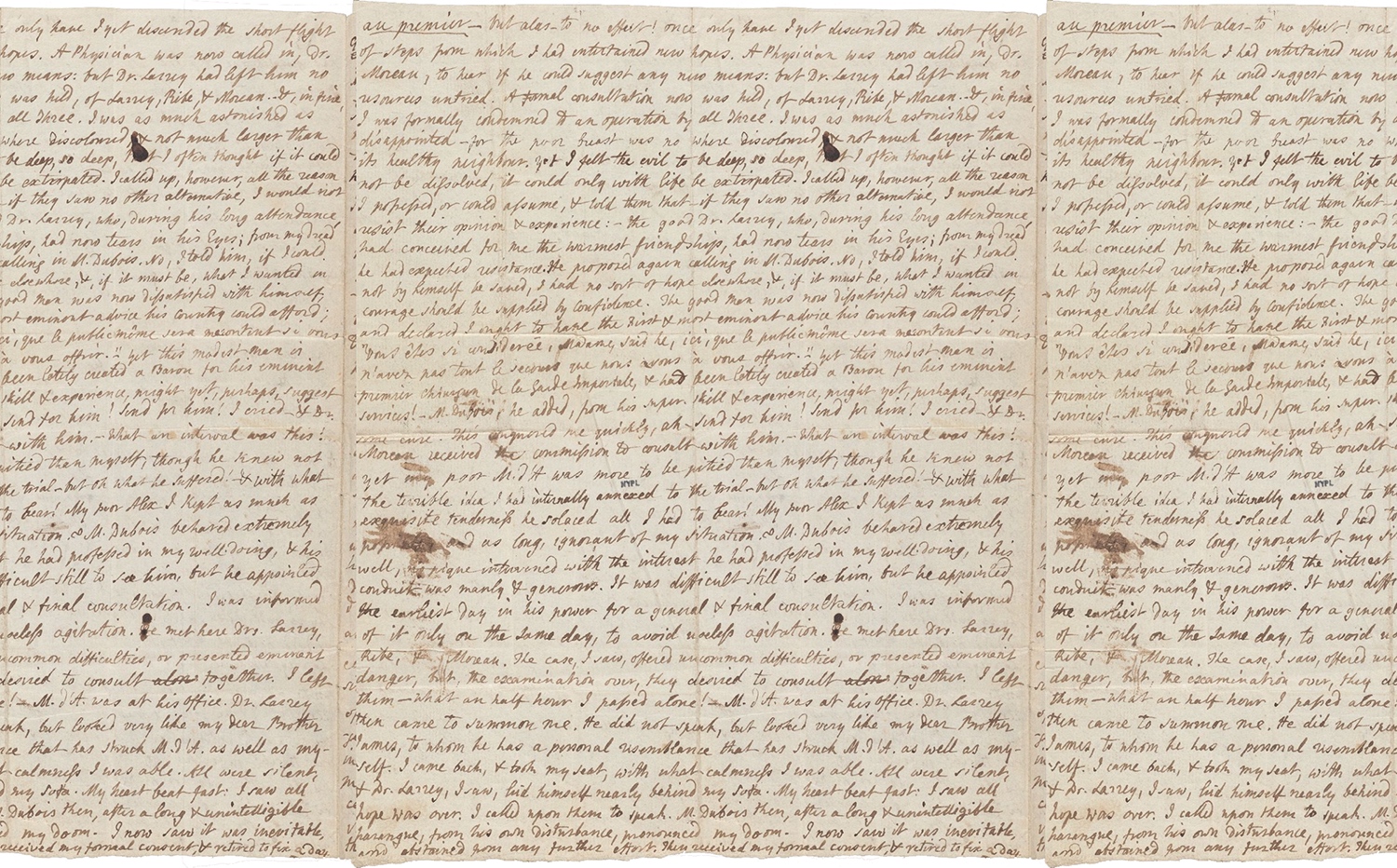
An Account
In college, I studied English because I liked to read and I liked to argue. I was curious about almost everything, provided I could read about it. At first, this was enough. What I didn’t think of was all the things I was interested in but hadn’t read about. All the things I didn’t know I was interested in because I hadn’t read about them. All the things that didn’t get assigned or published or written because they were too weird or small or ordinary to spend time on. All the things that needed someone to write about them.
But then, I took an eighteenth century literature class, and I met Fanny Burney. We did not read her novels or her plays, but her journals and letters. I was twenty-one.
The class was taught by the tall, flat, and bald Dr. Torrington. In my memory, he lumbered over us at the front of the room, bending and hanging from all joints. He wore gold rimmed glasses with large, round lenses not unlike the ones I wear today. The first day of class, a screw fell out of the right side of these frames, releasing one of the lenses to the carpeted floor. We—a roster that I remember as wholly female, like many in the English department—crawled on our knees, brushing our fingers across the soft ground to feel for the miniscule screw. We didn’t find it. He taught the first half of our class blind, waiting for his wife to arrive with an alternate pair of frames.
This is where the tale turns fabulous: The alternate frames arrived, emerging from the safety of Mrs. Torrington’s floral purse to rest on the lectern at the front of the room. Next, she procured a diminutive screwdriver. She and Dr. Torrington then proceeded to dismantle the newly arrived frames: the head of the screwdriver locking into its counterpart in the joint of the unmarred frames, twisting and releasing a fresh, lilliputian screw. They did this together, both Torringtons bent over their work, flattened bodies curving around the project like winter willows, long nobbled fingers now pointing, now holding, now plucking out the tiny screw. They set it on the podium; they—perhaps she—picked up the original, broken, frames, replaced the lens, pinched the joint together for refastening, four sets of eyes in close study, necks tight with concentration. Us too: We students held our breath in our seats. Dr. Torrington set the new screw in the old hollow, reached for the screwdriver, and bumped his wife. The frames flew open. The lens and screw shot loose. In unison, we slid to our knees, our hands already flat on the carpet to feel, again, for the missing piece. It would not be found. After a time, it was decided that Mrs. Torrington should retreat to her husband’s office. He would need a ride home.
Dr. Torrington taught the rest of that first class in his still-broken glasses, one side open, the loose, bottom half bouncing around as he spun from the board to face us, then back to his notes, then back to his students, dutifully aligned in their seats. Under the ceiling lights, the gold flicked and bounded.
Six weeks later we read Fanny Burney’s account of her 1811 mastectomy. As I remember it, Dr. Torrington did not warn us. As I remember it, I read and I discussed and I tried not to publicly clutch at my left breast. As I remember it, I used the break in our two-hour class to poll my classmates: Which breast do you think it was? Burney did not say, and I was not bold enough to ask Dr. Torrington. I theorized that we all assumed our dominant side was under the historic knife. I am left-handed. I was an English major, not a scientist. Methodology means little to me, but I remember that my theories were correct.
It was the methodology of Burney’s procedure—I cannot call the slicing off of the breast of a conscious woman a “surgery”—that shocked us the most. That she was fully awake; that she was lying in the parlor of her own home, not in a war surgery or even in a doctor’s office; that she was given only a glass of wine that only could have been spiked with laudanum to ease the pain; that she was surrounded by men—seven, when she was expecting two—and that these doctors attempted to send away the women Burney had organized and hired to attend her, so that only a nurse remained with Fanny and her hoard of physicians; that she had also seen to it that her husband and son were away from the house; that she was an English woman in France, far from her father and brothers and the sister to whom she would send, months later, the famous “Account from Paris of a Terrible Operation—1812” which we were now reading in a beige classroom in Illinois; that she was completely alone, that she was woman of no extraordinary social standing who had chosen to undergo this procedure—was shocking. I did not know such a thing, such a person, such a document, could have existed.
In that class, we read Charles Lamb. We read Adison and Steele in The Tatler. We read The Spectator. We read John Wesley’s sermons. In what I would call my third most memorable class—the first being Fanny Burney’s mastectomy, the second being the Day of the Broken Glasses—a student chose, for her presentation on John Wesley, to read a sermon aloud. She walked to the front of the classroom and began to declaim. Ten minutes in, Dr. Torrington cleared his throat and asked if she had prepared any research to present. The student, an earnest, homeschooled lass who had recently cut and dyed her hair tea-red, blushed to match her tresses. She stammered—she had thought the best way to understand Wesley was to encounter his work as oratory, not print.
The rest of us looked at our notes.
In hindsight, I want to call her presentation radical. To perform Wesley, as a woman, to a class of women, led by a man, who would soon be driven home by a woman. Wesley, who stopped courting a woman on the advice of cleric friends and then, when she married another man, refused her Holy Communion. Wesley, who believed that perfection was attainable, if followers used his method. In this class, a lifelong mystery had been solved: Wesleyans and Methodists, whom I could never keep straight, were in fact the selfsame creatures, Wesleyans who had A Method. For this student to perform: what boldness. She was not only trying to get out of doing her work. I knew her. She was trying to show us what it could be like to hear the message from the lips of our own, as it was meant to be heard.
On Burney Day, I have no memory of Dr. Torrington indicating that he knew his students might feel her account differently than he did—that we might clutch at our bosoms and shudder, that it took no effort or intention to imagine ourselves lying on her parlor table, the surgeons leaning over our exposed forms. That we, unlike Wesley or Adison or Steele, had bosoms, was never addressed.
In fairness, I’m not sure what he could have said that would have been appropriate. All right ladies, we’ll be talking about boobs next class. In fairness, Fanny Burney’s “Account” was less about boobs than Gulliver’s Travels had been. But I will never, never forget sitting among the sisterhood of English majors, listening to an agèd man lecture us on the first written account of a mastectomy. What had felt so alive, so shocking and horrifying, in my dorm room the night before, was now dissectible, summarizable.
The night before, my roommate—a fellow English major with high apple cheeks and long, long hair, a dear friend who had induced me to take this class together—had come to find me earlier than usual. She popped her head around the door as I chatted with a neighbor, her hair sliding behind her back like a bead curtain. Have you done the reading for Torrington yet? No, not yet. Okay. Tell me when you get to it. She marched off. When I got to it, neither one of us knew what to say. We lay on her bed and held our bosoms and moaned. Fanny Burney had made us speechless.
The end of that semester, Dr. Torrington retired. My roommate and I went to his retirement party—a joint fête with a short little scholar of equal age given to bouncing on the balls of his feet as he lectured about the “righteous north,” a place where it was too cold, the layers too cumbersome, to engage in canoodling. Minnesota. The retirement party was an insider affair, the men joking about each other’s age and length of their respective Festschrifts, the middle-aged female head of department rising from the stands to thank them for their service. What a hole they would leave in the department, she declaimed.
What a hole those doctors had left in Fanny Burney! What a hole she had burned into our memories. She knew what we did not: what it was to look death in the face, to feel his knife, his sterile hands, his placid voice asking all the assembled doctors: Qui me tiendra ce sein? Who will hold the breast? And to hear her own voice fill the silence: C’est moi, monsieur! It’s me, monsieur. I will become the essayist.
Lydia C. Buchanan’s essays have appeared in or are forthcoming from The Best American Food and Travel Writing 2025, Electric Literature, Gigantic Sequins and other publications. She has an MFA in creative nonfiction from UNC-Wilmington and currently lives in the land of blue hills and bluestockings—Boston, Massachusetts. Her website is her name: lydiacbuchanan.com.
Recommended
Wig

Strike

Lapsus Calami