


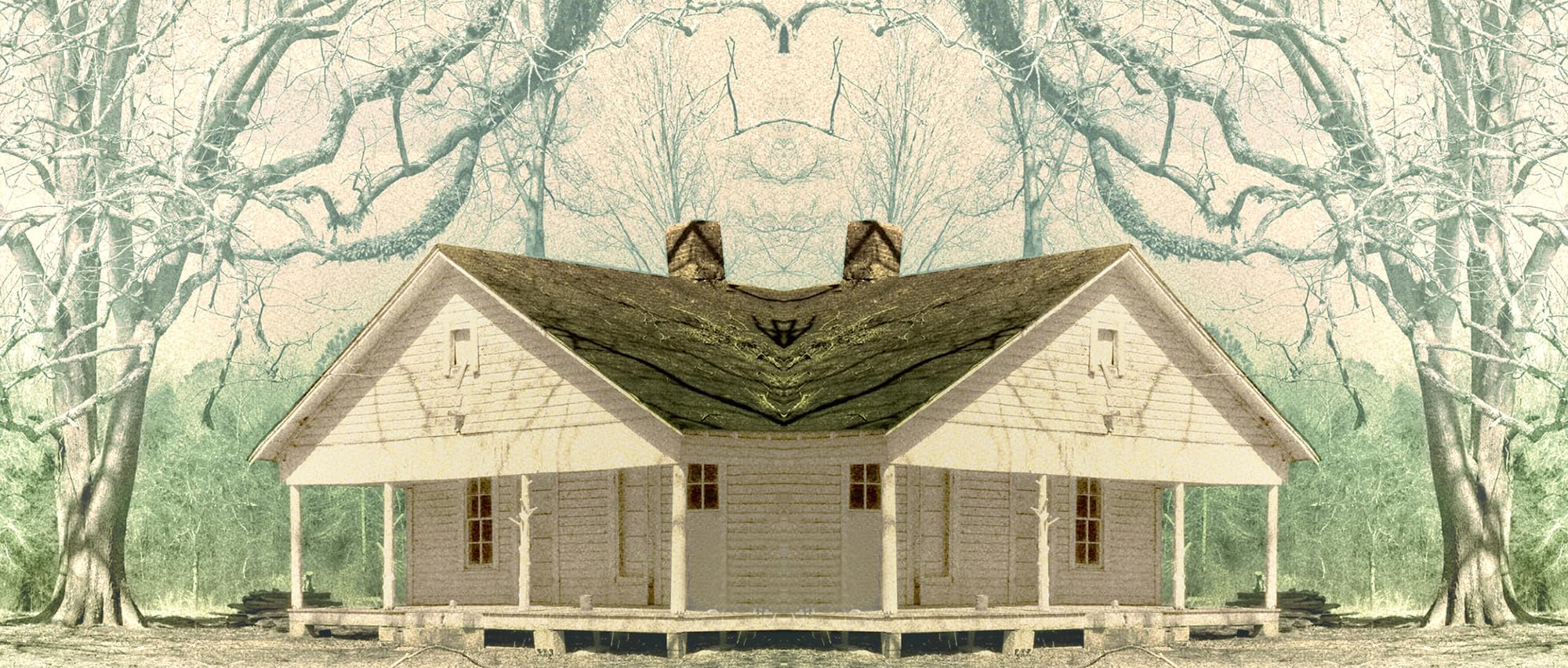
A Review of Haircuts for the Dead by William Walsh
Sundown is just a small town in rural Georgia, but it overflows with stories. Some are held by the dead, some are kept secret by the living. Some repose in abandoned houses and barns. Some are written down as we read and as people will read a hundred years hence, as our protagonist hopes. In Haircuts for the Dead, William Walsh evokes these layers of stories populating a setting not unlike Flannery O’Connor’s Christ-haunted, but not Christ-centered, South. Incidentally, O’Connor’s story “Wildcat” appeared posthumously in the pages of the North American Review in 1970.
In his second novel, Walsh chronicles the struggle of the White twenty-one-year-old Hannah Gardner to make a life after her father sells the family farm and divorces her mother. She works as a beautician at The Cute Curl and at the mortuary preparing corpses for viewing at their funeral.
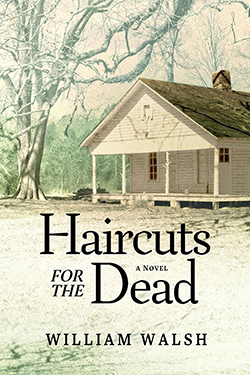
Much edgy happens in the novel, beginning with the death of Hannah’s baby sister in the first chapter and continuing with the lurking presence of Hawkshaw Bales, a gold-Lexus-driving drug dealer relentlessly pursuing Hannah for her brother’s debt. Yet the characters are so convincing, the descriptions of the town and the landscape so detailed, and the plot twists so spellbinding that readers stay on board until the end, desperately questing with Hannah for some kind of safe home.
Alone, Hannah finds one haven: the public library, where she befriends Margaret, the Black librarian who lets her use a computer. Hannah does not have a literary background (though she remembers a story she read in high school about “a family that was shot and killed by a misfit man and how the grandmother was an irritating person”), but she begins to write My Document of Life. Walsh nicely intermingles the narrative techniques of the third-person version of Hannah’s experiences, including rape, with the style of her diary’s account of events and reflections. In her “document of life,” she dialogues with an anonymous author of a nineteenth-century journal of a woman’s travels West in a wagon train. Parallel women’s rugged life stories hundreds of years apart, different, yet similar in the ways they are (mis)treated by men.
Walsh also intriguingly balances the Christ-haunted/Christ-centered dichotomy in Hannah’s life. Early in the novel we get a glimpse of Hannah’s skepticism of religion (in chapters such as “Original Sin is Just a Trick on Idiots” and “Your Church Ain’t My Church”) when she gets into an argument with the Baptist preacher’s wife: “Did you know that hundreds of ancient cultures had the Virgin Birth long before Christians stole it for their own use? ... The man who wrote that particular book is named Joseph Campbell.” You can imagine how that went over. And she has so many questions: “If God truly loved me, He would have crossed that dusty road long ago to save my soul from the evil waiting in the weeds.” So many questions such as can we “reestablish our virginity?” Yet most every diary entry concludes with a quotation (which she apparently has held in her head) from the Bible:
Without Margaret, I would be alone. I have flown so far from God even the angels have stopped looking for me.
The eyes of the Lord look over those who do right,
And his ears are open to their prayers.
I Peter, 3.12
And though she says, “He who sins is of the devil,” she also writes, “I prayed a lot yesterday. It’s not the God I prayed to when I was growing up. It may be better than God …. Maybe it’s the God for the Church of Injured Hearts.” As Baudelaire suggested somewhere, the existence of evil implies the existence of good.
Though the book begins with the death of a baby, and death is everywhere, including when Hannah cuts the hair of cadavers and in the bottom of Lake Lanier where cemeteries were flooded for recreation, Walsh lessens the morbidity with music and chapter titles. The novel is musical in its shifting of major and minor keys and repetitions of motifs sinister and comforting. Sometimes the chapter titles bring relief: “The Dead Don’t Usually Complain,” “Smile, You’re on Candid Heartbreak,” or “Shopping Before the Rapture.”
And songs abound. Somehow Hannah knows about Miles Davis. And she listens to music as she works in the mortuary, cutting the hair of the dead or giving them a manicure. She is so moved, working on a girl she went to high school with and playing “Do You Know the Way to San Jose?” Hannah laughs and says, “You’re not going there anytime soon.” And buffs her nails. These are the moments when we can relax a little even though “danger lurks everywhere.”
Besides the therapy of the writing in her journal, Hannah begins to find fulfillment in being creative in other ways. She may become a fiction writer some day: “Hannah fussed around in the glove compartment for a piece of paper and a pen, as a few ideas came to her, an idea for a story even though she never thought of writing something made up.” Also, she gathers old photographs from her parents and makes them each a picture book they can look at in their separate houses still disdainful of each other.
We see her poetic persona emerging at the end. As the narrative embodies suspense, here comes a lyrical passage as Hannah and Margaret drive to Memphis: “Then, she stared out the window at the vast terrain of land and thought how the world was comprised by how far a person elected to see …. There was no moon, only stars, and a sky so black, a person could run away and be lost in the white ruins of the world.”
The novel is filled with powerful images, scary and sad, about the people Hannah encounters on the gurney as she cuts their hair. Also, her old homestead is so evocatively described on her last visit to the empty buildings there. The book faces the challenges of racism, same-sex relationships, and women’s lives in this world. Yet even though the power of evil seems inescapable, she gathers seeds from her homeplace after the apple trees are cut down. “Save the seeds to plant apple trees in the backyard. I want to preserve the past by growing something good from it,” Hannah tells Margaret as their relationship grows closer.
Welcome the mystery and adventure of this book and of your life. Let yourself not be alone. Walsh controls the story, spools out the scenes, and does a good job of avoiding sentimentality, but looks at life square and does not bring us down to where we cannot get out.
I urge the reader to jump into this novel and ride with the surprises.

Dr. Rob Merritt is Professor Emeritus and Distinguished Professor of Creative Writing at Bluefield University. Born in North Carolina, he lives in the mountains of West Virginia. He has degrees from the University of North Carolina at Chapel Hill and the University of Kentucky. He is the author of Early Music and the Aesthetics of Ezra Pound and the poetry collections Sense of Direction, View from Blue-Jade Mountain, The Language of Longing, and Landscape Architects. He has recently published poems in moonShine, North American Review, Red Clay Review, Psaltery & Lyre, and The James Dickey Review. He has served as Vice President for The National Association for Poetry Therapy and as a visiting professor in English at Jiangsu Second Normal University in Nanjing, China. He is interested in finding mythology in everyday life, highlighting intersections between Chinese and Appalachian poetics, and using poetry therapy methodologies in higher education.
Recommended
A Review of Convergence: Poetry on Environmental Impacts of War

A Review of Stolen Flower by Irma Pineda, translated by Wendy Call