


A Month and a Wake-Up
We were AWOL. A sentence in Club ED was the risk, but Butters and I didn’t care. Personnel awaiting release had been confined to barracks. A medic, a veteran of three tours, hung himself that morning. Of the last of us to rotate back into the world, he had been the third.
At reveille, we ran the perimeter until sunlight came through trees beyond the unfurled spools of concertina wire. Filing back into the barracks to shower, we found him hanging from a length of parachute cord. We all just stood there in our towels, blinking, until Butters cut him down. After the fiftieth chest compression, Butters quit trying.
“He poured rifle oil over the walls,” Butters said. “Just in case he changed his mind.”
“Out of the army is where you want to be going,” I said, as I remembered the scuffs his boots had left on the shower tiles. “Marking time here is not where you want to be.”
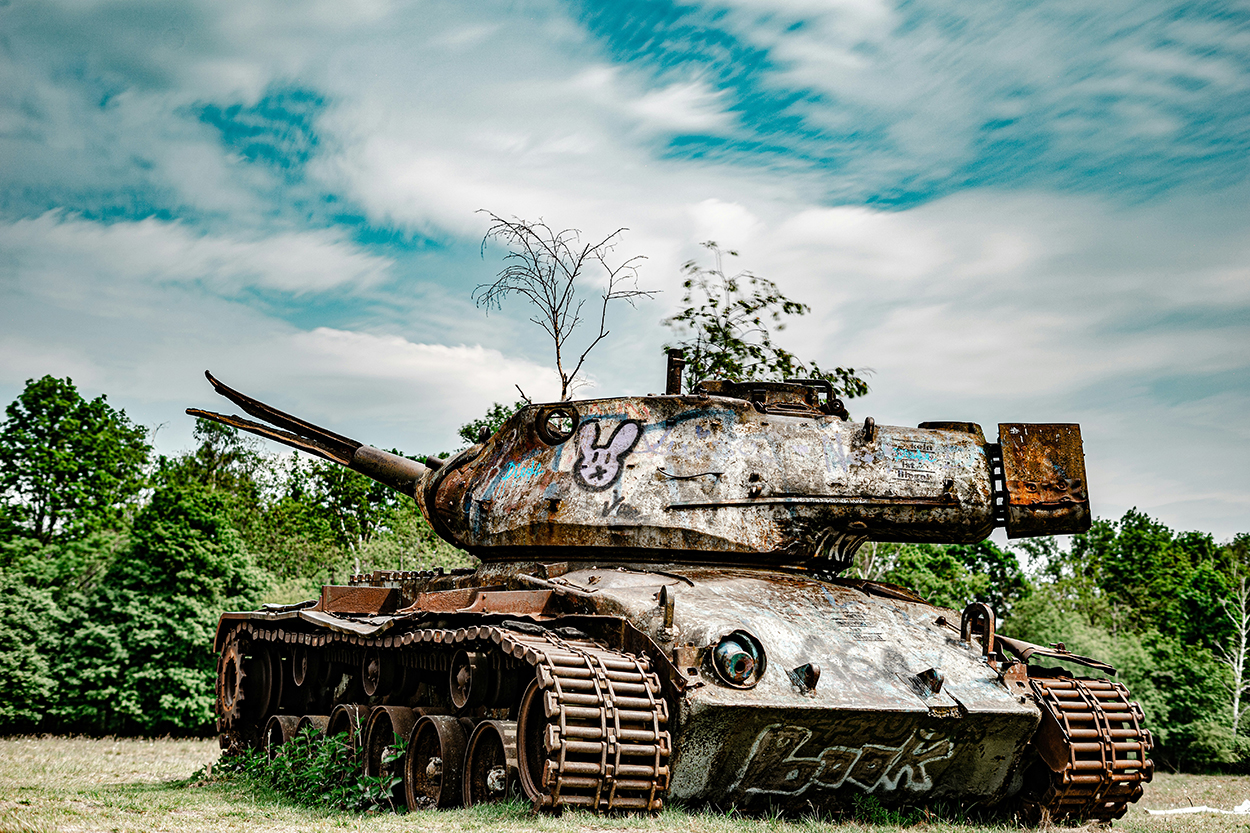
We sat smoking in the hull of a decommissioned tank, twenty clicks away from the barracks. We’d broken ranks after paramedics strapped the casualty bag to a gurney. By the time the order came down that personnel awaiting release were confined to barracks—indefinitely, pending what the CO called “psychological evaluations”—our rucksacks were packed. When service weapons were confiscated and rubber rifles were issued, we were already rucking out to the training sectors.
“All he had left to do was turn in his uniform,” Butters said, lighting one cigarette after the other. “He had been processed”
“I’ve wanted to take the uniform off since Afghanistan,” I said.
I tore my name tag from my combat tunic and dropped it into an old ammo can we used as an ashtray.
“Poor Gordie,” Butters said, looking toward the walls of the tank, rusted and pierced by munitions long obsolete. He didn’t say anything else for a while, and I realized, in the silence, that this was the first time today either of us had said his name.
I made up my mind about my name—whether I was going to give it to the army again—years ago, on the island of Cyprus. The platoon was on decompression. Our tour was over. We decompressed by drinking all day at the pool bar, all-inclusive bracelets on our wrists, hospital bands courtesy of the Department of National Defence. Flush with hazard pay, local cab drivers took us to the brothels and bars in town. We drank and danced until dawn. Still, no matter how much I drank or how many strangers I paid for, I could still hear that voice, broken up on the 5-22 radio, ordering us into the village. That human sound, a court-martial would come to rule as lawful, despite the testimony of survivors.
We were all getting out for something that had happened to us.
During decompression, Butters still wasn’t sure about his name, whether to sign it back over to the army again. While the rest of the platoon swam in the sea, Butters stayed in his room watching news broadcasts of the war. Fourteen years after the towers fell, the ISAF commander was announcing the drawdown of NATO’S combat mission to support the Afghanistan National Army. “There’s still so much left for us to do,” Butters would say when I brought up meals from the mess hall. Of course, Butters wasn’t wrong. The army always needed people. No matter what any general said, war still wasn’t over. Signatures belonging to able bodies—in war and peace—could be put down on a military contract.
Before shipping out of Cyprus, a medal ceremony was held on the beach. We stood at attention facing the Mediterranean Sea, indistinguishable from the sky, while the general from television walked down the ranks pinning campaign stars to our chests, thanking every soldier for their service. When he shook my hand, his eyes seem to look past me, as if someone else, or nothing, was there. After the parade was dismissed, Butters drank so much he shit his pants in the hotel lobby. Four MPs carried him off to the drunk tank, piss and shit dripping from his dress uniform, while he screamed, again and again, “Fuck the army! Fuck the army! Fuck the army!”
* * *
Outside of the tank, the wind was picking up. Leaning out of the turret hatch, sheet lightning streaked across the clouded sky as trees bowed in the first drops of rain.
“Do the time you have left here,” I said, closing the hatch. “That’s all we can do.”
“Do your time and you will be saved,” Butters said.
“How many days you got left now?”
“A month and a wake-up,” Butters said.
We’d been asking each other about our out-clearance ever since transferring into the personnel awaiting release platoon. Habit being so strong, I waited for Butters to ask about my release date, but Butters just stared down at his hands.
“Gordie didn’t wait,” he said after a while. “I can still feel his ribs breaking under my palms.”
“You did all you could,” I said.
“If I got him breathing again. If I had brought him back here,” Butters said sort of looking around. “He would’ve probably hated me for it.”
“Just a month and a wake-up. Butters,” I said. “That’s all.”
Reminding ourselves of time, how much we had left of it, was our own standard operating procedure. There was a lot to look forward to when the army finally let us go. Parading in the personnel awaiting release platoon, a soldier needed to remember that. Butters and I had released voluntarily. A post-deployment evaluation had ruled us fit for service. For others it was different. Some couldn’t VR. The army was out-clearing them on physical or mental grounds. Soldiers like my bunkmate, this EOD tech, had white phosphorus burns over half of his body and didn’t have enough fingers to close his hands around a rifle ever again. And there was Gordie, who had woken up, in his bunk, almost every night when he was still alive, screaming. Consent aside, we were all getting out for something that had happened to us.
After spending the rest of decompression in a room with nothing but a plastic mattress and a drain in the floor, Butters wasn’t charged with insubordination. Leadership looked the other way, on account of what had happened on tour. On a convoy from Kandahar Airfield to the embassy, an IED detonated under Butters’ LAV. From what I saw from my view from the rear vehicle, anyone near that blast radius was going to wind up KIA. A MEDIVAC was called in while a perimeter was set up around burning wreck. Mass casualties. No survivors. The word across all channels.
But when the helicopters landed, and casualty bags were retrieved from the cargo, and we began identifying bodies by name, rank, and service numbers engraved on dog tags still hanging from remains, someone in the platoon cried out because Butters seemed to be alive, walking through fire, out from a hole, shrapnel had left in his LAV.
With water from our canteens, we washed Butters down searching for an exit wound. “There’s got to be one,” the LT said as we poured and scraped away the ashes and blood with our fingernails. But in the end, none of the blood we washed away belonged to Butters. He couldn’t even be awarded the Medal of Sacrifice. The army chaplain presiding over the memorial service, called Butters a miracle amidst a tragedy. It was just one of those things.
* * *
When the rain stopped the hands of my wristwatch were close to midnight. We unrolled our sleeping bags, opened all the tank hatches, and lay under patches of the night sky. In the wake of the storm, the air had grown cold, and as we spoke, we could see our own breath drifting out from us.
“I wish I could have been there,” I said. “To talk to him.”
Butters reached into his rucksack and pulled out the handle of vodka we had bought at the PX before we had broken ranks. With his teeth, Butters unscrewed the cap and drank.
“I can tell you this,” I said, as Butters passed me the bottle. “When I finally get out of this place. I will try and do right by them”
Butters wiped his mouth with the sleeve of his combat tunic.
“How?” he said.
I didn’t answer at first. Only looked up at the stars, numberless and shining in the dark. I was thinking all that we’d seen—the desert mountains and valleys of Afghanistan through the window of the plane as it descended to Kandahar airfield, soldiers leaning against mudbrick walls after a firefight, procession after procession of coffins draped with flags slow marched into bulkhead doors of transport planes chartered for home. But what I thought about most, was basic training, how we were back then, marching kilometer after kilometer, in our newly issued uniforms, leaning against the heat of these very training sectors. I thought about Butters, one hundred pounds strapped to his back, putting one foot in front of the other and finally said, “I’ll go on.”
I fished my name tag from the ashes and pressed it to my chest—the letters burnt and ashen, but still legible.
“I talked to Gordie,” Butters said, closing his eyes. “A few days before he died.”
“What did he say,” I asked
“He told me that he had appealed his medical discharge.”
“On what grounds?”
“Doesn’t matter,” Butters said. “The army upheld the discharge and then Gordie put his own head in a noose”
“Butters,” I said.
“What doctor found on his psych eval,” Butters said, “never bothered Gordie while he was there. Fighting his war, tying tourniquets and sealing open wounds. He never thought about who he didn’t save. But when he was here, he could think of nothing else. At home, he told me, whether his eyes were open or closed, all he could see was their faces.”
I gave the bottle back to Butters, but he shook his head.
“If he only waited a little longer,” I said taking another drink. “It could have been different. But it takes time.”
“Maybe,” Butters said his eyes still closed, the rhythm of his breath slowing where it was caught on the cold, as he drifted off to sleep. “Or maybe the only way to be yourself again is to go back there and fight your war.”
The next morning, when I woke up, Butters was gone. A mountain of cigarette butts in the ammo can was all that remained. After I packed my rucksack, I fished my name tag from the ashes and pressed it to my chest—the letters burnt and ashen, but still legible.
A few steps into my march back to base, I turned back to look at where we had slept. The tank was an old Sherman, decommissioned after the Second World War, dragged off to the training sectors because it was no longer serviceable. The tracks were stripped, and in the years that passed since the armistice and rise and fall of the Berlin Wall, the wheels were only now starting to sink down into the earth.
That afternoon, when I got back to the barracks, work on the base had resumed as if we had never left or been anywhere else. Sections were running down the streets in AKAK formation singing battle hymns behind canisters of black gas masks. I moved between the green and gray buildings looking for my platoon. I found the personnel awaiting release platoon on the parade grounds. In ranks of two, they stood at attention, facing the flag of our country flying at half mast, rubber rifles held at present arms.
When the parade was dismissed, and the soldier’s broke formation, I pushed my way through the crowd, looking for Butters. But all I could see were berets atop heads. The same regulation haircut. With nothing to reference one soldier from the other, I began to call out Butters’s name. It was easy name to say, and I had been saying it for a long time. Butters, I said again. Name, rank, and service number. Then, I took a soldier by the shoulders. It could have been Butters, but it could have been anybody. I turned him around and said, “Buddy, come on, let’s get out of here.”
Terence Hawes is a writer from Montreal, Quebec, Canada. While currently studying to become a clinical psychologist at McGill University, he writes in his spare time. Terence is a thirteen-year veteran of the Canadian Armed Forces, having served as a reservist in the infantry. His poems and short stories have appeared and are forthcoming in Southeast Review, Narrative Magazine, Frozen Sea, and elsewhere.
Recommended
River Dreams
Our Lady of Angels Fire: Half-Life of a Hole

The Stranger