


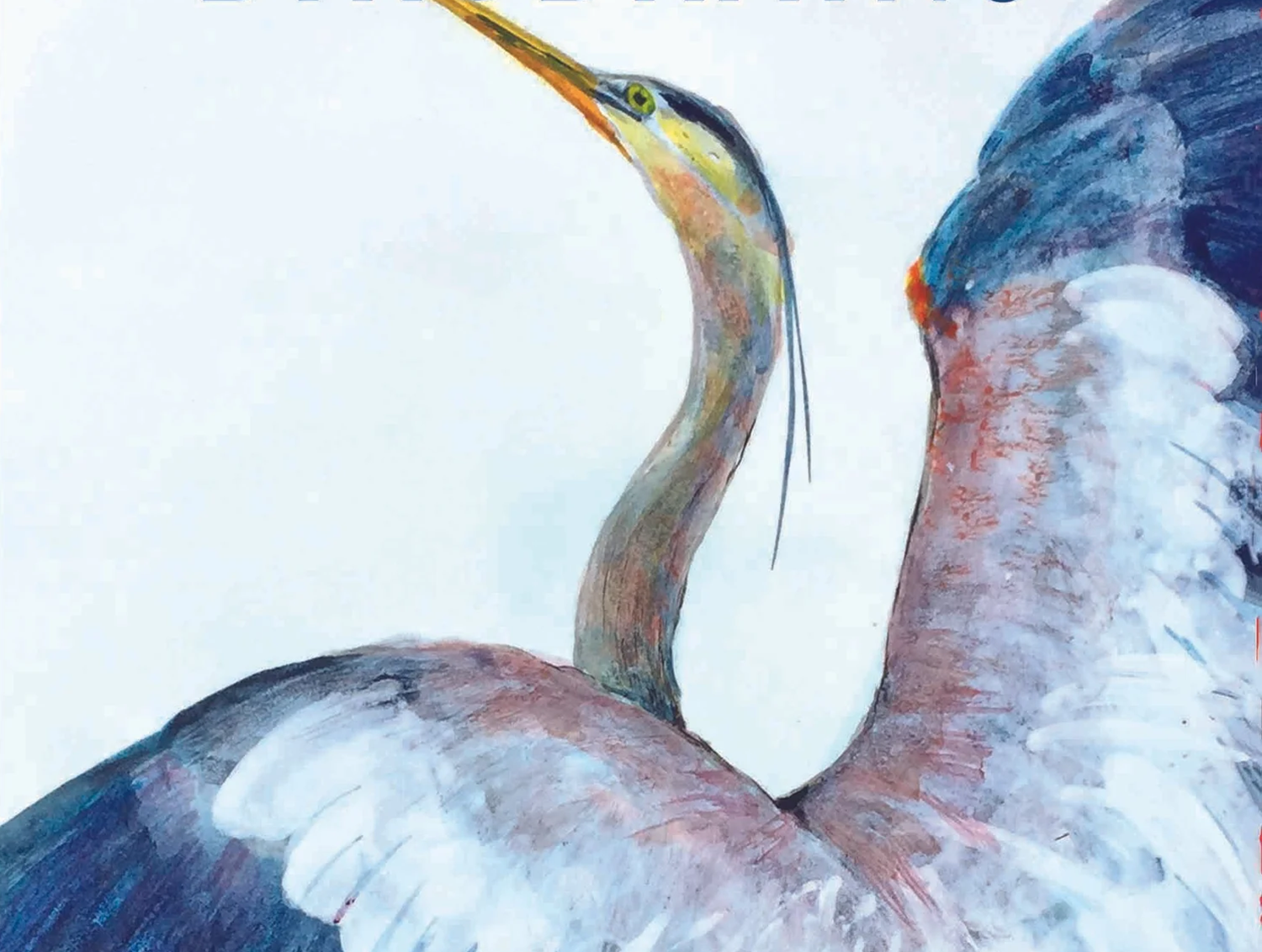
A Review of Birdbrains: A Lyrical Guide to the Washington State Birds
Birdbrains: A Lyrical Guide to the Washington State Birds (Raven Chronicles Press 2025), edited by Susan Rich, is an interesting compilation of the birds of Washington. Rich is the author of several collections of poetry and co-editor of two prose anthologies. This book will surely enhance that resume.
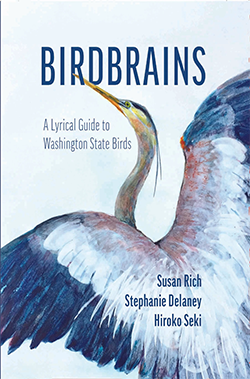
On the left side of each double page Dr. Stephanie Delany provides a brief description of a bird and its habitat. The page concludes with an “intriguing titbit” of interesting information, and each entry is capped by an artistic rendition of the bird. While this artwork of Hiroko Seki is not typical of wildlife art, she demonstrates a real ability to capture the essence of the birds. The bird descriptions are complemented on the right side of the spread with a poem or prose writing by a large assemblage of writers.
I will have to admit that I had a goodly amount of apprehension when I opened my copy. I am a retired ecologist who is inclined to read scientific articles and not poetry. However, I agreed to read it because I frequently travel to Seattle to visit my children and their families, so I am familiar with the birds of Washington. During these visits, I have enjoyed my young grandsons pointing out birds in their yard and neighborhood and showing me a pair of nesting Bald Eagles that they watched faithfully from their upstairs bedroom. My trepidation toward the book was soon set aside. I found myself reading the bird notes and then finding that the poetry or prose writings usually enhanced the bird descriptions. I also appreciated the “intriguing tidbit” that concluds the bird descriptions. I often found myself saying, “I didn’t know that.”
This book should appeal not only to those who enjoy birds but also to anyone who enjoys poetry and certainly to enjoyers of poetry who have even a casual interest in birds.
I was especially drawn to the entry for the American Coot. I had to chuckle at Hiroko Seki’s accurate drawing of their clownishly long toes. The entry brought back a memory of a cold hike our son and his family took us on near the arboretum on Lake Washington. While walking along the shore of a bay, we found a huge flock of coots that were bobbing their heads while swimming along and feeding like Dr. Delany describes. I also had to wonder, as Jasmine Elizabeth Smith wrote in her accompanying poem, “what moves several thousand coots closer to the center” when they have the entire bay to use. The coots seemed unfazed by the cold temperature, and by watching them, I soon forgot about the cold also.
The book is an enjoyable read, but there are some shortcomings. For instance, I was perplexed by the listing of “Mysterium Rara Avis.” The common name is missing, and I could not find the bird listed in the references I checked. Since it was mentioned in Rich’s introduction, its inclusion is not a mistake. I found that the name may translate as “rare bird,” so perhaps it was added as a metaphor for all the rare birds that we don’t identify. If so, I am puzzled that it is described as “pale purple with deep blue-gray wings and mask.” Most of the birds I can’t identify are brown or shadowy, and they don’t stay around long enough for me to see any markings.
The book is not a complete compilation of all the birds in Washington state, and I would have appreciated an explanation of how the birds were selected. I also wondered at how the birds were arranged since similar birds were often separated by unlike birds. However, I came to realize that the book can be enjoyed no matter how the birds are arranged.
In addition, there are a couple of birds that I would have liked to have been included. The Bufflehead is often confused with the Hooded Merganser, so the inclusion of the Hooded Merganser would have helped assure the correct identification. Also, while I understand why the descriptions are limited to males, in the case of the Red-winged Blackbird, including the female would have enhanced the entry. Female redwings are so unlike males and so sparrow-like that almost all beginning birders, including me, have trouble identifying them.
In spite of these issues, I recommend this book. It should appeal not only to those who enjoy birds but also to anyone who enjoys poetry and certainly to enjoyers of poetry who have even a casual interest in birds. It is not as a field guide, but it is book to read while sitting on a park bench enjoying nature or reading to my grandchildren on a rainy Seattle day while dreaming of outings to come – perhaps back to that bay in Lake Washington to see what else we can find.
David Voigts graduated from Wartburg College in Waverly, Iowa, with a B.A. in biology, and he earned his M.S. and Ph.D. from Iowa State University in Ecology. He spent most of his career as an ecologist with Florida Power Corporation, an electric utility. As such, he conducted environmental studies related to site and route selection, and he worked to resolve issues related to wildlife and endangered species. After retirement, David and his wife moved back to Iowa. Their two children and grandchildren live in the Seattle, Washington, area. During visits, he has enjoyed learning about Washington birds and wildlife.
Recommended
A Review of Convergence: Poetry on Environmental Impacts of War

A Review of Stolen Flower by Irma Pineda, translated by Wendy Call