



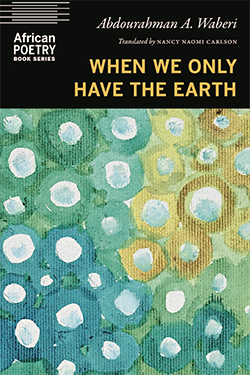
A Review of When We Only Have The Earth by Abdourahman A. Waberi, translated by Nancy Naomi Carlson
As Nancy Naomi Carlson points out in her translator’s note for When We Only Have The Earth, Abdourahman A. Waberi is a nomad. His poems depict restlessness which may be the result of his own mental and physical transience. This restless spirit, however, is deeply rooted in place. As the poems jump from location to location, such as Sicily or Virginia or Pennsylvania, the reader feels simultaneously rooted and uprooted. Waberi explores the fact that place is always within us and, therefore, is always part of the here and now. Furthermore, place only matters when we pay attention to it. Place is a universal human truth as well as a universal human need. Waberi draws our attention to the embodiment of place. “In Pennsylvania,” for example, reminds us that here is nowhere if we remain disconnected from people and place. Writing from “the middle of nowhere,” the narrator discovers in an email that his grandfather has died. Despite distance, these relations “radiate” to him.
Adding depth to this discussion of place, Waberi also questions why humans believe that heaven exists as a separate place from earth. His poems express the possibility that earth holds heavenly magic, power, and beauty. In a celebration of the imagination, “Open Air” directly addresses the poet. Moving through the marketplace, the narrator rejoices: “Mother was there, she/ Was mine/ She was the earth itself.” Moments later, however, this very same voice wonders “[w]ho would dare to write into the mineral night”? The poet recognizes inspiration in these busy human places. In response, the poet “ditches his certitudes” and unleashes the imagination which is “all attentiveness.” In the marketplace, the poet seeks and finds the recognizable touch of the miraculous nature that exists within each of us.
The problem, however, is that everything evolves. States of matter constantly change. As quickly as we recognize ourselves within the beauty, we have changed. Earth has changed. The story has changed. And still, the poet seeks to inspire us to imagine the celestial nature of earth, to “place a bit of green/ on our stony hearts” (“Sahel! Sa(y) Hel(lo)”). This collection laments the “surge in perils, tsunamis,” yet celebrates earth’s resilience and locates wisdom and the supernatural within her. “[T]he profound prayer erupts from earth” and demands attention.
The opening poem, “One Saturday in Virginia,” details an exuberant Bouvier des Flandres who hurls “himself against his master.” The dog returns again and again in ecstatic joy, “faith untarnished.” This spectacle humbles the narrator who finds himself wanting to locate such emotion in himself. The translator too must find language to match the scene. Carlson layers words such as splayed, delight, torn, cries, drinks, grows, trembles. The language engages the reader, acts as a conduit of emotion, and explores the explosion of sensory details. Astonishment follows. “I’m relieved/ And glad/ My whole body trembles/ Today’s the day I meet/ The Bouvier de Flandres/ I fear my reflection in the menhir’s mirror.” What seemed like a playful encounter with an exuberant dog has turned into a poem about the divine presence of the natural world. The dog wanders unencumbered by questions of mystery. The dog is. The dog is present. The dog connects. This punctuation-less poem realizes the mystery of the natural, returns our gaze to earth, but also invokes the supernatural. The unexpected menhir challenges us to question our own truths, a direct nod to the poet’s wandering imagination. Carlson’s careful attention to pace of the poem enhances its inevitable turn. The final line pauses in the present tense and rests in the humble experience of the unfamiliar, the unknowable, the ineffable.
Language becomes the pivotal site which directs the reader’s gaze toward generosity and beauty, toward truth. Language emerges as a place which enables poet and reader to bridge distant boundaries. As the poet instructs himself, he also instructs the reader. In “My Silence Told Me,” he writes:
Each time you want to see the light
Close your eyes
No speeches, no words
No imagination
Just close your eyes
The filmmaker said
Before leaving
For that high country
Whose silence is blinding
Ironically, Waberi calls for silence while also indulging the imagination. He demonstrates the tension between listening and speaking. A poet must first observe, interpret, understand, and then, speak. “My Silence Told Me” asks the reader to do the same. Silence is an action which enables revelation.
Waberi employs silence to discover unlikely connections. Playful lines and unexpected word choices might present a challenge to translators, but Nancy Naomi Carlson responds with wit, precision, and care. Carlson’s translations illustrate the ability to listen, an aspect of language that the poet holds dear. In the translator’s note, Carlson details vital elements of Waberi’s poems. Specifically mentioning “My Silence Told Me,” she writes, “variations of this title appear at least six times in the course of the poem, mixing past and present tenses.” This book is a conversation, an act, an invitation which culminates with the exclamation “O my body,/ Always make me/ A questioning man!” Waberi reminds the reader to remain open and Carlson echoes this reminder in the ability to listen, interpret, and express Waberi’s thoughts. When We Only Have The Earth prioritizes an openness that is both uncomfortable and necessary. It is here, in the place of being, of noticing, of listening, that one becomes. “Soliloquy” explains:
That’s how you find your place among men
By taking a stand, by approaching the heights,
By giving free reign to your reason
Which gets angry when faced with the thousand and one injustices
By suddenly deifying your humanity
By slipping into the red skin of gods
When the city burns again and again
Waberi’s poems plead, reason, celebrate, demand, and yearn. Waberi’s language is an act of noticing. Carlson’s translation completely captures the concerns and voice of the poet. The rest of the conversation is up to the reader
Alissa Simon’s writings have been published by the University of New Mexico Press, Public: A Journal of Imagining America, Meat for Tea; The Valley Review, Crosswinds Press, and others. She works for Harrison Middleton University and currently lives in New Mexico.
Recommended
A Review of Convergence: Poetry on Environmental Impacts of War

A Review of Stolen Flower by Irma Pineda, translated by Wendy Call