

A Review of Child of Light by Jesi Bender
When I was a kid, my dad worked at the Chapel Hill Mall powerhouse in Akron, Ohio. The place, to my young eyes, looked mammoth; made of brown brick and cement, this fortress, with its enormous door that could’ve been a contemporary portcullis, with its continual roar of machinery (I’ve never been anywhere so loud, not even concerts), with its rows of towering engines (dieselpunk incarnate), yes, this citadel, pulsing with energy, was probably intimidating to those who didn’t know its purpose. And maybe even to those who did. Me, since my dad worked there, I felt like I was connected to some sort of magic, though my dad taught me it wasn’t magic at all. It was electricity.
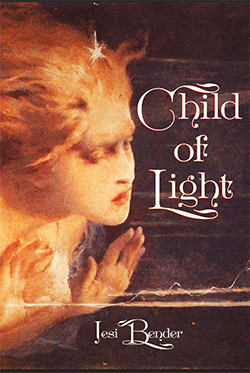
Ambrétte Memenon, the young protagonist of Jesi Bender’s beautiful, melancholic novel, Child of Light (Whisk(e)y Tit 2025), is also connected to electricity and, for that matter, magic (technically, mysticism), though her connections don’t bring her much joy. On the latter, her mom (hereon Maman) tells her that when some people are young they have the power to feel or even see the dead: “After we moved from Paris to New York, you were born. In the new apartment in Manhattan, you had just begun to speak, you started seeing two men—one named Daav and the other named Beneat. Men only you could see. Invisible men. You would talk to them endlessly in your small voice and wait silently for their reply.” But, as it turns out, only a few keep that power as they grow older. Maman, maybe showing her hand a little bit here, asks Ambrétte if she feels the presence of spirits anymore because “Nothing would make me happier.” Needless to say, Ambrétte wants to make Maman happy. But then is that all it is? Or can Ambrétte actually see the dead?
Papa is Ambrétte’s connection to electricity, the more (sure, why not?) grounded field. And whereas right off it might seem like we’re dealing with conventional gender roles (women are more mystical, men are more scientific), Child of Light takes place during the early days of galvanism, Utica, New York having just gotten their first arc lamps to light the streets, so to many this new force was as mysterious as wizardry. Bender therefore very purposefully puts Papa in the employ of none other than Nikola Tesla (who has become in contemporary lit a kind of sorcerer of science), not the fuddy duddy Thomas Edison. “Electricity is often thought of as being invented. But it wasn’t. It has existed as long as life itself. And, like life, we can only begin to imagine its beginning or predict its end. In the beginning was the word…” Couple a sentiment like this along with Papa’s belief in his own genius, having worked for two geniuses (Tesla and Lucien Gaulard, the inventor of the first transformer that could handle large amounts of power), and Bender definitely shows us that Ambrétte isn’t the only one who thinks they’re surrounded by mysterious forces that humans don’t quite understand…yet.
But whereas Maman is overly guiding (as in, if you can’t sense the dead, maybe I don’t care about you), Papa is distant. Like really distant, seeing as how Ambrétte, at first, only speaks English and Papa only speaks French. And he lives in his laboratory, which is just the barn out back. Well, okay, how about siblings, since the parentals and their ideas are off in the ether? Ambrétte does have a brother who she was friends with when they were younger: Modeste. But ever since Modeste became Georges, a name he picked because it’s “a powerful name […] An honorable name,” he’s mutated into a, frankly, conceited, sexist jerk. I must’ve misheard you when you said “honorable,” Modeste, I mean Georges. Anyway, full of himself because he makes the most money in the family (by building coffins), Georges pretty much believes whatever he thinks is the way things are, so everyone should fall in line. Lately, he’s noticed that Ambrétte isn’t spending nearly enough time preparing herself to be a wife and a mother, the only jobs fit for women, meaning she should drop everything that doesn’t help her score well on her MRS degree; so speaketh Georges from the late nineteenth century version of the manosphere.
So, Maman and Papa are titanic, but rather inaccessible figures, and Georges is darkness (and somehow, he only gets darker). Can’t a girl get a friend there in Utica? Actually, yes. Enter Celeste. “For little girls, their first loves are often their best friends—the other young person with whom they share their beliefs and wishes, the ones who hold their hand as they race together towards whatever may be in front of them. These romances are susurrated syllables, and full cheeks, and effervescence, and irrepressible appetite. It is sexless sweat and keen intensity. Amaranthine.” Not only is this a gorgeous passage, Bender treating us to so much lyrically beautiful prose throughout Child of Light, but that language delivers the heartwarming and endearing moments of Ambrétte and Celeste’s friendship, a refulgence of love in such a gloomy world. Separated at times for reasons I will leave up to you to discover, the two characters connect even more by writing stories to each other and leaving them in a tree hole, their creativity burgeoning, their confidence building, their fellow feeling mounting. Yes, Ambrétte and Celeste believe in each other, care for each other, even yearn for each other in the way Bender describes above. And soon we too want them to be together every time they are apart. Or, if that’s not possible, maybe there’s another story in the tree. I hope so.
Where will Ambrétte and Celeste’s friendship lead them? Well, with a character who is thought to have great powers, with Maman making connections with a group that can maybe help Ambrétte develop those powers, with Papa working for Nikola Tesla, and with Georges set to be a villain, it might sound like this is a superhero origin story. But anyone who’s read Jesi Bender can tell you, she doesn’t write superhero origin stories. In fact, she brilliantly plays with the fact that so many works of fiction use this exact form, even if the characters never appeared in or read comic books. So whereas the title here is Child of Light, Bender doesn’t shy from the darkness. She stares straight into it. Yes, some may come of age by having their innocence slowly eroded, but others are forcefully shoved into the horrors of the adult world. And horrors there are. In both The Book of the Last Word and Child of Light, neither of which are plot-driven works, Bender finds ways to shock me, the electrocution leaving me stunned, heartbroken, and thankful that such work exists. Yes, Bender’s prose is beautiful, but her true allegiance is to the sublime. Just like at my dad’s powerhouse, where, sure, the electricity lit the pretty lights at Christmas, but the constant earsplitting mechanical thunder likely made the benighted wonder, “What is going on in there?” or maybe, “Best just to avoid that place and pretend it doesn’t exist.” Jesi Bender doesn’t turn away, instead she explores the light and the dark. And we are better for it.
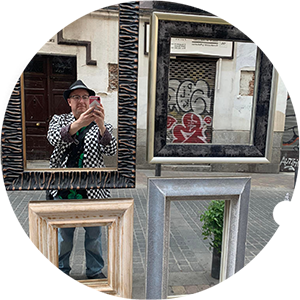
Andrew Farkas is the author of seven books and an Associate Professor of Creative Writing at Washburn University.
Recommended
A Review of Convergence: Poetry on Environmental Impacts of War

A Review of Stolen Flower by Irma Pineda, translated by Wendy Call