


A Review of How Can I Say It Was Not Enough? by Anne Kaier
“You never know what is enough,” says one of William Blake’s Proverbs from Hell, “unless you know what is more than enough.” Wisdom, thus conceived, requires excess. But what if an individual is denied this superfluity? Is the game over? Or can thwarted desire—let’s say, denial in excess—discover its own idiosyncratic trajectory and achieve, on its own terms, an appreciation of what is “enough”?
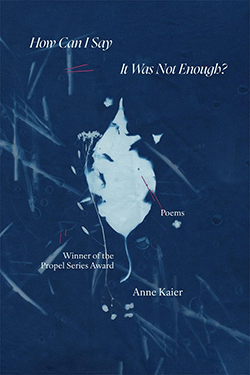
These questions animate Anne Kaier’s remarkable new collection of poetry How Can I Say It Was Not Enough? It is both a highly personal account of living with lamellar ichthyosis, a life-altering genetic abnormality, and a sensitive document of human yearning writ large.
Divided into five parts, these forty-four poems start with a section entitled “Skin.” Lamellar ichthyosis affects the skin, resulting in heavy scaling and, in the author’s case, a reddish hue. Born a “collodion baby,” she was encased in a shellac-like membrane which subsequently broke apart. From the beginning, the speaker in these poems is socially defined by her disorder. In “Portrait,” the insouciant child is unclothed, stripped down for the clinical gaze of a medical photographer; in “Praying,” she undertakes a trip to Lourdes and a quest for transformation, to become someone other than herself. In “Cossetted,” we are told that “Loneliness shrouds this child / she can’t beat it down.”
A harrowing poem called “The Dermatological Society Skin Fair” shows the speaker at a later stage in life, as an accomplished adult with significant personal and academic achievements behind her, who must endure nonetheless the voyeuristic gaze of doctors, including the asinine remarks of an intern: “You’re the star of the show! / The only full-body case.” This reductive observation hurts all the more because she’d “hoped they’d recognize the real, throbbing me.”
Kaier takes the reader into highly personal territory, and zeroes in on subjects that are often left unsaid. “Can’t Tell” and “Saturday Night” are frank and eloquent poems of unsatisfied sexual desire. “Shore Bird” describes an unfulfilled longing for motherhood:
“Nothing I can ever do,
Nothing,
equals the pure fact of childbirth;
nothing.
I’m a shore bird.
The great currents
merely tongue
my feet.
In these examples and others, the speaker has not known Blake’s “more than enough” but this denial seems to heighten her sensitivity. She doesn’t have the luxury of taking certain common experiences for granted.
Structurally speaking, other sections of the book (“Mother Love,” “Family Clutch,” “Lovers,” and “Death Songs”) respect their themes as well as a broadly chronological approach. Kaier’s free verse adopts a conversational register that, upon scrutiny, is more precise and probing than any ordinary conversation. She eschews tricksy enjambments, and her stanzaic divisions function as units of thought, avoiding the pitfall of much free verse that sometimes feels less like poetry than chopped-up prose.
The speaker’s mother looms large in many poems. In “The Dressing Table,” she is described as a “practicing beauty” who evinces a classy glamour. In “After the Golden Afternoon,” she asserts: “Oh, I turned heads. The boys flocked around.” This confidence in her appearance is both an asset and an impediment to awareness. The poem “Mother Love” refers to a time when the KKK was burning crosses and targeting other Catholics in her community, but she felt safe because “she knew they wouldn’t hurt a pretty girl.”
This complacency is out-of-reach for the speaker, who describes herself in “When All Is Said and Done: Mother at Eighty-Five” as a “strange disordered daughter.” Her mother sips wine and reminds her that “I could have let you die of your disease; / no one would have blamed me.” How Can I Say It Was Not Enough? charts a lifetime of troubled love and hurt, and eventually, acceptance. In “Mothers and Daughters,” the speaker ruefully observes,
Perhaps I’m learning how to tell the truth
and still survive it.
Kaier writes warmly of sibling love and about a cherished nephew, while “Madame X” is an excellent ekphrastic poem about a painting by John Singer Sargent. There are also sharply observed poems rooted in place, such as “Seashore Town,” “To the Garden,” and “When Mother Sells the Family Home.” In one of my favorite poems, “Come Kiss Me Like Oranges,” Kaier channels a Robert Herrick-like simplicity. It begins:
Come kiss me like oranges, kiss me.
Kiss me with your dark unruly hands,
your azure earring falling on my cheek,
your myth in my mouth: come
kiss me.
The title of the volume comes from a love poem called “Haven,” in which the speaker is both included and excluded, and is longing for more. The phrase how can I say it was not enough is effectively ambiguous: It can be an expression of frustration or a rhetorical question implying affirmation. And this captures the overall “feel” of the book.
In “All Souls,’” another very strong poem, the speaker looks back on her life and her lost loved ones with such tenderness that the sober subject is transformed into a feeling that can still, however fleetingly, offer comfort. In “Requiem,” she refers to “an ancient flowing grief / larger than our single selves.” This comfort and this grief, which are briefly enough and ever too much, are the core qualities of Kaier’s work.
How Can I Say It Was Not Enough? shows how confessional poetry, in the hands of an accomplished artist, respects the integrity of an individual self while shedding light on what it means more generally to be alive.

Charles Holdefer is a writer based in Brussels. His work has previously appeared the North American Review, New England Review, Chicago Quarterly Review and elsewhere. His latest book is Ivan the Terrible Goes on a Family Picnic (2024).
Recommended

A Review of Convergence: Poetry on Environmental Impacts of War

A Review of Stolen Flower by Irma Pineda, translated by Wendy Call