

Building from the Rubble: On Rose McLarney’s Rubble Masonry
The word rubble evokes the long echo of rupture. Its roots travel from the Middle English rubel—broken stones or debris—to the Latin rūpēs, meaning cliff, rock, something cleaved away from its wholeness.
But within those short syllables resides something quieter: what remains standing after the break. Rubble is not merely the wreckage of structure; it comprises the unchosen archive—each fragment keeping the record of what resisted collapse. To speak of rubble masonry, then, is to speak of building from the scattered fragments of history—assembling the leftovers of time into something load-bearing, something honest.
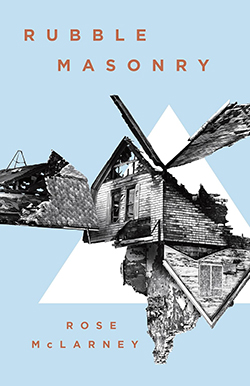
Rose McLarney’s Rubble Masonry enters this etymological lineage with lyrical precision and with writerly tools borrowed from the archeologist, the geologist, the ethnographer, and the historian. The collection moves outward from a cemetery survey into a wide terrain of inquiry—family letters whose replies are lost, Appalachian houses whose architecture conceals older histories of slavery, contested public monuments, eroding southern landscapes, and botanical puzzles that blur the boundaries of kinship and classification.
From its opening pages, McLarney insists that history is less a finished structure than a geological condition. We’re required to read what remains, not what we wish to find—and not what we may once have thought was always there.
It is no accident that such attention arises from the Appalachian landscapes McLarney has long written from—places where history, ecology, and labor remain visibly stratified in the ground itself, and where the smallest environmental shifts register as cultural ones.
Early on, we are given a directive: “Study the tombstones and make no changes or assumptions regarding missing or seemingly erroneous text.”
In the opening essay, “Instructions for Conducting a Cemetery Survey,” McLarney volunteers to catalogue a rural graveyard, recording partial names and eroded dates while resisting the impulse to reconstruct what time has worn away. The rules of the survey become a moral method: observe precisely, but refuse the consolations of invention. More than an archival instruction, the line offers an ethical stance—to bear witness without smoothing the past into narrative shape, to stand in the rubble and refrain from reconstruction. As the essay quietly reminds us, the act of looking outward eventually turns inward: “And turn the mirror to my own face.”
Throughout, McLarney returns to the question of what it means to name, measure, and classify—and what it costs to do so within a human lineage. In “Weights and Measures,” an essay that begins at her grandfather’s burial and wanders through the world of horse racing, she studies the strange economies of weight that structure both sport and culture. Jockeys purge themselves to ride lighter horses; women learn to discipline their bodies into the narrow margins of acceptability. “I’ve worked at getting nearer gone, she writes, running myself too thin to win.” Here sorrow and lucidity abide in partnership, dismantling the idea that endurance must also perform elegance. The body becomes documentary evidence, the field on which cultural pressures etch their marks.
The landscapes McLarney writes from—those of Southern Appalachia—are never merely scenic. They are stratified terrains where ecology, labor, and history remain visible in the ground itself. In “Storied,” she turns her attention to a once-admired architectural form known as the I-house, tall narrow dwellings that appeared across the mountain South in the nineteenth century.
What begins as a meditation on buildings from her childhood gradually opens onto the deeper histories those structures conceal: slavery’s expansion into the region, the quiet hierarchies encoded in domestic space, and the uneasy inheritance of land and belonging. Standing before one such house, McLarney arrives at the question that quietly governs the essay: “So what can I come closer to calling mine—what must I claim?”
Standing outside one abandoned house, McLarney realizes that even the structures she once admired are historical documents. They reveal not only how people lived but how power settled itself into the landscape.
The book’s historical reach becomes especially vivid in “Circling,” an essay that begins with a proposed public sculpture in McLarney’s North Carolina hometown—three women representing the region’s intertwined histories: a Cherokee woman, an enslaved Black woman, and a white settler.
The monument’s organizers intend the figures to symbolize shared inheritance, but McLarney follows the uneasy debates surrounding the project: the incomplete archival records of the women’s lives, the political uses of public memory, and the fraught proximity of stories that do not easily reconcile. “It is an enormous question for some human-sized pieces of metal to raise,” she writes while tracing fragments of the historical record—receipts, family papers, local accounts—the essay becomes less about the monument itself than about the difficulty of representing the past without smoothing over the violence embedded within it.
What emerges is one of the most precise and tender meditations on place, ancestry, womanhood, and inheritance in recent American nonfiction—a work that does not rebuild the house but teaches us how to inhabit what remains.
Elsewhere McLarney turns toward botany. In the multipart essay “A Lily Is a Lily Is a Lily,” she braids botanical taxonomy with a meditation on female kinship and inheritance. The distinctions botanists draw between true lilies and their look-alikes become a way of thinking about resemblance and difference within families—between cousins, sisters, and daughters whose lives diverge even as their histories remain entangled. As McLarney herself acknowledges, “I can interpret nature in ways that bolster my spirits and choose which components to make my similes.” Scientific classification becomes another language for the book’s central question: how do we name what binds us to others without simplifying those ties?
Taken together, these essays practice a discipline of attention.
McLarney assembles knowledge from what survives—letters without answers, houses whose meanings shift over time, monuments that cannot reconcile the histories they represent—treating landscape, archive, and body alike as incomplete records. Whether she is cataloguing gravestones, tracing the architecture of Appalachian houses, examining the economies of the body, or weighing the stories told by public monuments, her method remains the same: to look closely and to resist the temptation to resolve what history has left unresolved.
This cautious stance aligns McLarney with the practices of her father, a biological surveyor who returns to the same Appalachian streams year after year, recording subtle changes with patient devotion. He values knowledge for the sake of knowing, she writes—information as testimony to observation, to the slow accumulation of fragments from which understanding is built. Her book quietly proposes something quite radical: that scientific taxonomy and lyric memory are not opposing impulses but neighboring disciplines, each requiring a fidelity to what can be seen.
Such precision reaches its pressure point in a central question: “So what can I come closer to calling mine, what must I claim?” This question—posed amid the fractured legacies of land, labor, Southern architecture, and displacement—feels like the place where the entire book hinges. In it we hear not a plea for ownership, but an appeal to the gods of calibration: how does one stand inside history without falsifying one’s position within it?
The singular achievement of Rubble Masonry lies not in any attempt to mend the past but in its refusal to falsify it. McLarney builds not by smoothing the stones, but by allowing them to remain—let’s call it—honest.
These essays invite us to see like surveyors charting unmapped ground, to question like historians brushing dust from ruins, and to recognize how the smallest detail might break our hearts open and alter what we think we know about the past.
What emerges is one of the most precise and tender meditations on place, ancestry, womanhood, and inheritance in recent American nonfiction—a work that does not rebuild the house but teaches us how to inhabit what remains. Here restoration gives way to something steadier: a kind of ground—rūpēs once more—where cliff edge and foundation become indistinguishable, and where truth still has somewhere to stand.
Rubble Masonry extends this discipline of attention across borders, languages, and landscapes. In doing so, it connects her not only to the environmental writers of the American South, but to international counterparts whose work shares a similar moral stance: to observe without claiming; to listen without repair. Again and again, her voice returns to what resists haste, reminding us that “to counter ash and mud, I can say bedrock and flashes of creatures under water.”
She belongs, in this sense, to the quiet lineage of the Irish surveyors of land and loss—Tim Robinson walking the stone edges of Connemara, Michael Viney returning year after year to the same tidal inlet, both believing that the smallest changes are large enough to matter. Their work, like McLarney’s, suggests that to care for a place is to relinquish hurry. To show up again. And then again. McLarney writes from that posture of return, allowing even absence to become a form of presence: “What I get are a small box of strangers’ questions and the gaping blanks.” The blank, in her hands, is not failure—it is terrain.
At moments McLarney’s thinking recalls writers such as Rebecca Solnit and Robert Macfarlane, who read landscape as an archive of human history. Yet her orientation is quieter. Where Solnit often maps absence and Macfarlane descends toward geological depth, McLarney kneels beside what remains immediately at hand. She offers no grand interpretive key—only the humility of observation: “The pieces of stories I have collected are not equitable, their weights do not balance each other, they do not add up to a clear end.” She wishes to stay beneath the surface long enough for the unsayable to begin to hum. McLarney knows that our verities, like our lives, are composed of fragments—the only building blocks we are given.
Eliot’s line, “These fragments I have shored against my ruins,” may sound like an act of defense—but in McLarney’s work, the gesture reverses: she herself stands inside the rubble and refuses the salvific arc. More than archival instinct, it becomes an ethic: to honor the scatter without pretending it can be reassembled. What remains, then, is not the impulse to rebuild but the practice of attention: to show up among the ruins, unarmed, and stay there long enough that the fragments speak.
McLarney’s work moves easily beyond the boundaries of region or literary school. She stands within a constellation of ethical observers who build from what is left, allowing the fault lines to remain visible and precision to become a form of tenderness. Her prose suggests that care may be cartography’s plumbline—that ruin may hold the most accurate record, and that what persists, if regarded closely enough, might still offer orientation.
As one essay concludes, with almost prayerful clarity: “Daughter, wherever you come from, embark from here—.”
And perhaps that is what Rubble Masonry finally proposes: that the unchosen remnants of history, studied with patience, may still carry the shape of home.
Jeffrey Levine is the founder, Artistic Director and Publisher of Tupelo Press. A poet and essayist, he is the author of several acclaimed poetry collections and the recipient of twenty-seven Pushcart Prize nominations. In addition to his editorial and publishing work—where he annually shepherds eighteen books into print and oversees a national distribution partnership with the University of Chicago Press—Levine teaches poetry seminars, consults with nonprofit literary organizations, and is widely recognized for his exacting editorial guidance, his devotion to emerging writers, and his ongoing exploration of lyric craft, attention, and moral imagination. He reviews regularly for Southern Humanities Review, LARB, On the Seawall, and Tupelo Quarterly, among many other venues.
Recommended
A Review of Convergence: Poetry on Environmental Impacts of War
A Review of Stolen Flower by Irma Pineda, translated by Wendy Call