


A Review of Abiding Time by Robert McNamara
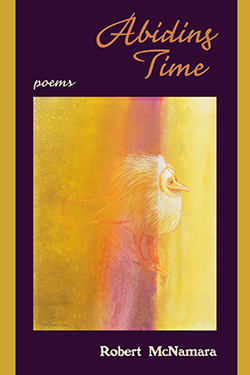
Poetry for Robert McNamara is often a bridge between the quiet wonder of the everyday in the modern world to precedents from the past, linking the experiences he writes about. In his latest book, Abiding Time (Lynx House Press, 2024; lynxhousepress.com), his work shows how “abiding” reveals time to be an element that not only endures but also one that can and must be endured. And, considering an archaic/poetic definition of “abide,” something that can be resided in like a world made for the writer that the writer also makes.
In a poem about setting up camp on a beach only to have strangers intervene to rescue a family’s gear by moving it above the flood line when the tide comes in (“Shapes of Water”), he uses this incident to invoke the time he “coughed awake in a lifeguard’s arms” and then goes on to bring in Narcissus, Actaeon, and Diana as earlier, mythical figures who also had iconic encounters with water. In this way, he shows that myth parallels and connects our lives to those that came before, even those we’ve only imagined.
In dealing with the contemporary death of a marine by IED in “Another Neighbor,” McNamara reminds the reader of the long history of warfare: “Spring rustles up the Latin in the leaves,/dulce et decorum est—/susurrus of his neighbors’ love.” These lines also demonstrate the writer’s sure feel for the poetic possibilities in the language: the l’s of Latin, leaves, dulce, and love; the s’s and r’s of spring, rustle, susurrus, and neighbors.
McNamara’s affinity for formal verse appears in many of these poems, though his subtle touch never makes the structure impede the poem’s progress, instead adding to its depth. He seems to maintain that such architecture enhances and concentrates the impact of the piece. “Venetian Villanelle” is a good instance of this. Taking a poetic framework that’s been used for centuries, he imparts a scene that could be either contemporary or from the past, though written in present tense. A mother visits a church to light “a candle for her harrowed son.” In the church also is an icon of St. Mary, “our second Eve,” which duplicates and reinforces their bond of motherhood, as the reference to Eve connects them both even further back in time.
In a kind of sonic echo of this multiple presence, McNamara’s uses different meanings for the word “match.” First is the common one: to light the mother’s candle, “[o]ne already lit supplies the match.” A metaphorical one follows: “Someone’s loss will be her match.” In answer to this, the poet states: “We are Croesus rich/in grief, God knows, having lost a son.” But believing that even God’s son returned, the mother asks her own son “to be a perfect match.” The references to Eve, St. Mary, and Croesus braid the past into this more contemporary scene, just as the use of the villanelle binds the sense of devotion and loss from ages ago to our own.
Just as he doesn’t consider the use of formal verse to be a straitjacket on his imagination, McNamara also isn’t a writer who believes having a sense of humor is detrimental to serious poetry. His “Ballad of My Lucky Day” uses the pantoum form to recount the persona (a “long-haired hippie kid”) being accused by a woman of lurking and “prowl[ing] around.” This brings a trio of cops, one of whom argues for taking the accused in, despite him telling them he was “[j]ust walking Union Square to Stuyvesant Town.” It seems he’ll be hauled off when suddenly the woman yells “at some poor bastard walking down the street…It’s him, that’s him!” This confusion finally convinces the cops to let the “hippie” go. But what seems mainly a comedic tale ends on a more somber note: the persona “trundle[s] home, beaten and ashamed,” admitting “It took me a fearful month” to “let it go.”
“Bear on the Beach” also mixes a touch of comedy into a potentially dangerous situation, demonstrating that McNamara understands even the most serious incident can contain humorous facets. The encounter of the speaker with the bear, though scary, remains non-lethal. And when a cub appears, “frisking along the swash behind its mother,” the speaker acknowledges the urge for natural harmony encourages the conclusion that “[t]his will be love’s memory of the day.” But the full truth requires a different evaluation: “Your picture tells another story.”
The hold of time through history and remote landscapes for McNamara braid into many of his poems, showing his belief these apparently distant components live in the modern world and are integral to his vision. “Calcutta Calling” and “Foreigners” place the speaker, respectively, in awkward physical and social settings. Like rough edges of different eras, the friction of older cultures and unfamiliar terrains with his own produce an uneasiness that forces him to look more closely at them, making him learn to accommodate and so become more at home in them. A prime example of McNamara’s art is “An American in Venice,” which returns the speaker to the city that his work establishes as a center for his imagination. Though the scene opens with “No headroom in our attic,” the reader is immediately presented “with an archer’s view/through a cereal-box window of the sun-spangled/Bacino di San Marco and the dream// of buoyant stone.” In these few lines, we have the modern allusion to a cereal box woven into a view of Saint Mark’s Basin and a dream with a seemingly contradictory image: “buoyant stone.” But the dream is anchored in reality: “It sits on a forest/inverted, trunks driven shoulder to shoulder/in mud, a thousand years becoming stone/beneath the stone.”
McNamara sees “[t]his city of loot” as one fully entwining the past and the present. “A cruise ship looms—King Kong on the Empire State” pulls the reader abruptly into the modern period with a giant vessel and an allusion to the great beast attached to the iconic New York building, two features at severe odds with the romantic world of canals and gondolas. The poem continues to alternate old and new elements: the Bridge of Sighs with “a black-ice pile-up/of tourists in photo-interruptus,” “Daedalus dreaming of a pale/chimera leaning from St. Mark’s” with “the usual clutch of children/playing in a campo,” and “visions of kayaks and jet skis zig-/zagging canals and streets/become canals” with “O city my cities!/Venice Calcutta New York—/drowning.” This last juxtaposition brings the reader to the current, grim prediction of climate change and water levels rising around the world. McNamara concludes the poem with the recognition that, given how ephemeral we are compared to the planet, “We haven’t done a thing and then we’re gone.”
But despite this apparently grim summation, by writing in such an imaginative, clear-eyed fashion about this world and the composite of time and the living beings it has contained and will contain, McNamara effectively argues that bringing it all to life through language is doing something of true weight and worthy of praise.

Michael Spence’s latest book, Umbilical (St. Augustine's Press, 2016), won The New Criterion Poetry Prize.
Recommended
A Review of Convergence: Poetry on Environmental Impacts of War

A Review of Stolen Flower by Irma Pineda, translated by Wendy Call