


A Review of Apostasies by Holli Carrell
I came to poetry as an escape hatch to perfectionism. I’ve blamed many things for my relentless need for flawlessness, but mostly, I’ve blamed Mormonism. This warped abhorrence of the humanness of being human cannot be reduced to one source, but in my calculated deflections, I often place it at the feet of my childhood faith, a faith that promotes and rewards perfectionism, a faith I’ve left. I came to poetry for its blemishes, its celebration of them, the art it makes of tension between what is real and what is expected, the ways it sits in that tension, plays with its grains, leaves its wrinkles wrinkly.
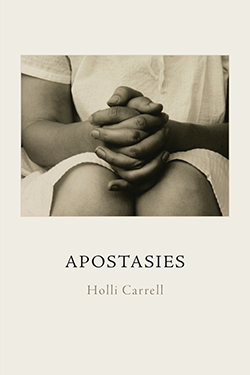
When I first heard of Holli Carrell’s poetry collection, Apostasies (Perugia Press), I admit, it was an ugly twinge of jealousy that drew me to it. In the highest degree of Mormon heaven, there’s room enough for everyone (as long as you’re Mormon). In poetry, was there room enough for more than one? In my few short years as a serious student of poetry, I have encountered what feels to be an enormously disproportionate number of ex-Mormon poets. And in reading Carrell’s collection, it was immediately evident why—we are all recovering perfectionists. Poetry is not the only antidote, but it is a good one.
Carrell begins as every Mormon testimony begins, with the first vision of Mormonism’s first prophet, but from the first moment, Carrell makes clear that the concerns she will go on to circle in one trenchant poetic exploration after another lay outside the validity of the faith’s cosmic claims. “We all have visions; / we’ve all cried out in the woods.”
Carrell’s poems explore, more interestingly, what happens when men make themselves Gods. There are many men who appear in Carrell’s poems: fathers, local lay clergymen, historic Mormon prophets. These men are positioned as flesh made God. In the world of this collection, these are powerful beings of self-aggrandized knowledge. Yet unlike the Gods humans tend to worship, these man-Gods are fully embodied. Meanwhile the women in the collection—the speaker, her pioneer ancestors, the polygamist wives of early Mormon leaders—these are distinctly disembodied, and the closer they draw to the institution, the less rooted they are in a sense of self. These poems play a devastating game of hot-and-cold with selfhood, and Carrell is brilliant in her recreation on the page of what that game feels like from both inside and outside the body.
If the girl could think
in metaphor, she might
equate her body to
paperwork.
Over and over again in this work, I was struck by Carrell’s careful conjuring of Mormon oddities I have long suppressed—people as paperwork, for one, the enormous weight placed on gendered clothing for another. In the poem “WOMANHEDE” these strict dress and grooming standards are a vehicle for disembodiment, a reality I myself lived and have relived as I’ve explained to many a shocked friend that wearing pants to church as a Mormon woman was a potent an act of rebellion.
The flock watches and monitors.
The flock always watches
and monitors.
The girl spinning in the dress drops.
Divested,
she is only
her mind and limbs,
henceforth.
Mind and limbs only—the precise and piercing words for what I longed for as a human being striving to be a translated Mormon vessel of perfection. The body below the mind, the body between the limbs, was always seen and felt to be an obstacle to that perfection. Like me, like so many Mormons past and present, Carrell’s speaker is left wanting, a watery apparition of a self, dripping wet from a coerced baptism labeled an act of agency into a narrow and singular life.
Her body is raindrops
outside of her;
raindrops on the window glass, outside
of her.
In the innocent and believing child-mind, which Carrell captures so acutely, Carrell’s speaker is curious but without control. She probes the world of her religion while simultaneously holding firmly to its inevitability. In “SACRAMENT” the speaker moves through the poem in earnestness as she sits in a congregation of Mormons. If something amiss is detected in this world, it is given that the untouchable institution of the faith could not possibly be its source. If something feels wrong, then of course, something must be wrong with the detector. It is self-abandonment in its most practical, matter-of-fact form.
There is no performative perfection in this work. There is only recognition, and its accompanying relief, in the echoing cracks of the voice.
“She understands they are good / and she is not.” This too felt familiar to me: internal resistance, doubts, and questions presumed as being the faults of the self, never the faults of the institution, never the faults of the untouchable prophet.
Anchored in the middle of Carrell’s collection is a lyric essay titled “PATTERNS” about Mormon polygamy that serves as the collection’s shift from disembodiment to embodiment, moving the speaker from conflation with the faith’s rigid constructs of gender toward a place of distance from the grasps of manipulation, a distance just great enough for a rehabitation of the self to be made possible.
Maybe I want to baptize myself in the facts, the poem which will not poem.… Maybe I want to remember my own indoctrination clearly defined and solid and felt as a bowler hat but the indoctrination is inseparable from me.
The essay braids together the graspings of a palimpsest Carrell with first-person quotations from the secret wives of Mormon founder and self-proclaimed prophet Joseph Smith, and also with clinical terminology—for narcissist, authoritative ruler, sexual grooming, etc.
Lucy
(Wife 17)
How could I speak, or what could I say?
Every feeling of my soul
revolted against it.
Carrell questions her own intentions in this leaping and landing essay, its braid building a subtle case for the subjugation and malice at the heart of this hidden corner of Mormon history, one still hidden from many contemporary Mormons by the church they think they know. In an intentional rebellion against perfectionism, this essay’s conclusions are not to be found. And yet, when the collection shifts from this essay into its final selection of poems, something has shifted also in the speaker. The speaker is getting warm, warmer, and warmest still. The speaker is increasingly and decidedly her own.
In Carrell’s stunning collection, in all my personal stake in its explorations, it is the visible seams of these poems that I find most moving. The stitching has not been tucked away, made invisible. There is no performative perfection in this work. There is only recognition, and its accompanying relief, in the echoing cracks of the voice.

Samantha Strong Murphey has an MFA in poetry from NYU’s Writers’ Workshop in Paris. Her work has been supported by the Bread Loaf Writers’ Conference and Vermont Studio Center. She teaches creative writing at UT-Dallas and her poems appear in Rattle and the Crab Creek Review.
Recommended
A Review of Convergence: Poetry on Environmental Impacts of War
A Review of Stolen Flower by Irma Pineda, translated by Wendy Call