

The Translation of Feminism/The Feminism of Translation: A Review of Naoko Fujimoto’s Of Women
What do translation and feminism have in common? For starters, we might think of both in the plural: translations and feminisms.
As a literary art, translation is a contested craft, often characterized by an argument between what we might call “originalists” vs. “historicists” (to borrow from constitutional scholars). The goal of the former is to be as literally faithful to the original as possible, while the goal of the latter is be as artful as the original, that is, free to make adaptations for new contexts, to be the reader’s guide to and from a portal between a past, and/or an elsewhere, and the reader’s here and now. Between the opposing poles, we find not so much a continuum as a constellation of qualifiers: source-focused, authorial-intent focused, semantic, communicative, audiovisual, and so on.
As a political movement, the word feminism in English calls to mind historical waves, especially the Second Wave in the 1960s and 70s in the United States, with its emphasis on agency, choice, and equality of opportunity in a capitalist, yet supposedly democratic system. But “feminism,” as Katie King argues, “travels” and, in its plurality, takes on qualifiers such as eco, queer, Marxist, ludic, intersectional, postcolonial, and postmodern, including Hélène Cixous’s and Luce Irigaray’s hotly debated écriture féminine.
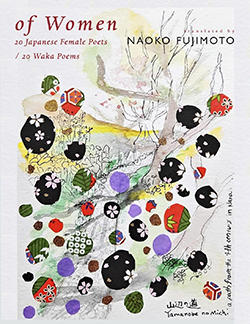
Naoko Fujimoto’s stunning new collection, Of Women, is a work of translations, plural, which balances attention to the “original” with attention to the twenty-first-century reading context. As an Anglophone reader with more ignorance than knowledge of Japanese literary and civic history, I also make sense of the collection as attending to many feminisms, plural. Of Women introduces Anglophone readers to twenty Japanese poets from the seventh to twelfth centuries, whose preferred form is the waka, composed of 5-7-5-7-7 Japanese syllables, as Fujimoto explains in her helpful introduction. For each poet, Fujimoto gives us five versions of one poem, one of which is the original, plus a quick summary of that poet’s biography and historical context. Four translations, that is! The word waka may be variously translated as “Japanese,” “poem,” “song,” or “harmony,” so the phrase “Japanese waka-poem” is itself tautological in its attempt to communicate with an Anglophone audience.
For each poet, the first version is a brief prose poem which gently guides the reader in the direction of the original by translating it, very, very loosely, into Fujimoto’s neo-confessionalism. The second is an English language version of the original waka that generally eschews the strictures of syllabic line, makes use of intentional white/blank space, caesura, enjambment, the diction, wordplay, and the sounds and rhythms of twenty-first-century American English. Together, the first and second combine to create a new type of haibun (the traditional haibun is a prose block, usually about a journey, followed by a haiku).
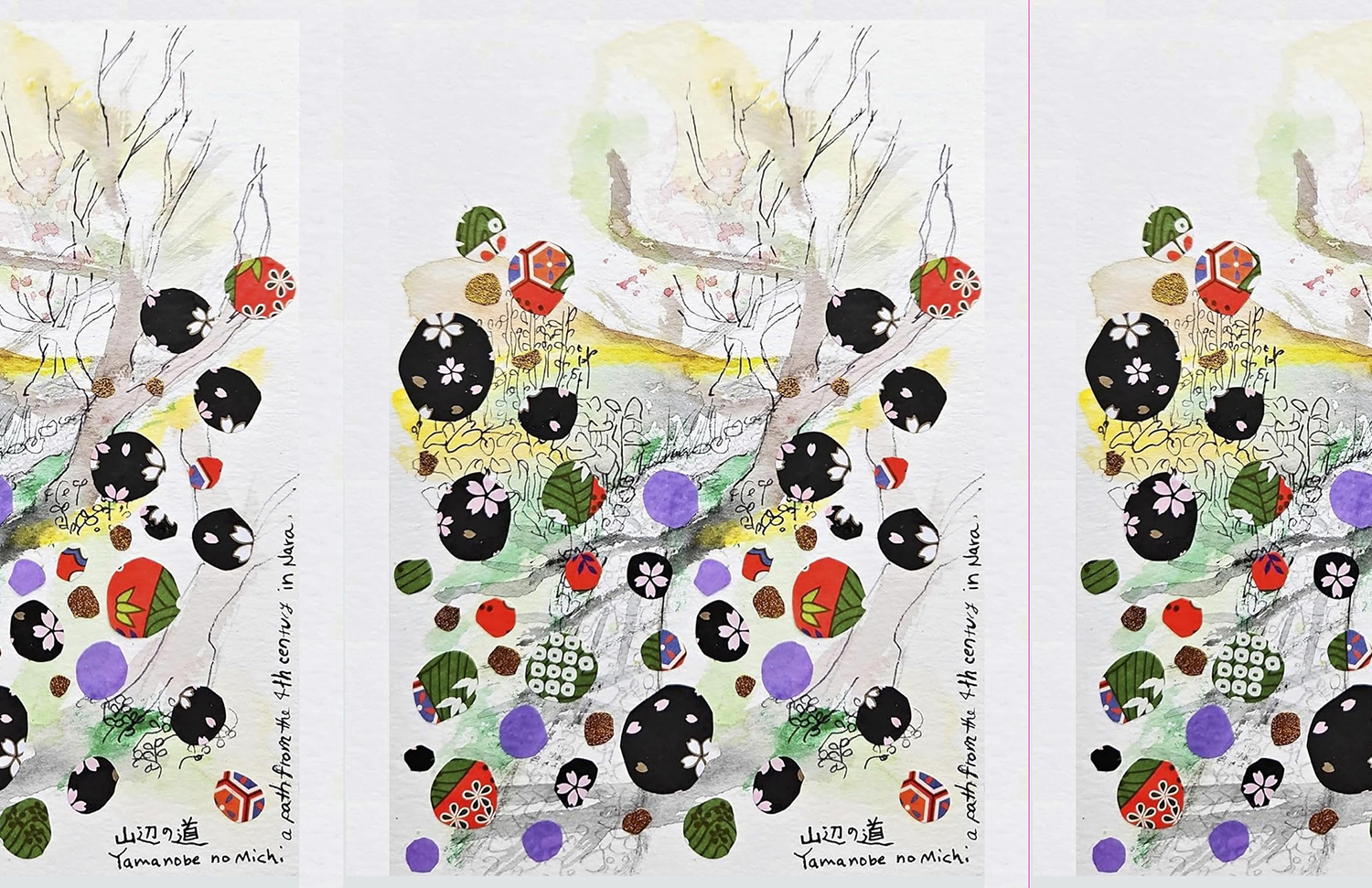
The third version is in the signature style of Fujimoto’s highly acclaimed graphic poetry (see her collection Glyph, Tupelo Press, 2021), with an emphasis on visual collage that straddles the representational/abstract line, suggesting both external landscapes and internal emotion-scapes. These pages are some of my favorites because of the speed and immediacy with which they grab my attention. One might approach this whole collection non-linearly, flipping through to take in the visual gallery and then helicoptering in to spend more time on individual poets.
The fourth is a transliteration of the original waka so that Anglophone readers might try to make the sounds in their own mouths, experience the rhythm of the 5-7-5-7-7 syllabification, and, overall, attend to the pleasure of language in its materiality. The fifth and final version is a reproduction of the original waka in the Japanese script that the twenty poets used, a thing of visual beauty. For non-speakers or readers of Japanese, these last two are both a restoration of the original and its opposite, an emptying-out of the original until all that is left is the materialist enjoyment of sound, rhythm, or brushstrokes—that is, now, digital font.
With the publication of Of Women, Fujimoto joins the field of … women translating canonical and neglected works into English for twenty-first-century readers and, in the process, reinventing both “translation” and “feminism.”
Let’s spotlight a few examples. The opening poet in the collection is Sei Shōnagon, but also, and always, Fujimoto too. The visual translation is a dazzling and colorful (gorgeous blues predominate) maze of vertical and horizontal, thin, rectangular strips of paper, which I read as walls, fences, and hard, right-angled barriers, but also, paradoxically, as infinite openings into turns, passageways, paths, and interstitial spaces. The only text embedded in the image is the equivocal, “I might”!
Reading backwards to the previous page, the speaker in the prose block declares:
A wall is something I build when I see you, it does not matter what type of seal. I draw one, too—a silk curtain, a paper screen—and close it. Shut it hard. I hate the noise of unfitted sliding doors. I don’t track where you walk from the corridor to the room. I do not want to sink into your smell. I refuse your voice. I have enough—
The waka that follows doubles down on the speaker’s power to make decisions and erect boundaries, if imperfectly, if with lingering doubts, but never in response to the addressee’s commands or control of her. The speaker retains the right to equivocate:
maybe I was short-tempered,
I was wrong—
perhaps
I might
like you.
To compare and contrast, for the entry on Taikenmon'in no Horikawa, the visual art again is a collage of colorful and thin strips of paper. But here the colors are a hotter, more dis-regulated combination of fire engine red and sour apple green, among others, and there are diagonal strips which bisect, dis-regulate, and mess with the horizontal and vertical attempts at order. The only text embedded in this image is the terse, but agonistic, “I don’t know.”
Backing up, again, I find this discomfiting epistemological crisis echoed in the prose block, but now in more sensuous terms, and ones that imply more reliance on the lover to offer resolution, rather than the speaker’s choice:
I breathe. I soak my finger in porcelain. Camellia oil turns amber on my boxwood comb. I trace the flower engraving on it. I breathe. Mornings, I brush my hair. Last night, you came. My hair weighed on your shoulders. Now I forget to breathe and brush.
The layout of the waka that follows is more straightforward, with the gap leaving the speaker in an endlessly enjambed predicament:
My long black hair tangles
so does my heart-kokoro [BV1] is distressed
will you seek me forever and ever after this I don’t know
All this is exciting, energetic stuff. With the publication of Of Women, Fujimoto joins the field of Izadora Angel, Mary Jo Bang, Anne Carson, Lydia Davis, and Emily Wilson—women translating canonical and neglected works into English for twenty-first-century readers and, in the process, reinventing both “translation” and “feminism.” The title, Of Women, initiates the reading experience with the plural women and the deceptively complex preposition, of, which, contextually, can mean “by,” “about,” “from,” “having to do with,” “belonging to,” “possessed by,” etc.
Like confronting a Mad Lib, I also begin and end reading this collection by shifting the word of back into lower case imagining the word Poems or Poetry to fill in the blank that precedes “[of] women”: Poems by Women (with a focus on women as writers/authors), Poems about Women (which we often assume are written by men, but we could be wrong), Women’s Poems (which suggests something essentialist, if not derogatory, about the way women write, like the derisive colloquialism, “chick flick”). But I can imagine other blank-filling words as well: the Lives [of Women], the Social Positions, the Desires, the Ambitions, the Choices, the Grief, the Restrictions, the Competitions, the Differences, the Debates, the Genius, the Inventions—now, go out and read Naoko Fujimoto’s Of Women, and decide for yourself.

Virginia Bell’s poetry collections include Lifting Child from the Ground, Turning Around (Glass Lyre Press 2025) and From the Belly (Sibling Rivalry Press 2012). Bell won NELLE Magazine’s Nonfiction Prize in 2020 for the personal essay, “Chicken,” and her poetry won Honorable Mention in the 2019 RiverSedge Poetry Prize, judged by José Antonio Rodríguez. Her work has appeared in New City Magazine, Five Points, Denver Quarterly, SWWIM, EAP: The Magazine, Hypertext, The Night Heron Barks, Kettle Blue Review, Fifth Wednesday Journal, Rogue Agent, Gargoyle, Cider Press Review, Spoon River Poetry Review, Poet Lore, The Nervous Breakdown, The Keats Letters Project, Blue Fifth Review, Voltage Poetry, and other journals and anthologies. Bell is Co-Editor of RHINO Poetry and teaches at Loyola University Chicago and Northwestern University.
Recommended
A Review of Convergence: Poetry on Environmental Impacts of War
A Review of Stolen Flower by Irma Pineda, translated by Wendy Call