

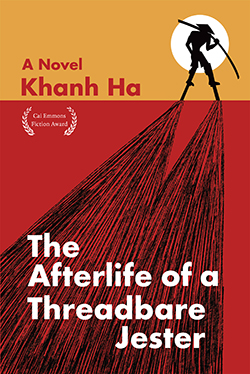
A Review of The Afterlife of a Threadbare Jester by Khanh Ha
“To trace a man’s life from reveille to retreat…” writes Khanh Ha in The Afterlife of a Threadbare Jester, winner of the 2025 Red Hen Press Fiction Award. “Not one day in his life … but five thousand four hundred and seventy-nine days—four leap year days accounted for.”
For many Americans, the memory of Vietnam stops somewhere around the fall of Saigon in 1975. Even the Vietnam Memorial Wall, constructed in 1982, designed by Maya Lin to symbolize a wound, reminds us of nothing less than a nationwide gravestone; a slice of our parent’s or our grandparent’s history; an interment of the war’s memory, as glimpsed through our own jaded lens.
However, many authors, such as Bao Ninh and Viet Thanh Ngyuen, whose lives have been shaped not only by the war itself but by the long, long aftermath, have shown that what we thought dead and buried yet continues to resurrect itself. Khanh Ha continues in that tradition: a quiet rejection of putting the war, the fallout, the memory, somehow sentimentally behind us.
Enter Brother Khang.
“I was hung butterfly style on a barbed-wire pole,” our narrator states in the first line of The Afterlife of a Threadbare Jester. To Khang’s left hangs another prisoner. To his right, yet another. In this way, through a kind of reenactment of the Crucifixion, the reader enters another reality, one which very much existed in its own time, its own place.
Cổng Trời, or Heavenly Gate, was a notorious reeducation camp in North Vietnam. Brother Khang tried to escape Cổng Trời, along with two others. Brother Khang learns his lesson.
What follows for the next two-hundred-ish pages is nothing less than a day-by-day enumeration of pain and persistence; a compendium of hunger and hypocrisy; of the counting of throbs at night in his ankles shackled to the floor; of waking to find a rat gnawing on his toe; of forcing himself to eat, not think; to drink, regardless of where the water comes from; of tracing time in a “timeless blackness”:
I never knew why, as the living, we kept thinking about time; even when I was completely shut off from the outside world, alone in darkness, I heard time tick.
Most prisoners in Cổng Trời are ex-soldiers from South Vietnam. When the South fell, they were rounded up and transported to the North. Khang, a former South Vietnamese intelligence officer sympathetic to American ideals of freedom, was among them.
This camp is not a prison, insists the warden, but a school. (Then why does this school have barbed wire?) You have freedom here. Freedom of movement. Freedom of speech—so long as you condemn imperialist America and extol the Revolution’s greatness. Never think of yourself as a prisoner, says the warden. You are a student, and the guards, the prison itself, so remote as to prove virtually inescapable, time and again—they are your teachers.
The reader learns, too. We learn that there is the actual war, yes—the shooting kind with fighting and dying, with battle lines and trains of refugees—but there follows, after the shooting war, the war of memory. And, yes, the war of memory is no less one of force and dominance. And, yes, there is death in this war, too. And, yes, the war of memory proves the more enduring of the two.
Liberation, freedom, release, life as it was in the South, haunt our narrator like an unseen specter. How long is he to be imprisoned for? Will he ever get out?
The past creeps in and settles like a chill mist upon the reader while experiencing Khanh Ha’s The Afterlife of a Threadbare Jester. Yet a sharp little ringing, a tiny bell, can be heard just over the sand dunes in the distance.
After release from solitary and back in daily prison life, Brother Khang is advised by Mr. Liên, a devout Buddhist, that “Karma must be paid in full before you are liberated.”
Though Khang remains an avowed atheist, and religious iconography is banned under the communist regime, faith remains stubbornly omnipresent in many prisoners’ lives. Khang almost seems to envy the Buddhists and Catholics he’s imprisoned alongside. Of the Catholic priests, he states, “They feared nothing. Heads could roll; Death could wait at the door, yet their hearts never surrendered. I [on the other hand] had no answers.”
Death stalks the prisoners, even while carrying out their daily activities. Whether dumping buckets of their own excrement to fertilize the manioc fields they grow to feed themselves, or demining entire stretches of forest with nothing more than sticks and the barest of safety instructions, or laboring under oppressive heat, or shivering in the dank, cold nights of the mountains, or always looking over their shoulders to see where the guards are at, death remains an everyday experience. Places in the camp earn nicknames like “Death Dwelling” and “Pending Death.” Many deaths occur from disease that—in the West, or even in the South—would have been easily curable: hepatitis, infection, diarrhea. However, muses Brother Khang, to let him die would be a mercy, rather than suffer another day alive.
It comes as no ironic surprise to find Brother Khang conscripted into service alongside the camp coffin maker; to regard with horror, then resignation, what must be done with an ax when a prisoner’s ankle shackles are so rusted they can’t be unlocked; then, as disease and malnutrition take their toll, to, in turn, bury the coffin maker in a casket constructed by his own hands.
Throughout Threadbare Jester, Ha maintains a daredevil of a high-wire act: balancing the hypocrisy of the communist regime with the basic needs of human beings; the depression of daily life with moments of hushed poetry and tongue-in-cheek jokes; and the cynicism, the deep bitterness, of having lost the war, and of the way life used to be, with the subtlest blips of release, of hope, of longing for a life outside. Brother Khang, while performing the necessary work of truth telling, of chronicling the abuses of the prison camp, yet manages to keep a wary eye on the horizon:
The camp sat high up on a rocky mountain, so high that when you lifted your face you could breathe into the clouds. The mountain sides dropped steeply into a valley, and from high above you could see glittering reflections, like broken pieces of glass in the coursing streams. It was rare to see the sun in a cloudless sky, and every day was the same.
To survive the camp, he’s told to “Lie low, hide your hatred of them, then you shall see your family again.” As the years wear on, he wonders, amazed, at how many different camp shirts he’s collected and worn. “All of them had weathered sweat, sun, and rain, and eventually were disposed of as rags to wipe myself in the latrines.” These are the “threadbare” shirts he must wear, to disguise himself in. Again, he’s told by an old-timer, to “Please lie low. Play the jester's role to fool them. One day you shall return home again.”
Like an apparition, a memory returns to Khang again and again of a young girl who sold dumplings down by the beach in Hồ Chí Minh City, previously Saigon. The girl wore a tiny bell on the end of a pole so people would know she was coming over the sand dunes. While in Cổng Trời, Khang’s own wife and daughter hang like distant memories in a half-forgotten closet. His daughter was only three when he left for prison. He counts the years she must be growing as his heart aches for all the young women he comes across at various points and the lives they’re forced to live outside the camp, in a “larger prison” under the communist regime.
“I did not know how to pray; even if I did, whom would I pray to?”
The past creeps in and settles like a chill mist upon the reader while experiencing Khanh Ha’s The Afterlife of a Threadbare Jester. Yet a sharp little ringing, a tiny bell, can be heard just over the sand dunes in the distance.

J.G.P. MacAdam is the first in his family to earn a college degree. His fiction and nonfiction can be found in The Colorado Review, JMWW, and Pithead Chapel, among others. His novelette A Square of Dirt is available from ELJ Editions.
Recommended
A Review of Convergence: Poetry on Environmental Impacts of War
A Review of Stolen Flower by Irma Pineda, translated by Wendy Call