


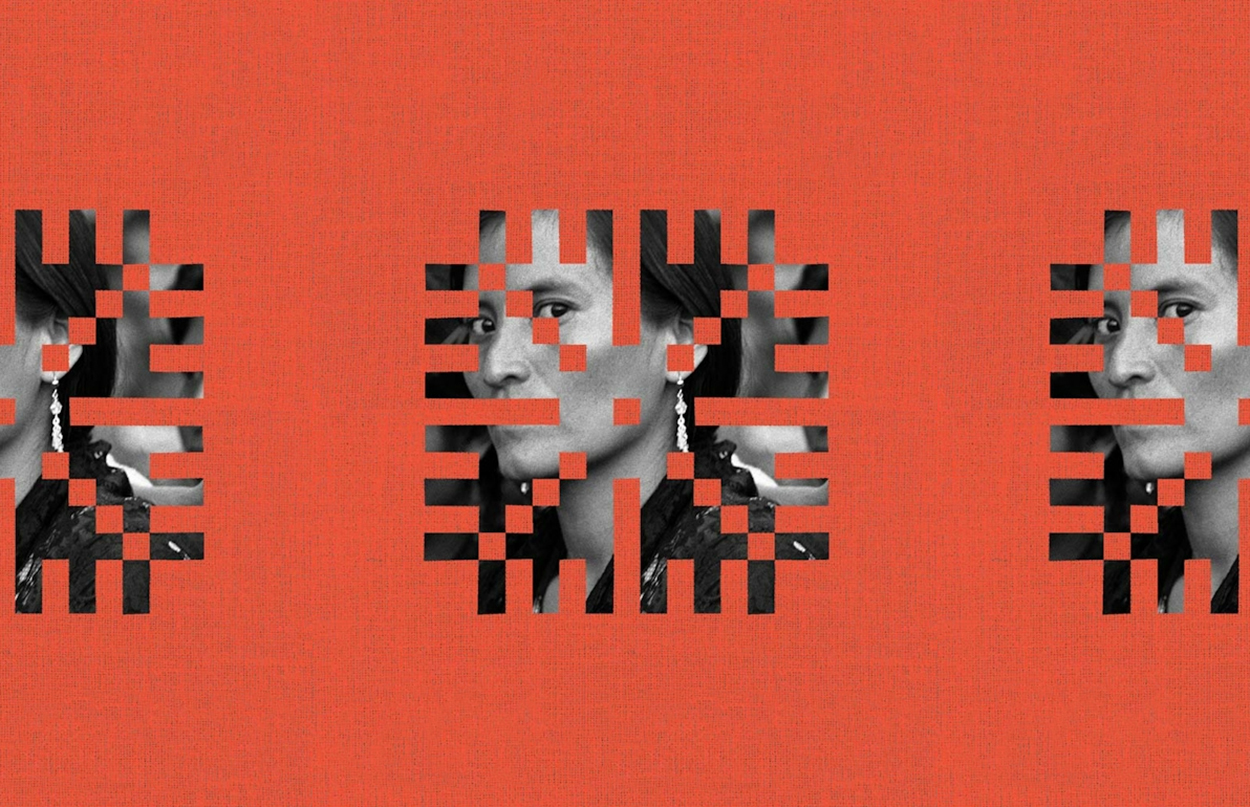
A Review of Stolen Flower by Irma Pineda, translated by Wendy Call
Irma Pineda has written a dozen books of poetry in Spanish and Isthmus Zapotec (Didxazá). This makes her the most prolific woman poet in Zapotec. As a respected professor and a member of international committees, she advocates for her culture and language in Mexico and abroad. The bilingual (Spanish-Didxazá) Guie’ ni zinebe / La flor que se llevó came out in 2013 with Pluralia Books and included photographs by Frida Hartz and a bilingual audio CD. This book, a series of forty-five poems that tell a story, brings her work of language revitalization to a new height. In the tradition of Latin American testimonial poetry, she exposes injustice in glaring detail. Stolen Flower surpasses Pineda’s other books as she tells this horrible story while acknowledging the beauty of this Nahua community. She also achieves unity to her story by using multiple voices: women and girls who suffered violence, other witnesses to those crimes, Nahua people as a community.
Stolen Flower is one long poem made of many short poems that can each be read on their own. But together, they tell the story of an atrocious event. Pineda participates fervently in the genre of testimonial poetry and as such her words become weapons of resistance: “This is war / we told ourselves / and sharpened our words.” Her exquisite images reveal painful truths:
I am the earth woman you slashed to plant your seed
I wash my body to chase away fear
I wipe away red-petal fingerprints
From the sleeping mat’s tender palm
I’m no longer the girl in bud
Waiting for the day she would flower
In her lover’s hands
You stole my flower
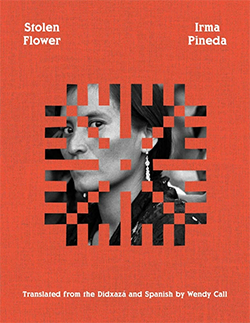
In this poem/part that gives the collection its title, Pineda conflates earth and woman and flower: the harm done to one is done to them all. By condemning these horrors, she honors the people and land that suffered them. She also calls the perpetrators to account by reminding them of their own humanity: “you cry among the trees / because you too know fear.” But her poetry offers the power of redemption as its gorgeous images plant a seed of hope: “though he is the hand of evil / he too / is my brother.”
This book is my favorite of Irma’s so far, especially as illuminated in English by Wendy Call. Importantly, the translator contextualizes the work in the history of the language and its present condition, providing compelling background information to this series of poems. She also does a wonderful job of explaining her translation process. This is an essential step for books in translation and something that not all translators and publishers offer readers. Call also brings her background as a nonfiction writer to the project, investigating the event that sparked this collection.
Since I don’t read Didxazá, I am reading this series of poems in Spanish and English. Call possesses an intermediate level in Didxazá and extensive experience in the culture. She makes beautiful word choices that demonstrate her attention to sound. She chooses her words with care and doesn’t just settle on the Latinate version or the first synonym that might come to mind. For example, she uses “sluice” for “escurre” rather than the easier “runs.” Her attention to sound makes for sonorous poetry in English that reinforces meaning: “la tierra regada con sus sueños” becomes “the land drenched by their dreams,” a glimpse into the heavy hopes left by the violence. I suspect that the translator and poet have read these poems aloud many times since their sound affects the reader as much as their meaning.
Call’s knowledge of both languages allows her to capture subtleties of form and meaning in Pineda’s two versions, thus enriching the English considerably.
Call also pays attention to register and chooses expressions and constructions that respect the tone of Pineda’s poems without sounding stilted. She offers creative solutions for adjectival constructions in Spanish with compelling results, “pequeña luz del alba” as “dawn’s hesitant light.” This translator has an amazing facility with transforming the original grammar and syntax to produce the most satisfactory image, e.g., “eviscerated the earth” (from “sacudió el vientre de la tierra”). She labors carefully and the reader has the sense that she creates poetry in her own right. For example, “con las sombras de los muertos / que detienen mis pies” becomes “with the shadows of our dead / entangling my feet,” an image that makes the action even more tangible.
Call’s knowledge of both languages allows her to capture subtleties of form and meaning in Pineda’s two versions, thus enriching the English considerably. Not many translators into English who work with indigenous languages have this expertise. This allows her to triangulate her version and make it richer in insights and allusions. I suspect that this vantage point freed her to make poems that were at once lyrical and full-bodied. Her experience with Didxazá culture teaches her to consider that an image may have more than one interpretation. For example, in a one of her “Translator’s Notes” at the end, she explains that stones are living beings in Zapotec while in Latin American Spanish they recall history carved into stelae.
Teaching this book
As Call mentions in her introduction, the Mexican ministry of education republished the book in 2023 and distributed twelve thousand copies to school libraries around the country. Making this text available to school-age children and their families suggests that those officials had never read the book. This collection is geared to a mature audience and can serve as a highly engaging text in a college or adult classroom. I had the privilege of teaching this book in a graduate seminar this spring where students were so moved by the events depicted that they attempted to translate some of the poems themselves.
Of course, we had the advantage of a virtual visit from the translator. Wendy Call generously led us through her translation process. She explained that, especially when dealing with two separate originals, the translator can’t seek the one right word but rather a “cloud of meaning.” This expression stayed with the students, and they applied it to the subsequent translations we read together.
But, even before we met with Call, two students had devised an activity where their classmates would “triangulate a translation” into English from what they could gather about the other two versions. Students considered not only the meaning of words but their form on the page, the photos that accompany the poems, and the sound they imagined coming from the words.* They also referred to the “Translator’s notes” at the end of the text that highlight certain word choices and meanings. This was an activity that we recalled throughout the semester since it taught a deep lesson about translating: we do not seek to reproduce meaning but rather experience.
To successfully teach this book, learners need to be made aware of its cultural and historical context. It can be a point of departure to study the complexities of Didxazá linguistics and cosmology. But to appreciate these poems also requires understanding the political history of the region and its implications for indigenous peoples, women in particular.
It is hard to overestimate the role of hearing poetry aloud. Unfortunately, the original Pluralia publication with an audio CD is no longer available. But the National Autonomous University of Mexico (UNAM) has a poetry series that features Irma Pineda. The last five poems she reads in Didxazá and Spanish come from Stolen Flower.
[The author thanks the students of Humanities 663, especially Hannah Rego and Sara Baabalki.]
*These student translators offered a powerful caveat to the process: “Stolen Flower is a trilingual edition, but that does not mean that all readers can read it multilingually (at least directly), even for sound alone. Zapotec languages (as Zapotec is a language family, not one language) are tonal, and the distinct languages use tone differently. Careful study and practice would be required to simply pronounce the poetry with moderate accuracy. In terms of reading for meaning, there is the issue of grammar equivalencies, which from Zapotec to English (and/or Spanish) is not straightforward and would also require careful study to understand.”
Clare Sullivan teaches Spanish and translation at the University of Louisville where she and her students collaborate on poetry translation and community projects.
Recommended

Review Of A Little Feral
A Review of Convergence: Poetry on Environmental Impacts of War