


A Review of Convergence: Poetry on Environmental Impacts of War
When I was a little girl, my grandfather sometimes pulled out a tiny black-and-white photo from his wallet. Framed in a white serrated edge, the image revealed a horse pulling a cannon on wheels. He only showed the photo when he had been drinking, and with slurred speech, he muttered something to the effect, “They were so brave ….” My grandfather cared for military horses during World War II. I was too young to understand the tears rising in his eyes.
The inhumanity of humans against humans during times of war is a well-worn truth. But what about the non-human world? Are there words for the devastating assault on the earth, the water, the air that all sustain life on our planet? Are there words to describe the carnage wreaked upon the countless animals caught unaware?
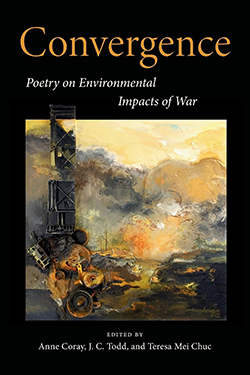
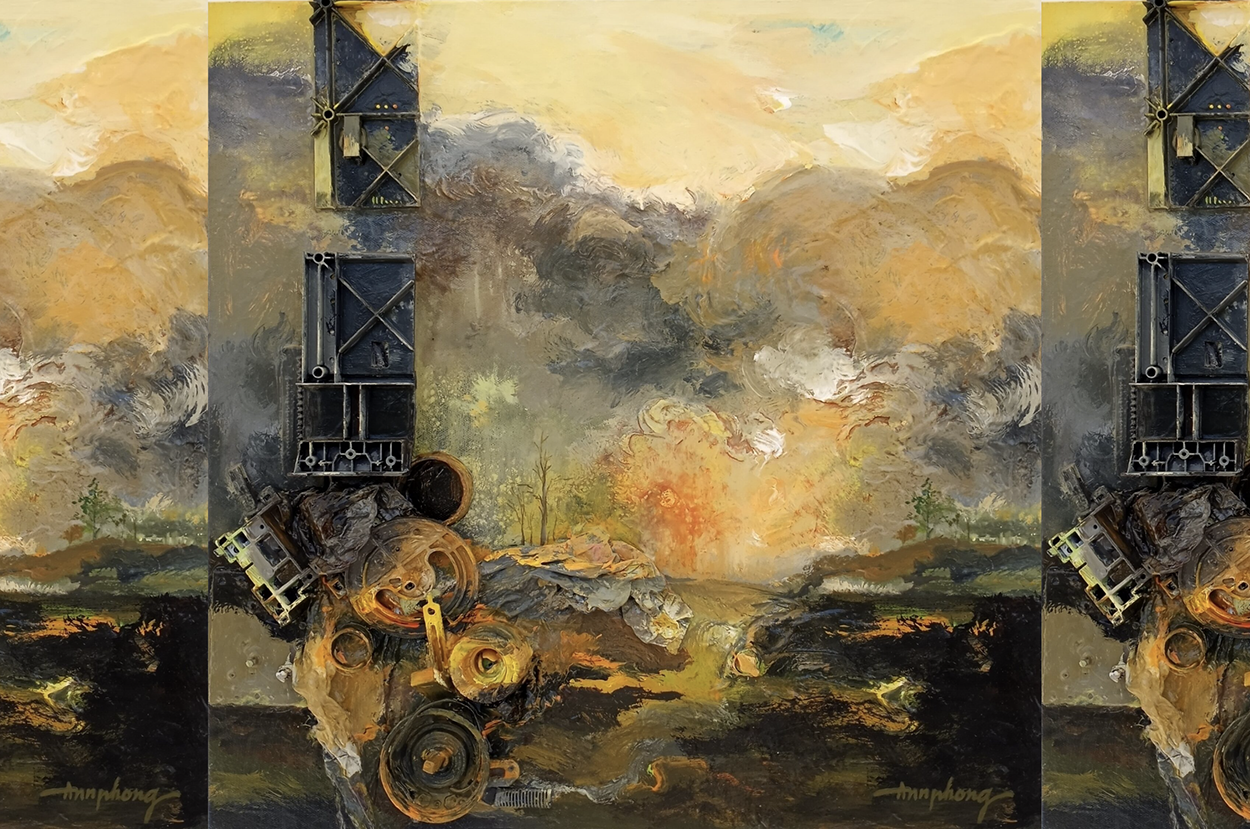
In the book Convergence: Poetry on Environmental Impacts of War, sixty-one contemporary poets use words to paint the wounded landscape of all beings that suffer as a result of wars, past and present. Each poem has a note by the author and/or editors with reflections about the origin of the poem. The book is organized loosely in chronological order, beginning with the Marcomannic Wars (167–180 CE) in Austria and ending with present-day wars in Ukraine and Gaza. An introduction and two forewords accompany the work. As co-editor Anne Coray notes in her introduction, the anthology combines two genres: war poetry and ecopoetry.
As I write these words, fuel depots outside Tehran, Iran, are ablaze, with black smoke billowing over the skyline. Further to the north, in a different conflict, a Russian attack on a hydroelectric power plant in Ukraine threatens life on the Dnieper River, home to 105 protected plant species and a wide range of mammals, birds, and fish. Scientist and conservationist Rick Steiner, who wrote one of the forewords in Convergence, notes that on any given day in the modern world, we humans are engaged in more than one hundred armed conflicts and wars across the globe.
While present-day conflicts rage, the damage of war on the environment can last for generations. Recent news reports that eighty-five years after the attack on Pearl Harbor in 1941, the sunken battleship USS Arizona is still leaking fuel from the five thousand metric tons of fuel that went down with the ship. In the poem “De-tour of the Pearl Harbor National Memorial,” Craig Santos Perez asks, “What if we hiked to all 700 toxic Superfund sites / in Pearl Harbor, and enjoyed a picnic of wild caught / seafood from these contaminated waters?”
Today, entire zones in Europe and Asia are cordoned off from use because of unexploded munitions and other hazards from past wars. Yet in those areas, many non-human species are making a comeback, a testament to nature’s resilience in the face of human conflict. Many of the poems in Convergence pick up on this theme, including the co-authored poem “Scarred” by Mariko Kitakubo and Deborah P Kolodji, about one weeping willow tree that survived the atomic bombing in Hiroshima. Marybeth Holleman in her poem “Infinite Love in No Man’s Land,” writes “Mongolian race runner, mountain goat, golden eagle, / river otter porpoising between two warring nations, / lacing them together with water dance, only there / because we are not.”
Poet and naturalist Scott McVay quotes Wendell Barry in his foreword: “the care of the earth is our most ancient and most worthy and, after all, our most pleasing responsibility. To cherish what remains of it, and to foster its renewal, is our only legitimate hope.”
Yet where to start? “When in doubt, trust the poets,” Rick Steiner writes. “Beyond knowing, poetry helps us feel. And that is precisely what is needed now—to feel the enormity of this existential crisis, the entirely unnecessary damage that war inflicts on other people and the environment.”
Convergence is also a powerful educational resource. Discussion questions and writing prompts for writers, students, and teachers engage readers long beyond the pages of the anthology. At the end of the book, “Tallying the Costs” gives an itemized summary of the sobering impacts of war on the environment. As Scott McVay explains, “Convergence reminds us of our sacred mission on this precious Earth.”
The poems in the anthology are not always easy to read. The hope is that this collection will bear witness to the environmental and ecological cost of conflict while giving voice to the beings who have no say in the matter.
A poem about military horses in the U.S. Civil War is included in the book, Lisa Couturier's “Standing with My Horses in My Fields in Maryland.” I am now the age my grandfather was when he showed me the photo of that horse pulling a cannon. Today, as oil depots burn and children who survived the rubble are warned away from the Dnieper River, I wonder what kind of home we are leaving our children’s children. We must trust the poets and not turn our backs on what Convergence has to say.
Kaylene Johnson-Sullivan is an award-winning journalist and the author of Our Perfect Wild: Ray and Barbara Bane’s Journeys and the Fate of the Far North (University of Alaska Press, 2016) as well as other books of non-fiction. Her book Canyons and Ice: The Wilderness Travels of Dick Griffith was made into a PBS documentary. Kaylene’s poems and essays have appeared in the Louisville Review, Deep Wild, Sisyphus, and several anthologies, including Alaska Literary Field Guide.
Recommended

Review Of A Little Feral

A Review of Stolen Flower by Irma Pineda, translated by Wendy Call