



A Review of Ghost Hunting Glaciers by Michael Garrigan
The first poem of Michael Garrigan’s latest collection of eco-poetry, Ghost Hunting Glaciers, the 2025 Winner of the Grayson Books Poetry Contest, is called “Landscape Fugue (Spring).” As defined in Merriam-Webster, a fugue is “a musical composition in which one or two themes are repeated or imitated by successively entering voices and contrapuntally developed in a continuous interweaving of the voice parts.”
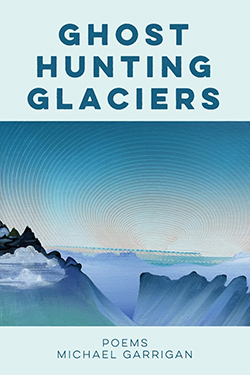
The definition defines both the poem, in which “ferns unfurl from selves hidden in spores” and “fungus cradles algae, leaf brushes leaf, the intimacy of living is learned again,” as well as the collection at large, which is primarily composed of persona poems. Garrigan’s book is structured through interspersed sequences that take the perspective of four characters: a recently deceased elk, a woman’s key coming-of-age moments, a black bear, and the enigmatic “stone swimmer,” whose identity and perspective eludes me more than that of the others. The personae haunt each other’s poems throughout the collection.
Regardless of the speaker of each poem, Garrigan’s poetry is rife with motion, of verbs, creatures and elements of the natural world in action. The kinetic and sensorial are present in black bear’s “first berries that my mother / fed me and how they snapped between my teeth” and the woman’s feeling of “shattering, enveloping, breathless” when she wades into an alpine lake.
The poetry is grounded in specificity, often in the names of species and places. And at the same time, the limits of names are touched upon. For instance, in “Epistemology: Conejohela Flats,” the woman persona struggles to understand the meaning and pronunciation of a cherished marsh, and the final turn of the poem goes: “names are like that sometimes—thin water and thick mud.” Elsewhere, dead elk “knew no words / for this world/ and loved it without / language.”
Such contradictions are at the heart of this book and give the poems depth and complexity as they push towards meaning and revelation. Garrigan, I should note, has become a friend of mine over our shared interest in the outdoors, particularly fly fishing, and nature poetry. His work in Ghost Hunting Glaciers builds on similar themes in River, Amen (Wayfarer Books, 2023) and Robbing the Pillars (Wayfarer Books, 2020), from which he has become known for blending spiritual and metaphysical concerns with a deep attunement to the natural world.
It’s risky business, when both spiritual and nature writing can so easily verge into clichés, as can writing from the perspectives of non-human entities. At times, Garrigan takes the too-easy abstractions, like when the speaker of the poem in “Epistemology: Bullfrogs” likens the croaking motion of horny bullfrogs to “contracting into questions and answers” and in “Long Plateaus of a Black Bear,” when the speaker says the “ridges reach into the past on one side / and the future on the other and the present / is an infinite sky in front of me.” Those brief moments aside, Garrigan, however, largely succeeds in drawing deeper metaphysical revelations, often through the sheer specificity of his metaphors, but also his refraction of perspectives.
Take, for instance, the fly fishing scene of “Epistemology: Parking Lot Muskies.” Fly fishing literature is rife with common spiritual phrases, and one of them is the invocation of devotion, often because of the repetitive act of casting, as well as the patience required to wait for a fish to bite. Here, though, the angler is not the speaker of the poem, but her beloved. After he catches and releases a gigantic fish, she watches him “bowing to the river and all it held, he whispered to that thin / space between its eyes and she finally understood devotion.”
The moment is similar to the turn in Rilke’s famous “Archaic Torso of Apollo,” in with the speaker comes to a revelation through a moment of observation. In Garrigan’s case, the metaphor is both grounded in the specificity of the musky, and also, the open but not heavy handed parallel between the act of fishing and of committing to one’s love.
Similar revelations are filtered through the perspectives of the collection’s other characters, with perhaps the most poignant moments coming from Dead Elk, whose poems are the ones that will haunt me most from this book. They are also the most bittersweet.
Dead Elk wakes “with a body made of mist” and “breathes with wildflower lungs.” His poems follow both his unbecoming—the decomposition of his once-body—and his metaphysical becoming as he reflects on his life and also considers typical and non-typical elk concerns. The typical concerns are reflections on things such as “his mother who nudged his stomach with Her nose whenever he stumbled finding four-legged balance,” while the more surprising atypical concerns have to do with having a psychedelic trip after eating a rhododendron bloom and attending a Billy Strings concert. Here, the constraint of a “persona” poem is collapsed in a way that’s particularly pleasurable to the reader.
Yet, even these somewhat humorous moments are tainted by Dead Elk’s simultaneous earnest interest in the world—or his “hunger / that is no longer just in his stomach / but now is all of him”—and impending dissolution. And as he does so, he feels moments of fear and loneliness, as when he ponders “if anyone still smells him.”
There is freedom in his realization of his death, and coming loss of self, too, as when “Dead Elk Drops His Antlers” and finds “it is so easy to lift your head and look up / without the weight of the need to be seen.”
The speaker of “Dead Elk Finds His Body” puts it another way. He “wonders what he ever did / with just four legs and two eyes / and how much life he missed / and how much love he lost / not able to walk further and see clearer / under the muscled weight of living.”
Above all, Garrigan’s poetry attempts to do just that: write into the place beyond the muscled weight of living while acknowledging with clear eyes the ultimate impossibility of doing so. It is a beautiful and painful task.

Sage Marshall is an essayist, poet, and journalist. His creative work has been featured in publications such as The Missouri Review, Sport Literate, Catamaran, elsewhere, and has been named “Notable” in the Best American Essays series. He is the author of the poetry collection Echolocation (Middle Creek Publishing). Marshall is also a contributing writer and former editor for Field & Stream. Check out more of his work and drop him a line at www.SageMarshall.com.
Recommended
A Review of Convergence: Poetry on Environmental Impacts of War

A Review of Stolen Flower by Irma Pineda, translated by Wendy Call