


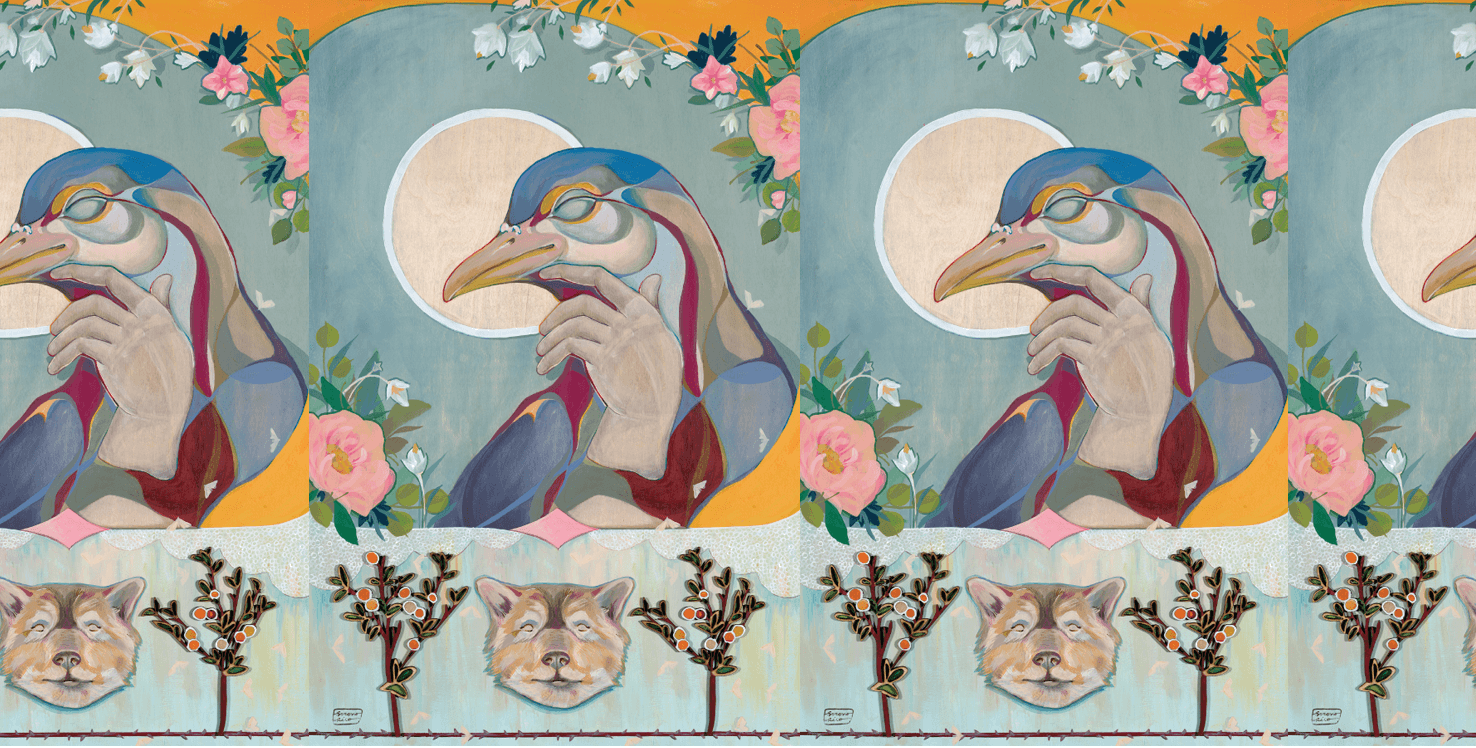
A Review of The Unbelieving Yelp of Prey by Alex Mouw
He will
sweep you up for what you are: prey,
blind and hungry, searching the air.
Thus closes “Psalm 43 Driving through the Heartland,” a gem tucked away in the fourth and final section of Alex Mouw’s warbling, screeching debut, The Unbelieving Yelp of Prey (Texas Review Press). Raising afresh the oft-carried banner of a given preoccupation—in Mouw’s case, the vertiginous seesaw of human/divine dialogue—is a bold and worthy way for a new voice to test its mettle. Strange-ifying the familiar requires a deft blend of ingenuity and skill. In this regard, Mouw’s readers will be well-rewarded.
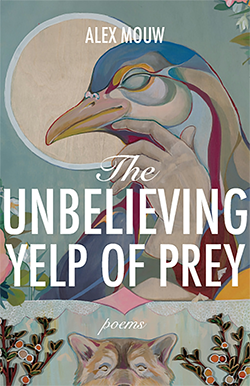
The Unbelieving Yelp of Prey is, foremost, one speaker’s long, careful articulation of what it is to engage a wild God. Cri de Coeur and carrion cry become fused, odd bedfellows in a book that responds to—and inquires of—God the uncontrollable. Divinity appears as a predator stalking the heart of man, and Mouw leans everywhere with earnest intensity into the language of this violence, as in “Apology for Belief”:
Who’d pierce me? I thought.
Who would lure me through depths and not be caught?
and in the more interrogational “Psalm 139 From a Downtown Window”:
So rarely do you have anything
to say that doesn’t turn bloody.
In a cultural moment where authenticity and literary quality are too frequently conflated, the poems in TUYOP pull their emotional weight wonderfully with clever, startling images, elegant economy of language, and a capacious, invitational intimacy allowing readers to fall into—rather than flounder as uncomfortable voyeurs in—the world of the speaker. Mouw moves cleanly in each section between standard couplets, strophic stanzas, and continuous form poems, though he’s clearly especially devoted to the fourteen line sonnet. This devotion is well-placed, as sonnets have been used by spiritually-inclined poets as existential boxing rings (John Donne comes immediately to mind) for centuries. Only in “Last Address to the Lord,” the collection’s penultimate poem, does Mouw depart from these patterns into open space and fragments across the page—
What did you mean when you opened
the book
with a spider crushed
between its pages
and said
eat these words?
Though such visual arrangements risk becoming an arbitrary box-tick of “modern” poetry, this infusion of white space does conflict of all kinds honorably, elevating and clarifying the experience of tension to the eye with an impact that traditional lineation does not always achieve. For this reason, I was surprised to see only one such poem in a crop of forty-something, but “Last Address” is a fine example of the merits of blank space.
The Unbelieving Yelp of Prey takes its place in a long, harrowed lineage of Christian musings on the human condition. It is concerned with the inexhaustible, ancient questions of our doing and being. To this end, threading prayer and poetry together until the two are indistinguishable builds a highly durable vehicle of language—one equally at home joy-riding and serving as a battering ram. Reverence and awe are everywhere tempered with anxiety, disappointment and frustration—frequently across the landscape of a single poem. “Incarnate”—the collection’s closer—introduces Christ
in a breastplate of bark,
raiment of leaves whooshing laps around him.
I might shit myself in fear as a dark
wail blooms from his mouth.
It is not lost on reader or poet, I think, that fierce cries “bloom” in the beaks of birds of prey as they swoop down for the kill. The Christ figure’s conflation with these predators throughout the book make Mouw’s most commonly deployed opening words (“my Lord”) become, in the reader’s eye (or ear, if read aloud) the very “yelp” from the book’s arresting cover. “My Lord” is never spoken ironically, but it is spoken in shock, reverence, grief, and profound fatigue. The speaker of section three’s “My Lord, I’m Not Too Far Gone, Right?” ventures to ask, after likening God to a ceramics worker smashing ten thousand attempts before firing one, “whom did you make and break today?” It is impossible to spend any decent interval of time with Mouw’s verse and not feel the crush of closing talons. In this sense, the gift of the poems is also their burden.
The Unbelieving Yelp of Prey … makes of Christian faith a laboratory in which the conditions of human experience might be tested, examined and weighed.
Midway through this write-up, I received—to my great interest—“Guzzle,” which appears in TUYOP’s opening section, in my inbox, courtesy of the Christian non-profit The Rabbit Room. Why interesting? Because “Guzzle” was my nearest brush with something like disappointment in an otherwise deeply satisfying body of work. This minor and relatively personal beef should be a hefty point in the book’s favor; but let us consider this poem’s treatment of Christ:
Do you remember how Christ
begged his Ancient of Days, “Will you take this cup from me?” Despite that
bloody crown and heaving chest,
the answer was a bitter, unspoken NO. And though Christ screamed that
whole night, he never really tried to bust
the chains, stop the hurt. He reached for that
cup of pain which looked as endless as it felt pointless.
He drank as friends wordlessly fled. Who does that?
After a promising, surprising setup where the speaker places his reader in the intimate world of a particular sufferer & friend, we close here—after walking such fresh, unexpected terrain—on what feels to me by comparison a fatiguingly predictable gesture. It is not that I think “Guzzle” would’ve landed better without an upward turn to awe or even to Christ’s very face. Rather, any Christian reader’s deep familiarity with Jesus drinking the cup from which he prayed to be spared necessitates more effort from authors wanting to effectively re-voice the message “isn’t it amazing Jesus still drank the cup.” The ubiquitous repetition of this event in Christendom (which is where this book ultimately lives and desires to live) has considerably drained the story of its original powers of astonishment. A jolt with enough voltage to deliver the old shock anew is needed to successfully avoid that most precarious of dangers in modern religious writing: sentimentality.
A Michigan native myself, I would be remiss not to mention the proximity of many of these poems—both literally and figuratively—to storied Lake Michigan, and other topography instantly familiar to any bona fide Midwesterner. Perhaps too spiritually and existentially preoccupied to be an entirely traditional “poet of place” after the fashion of Gary Snyder or Robert Frost, Mouw’s poetic and Christian imagination have clearly been formed and informed by a particular landscape. This formation is reflected beautifully in poems like “My Lord How Long Do You Build A Lake?”
Lovers of Gerard Manley Hopkins, (who gets a nod in this book) John Donne, and Geoffrey Hill will feel utterly at home with—and gratified by—The Unbelieving Yelp of Prey, a collection that makes of Christian faith a laboratory in which the conditions of human experience might be tested, examined and weighed. It is by no means irrelevant to secular readers, containing enough relational and emotional universals to generate broad appeal and sympathy, not to mention enough beauty to lure the eyes of other poets, particularly sonnet lovers. It is a strong first showing from Alex Mouw, whose willingness to gaze steadily into the eyes of the raptor has produced an exciting and commendable debut.

Haley Hodges received her MFA from Seattle Pacific University in 2025. She holds additional qualifications in music and theology from Hope College, Shenandoah Conservatory, and Oxford University. Her work has been featured in Cassandra Voices, Only Poems, Luna luna, t'ART, Reformed Journal, and elsewhere. Her first book of poems, Eros Rex, was released with Orison Books in 2026. She lives in rural West Virginia.
Recommended
A Review of Convergence: Poetry on Environmental Impacts of War
A Review of Stolen Flower by Irma Pineda, translated by Wendy Call