



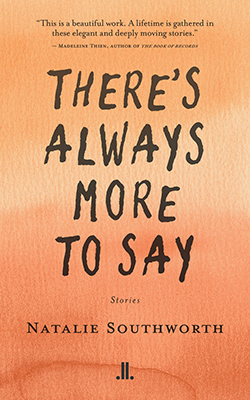
A Review of There’s Always More to Say by Natalie Southworth
What constitutes “real life” and how are we to function if the lives we lead feel somehow unreal? Natalie Southworth’s debut collection, There’s Always More to Say, circles this question cautiously, wisely never answering. Instead, many of her characters scramble for purchase on shaky ground, unable to find balance in a world they seem to believe is cleanly divided into real and unreal. On the one side, a square, suburban blandness, a sturdy job, the gritty facts, a practical existence. Or its perceived flip side—a slippery slide into art and murky spirituality where adults first flounder and then fade, often leaving their children ill-equipped and unprepared to reconstruct the broken homes they leave behind. These are heartbreaking stories; Southworth is unafraid of navigating the psychological labyrinths her characters lose—and sometimes find—themselves in. She is also incredibly gifted at revealing the unexpected glint of light in the bleakest of moments.
Though each of the nine stories stands alone, perhaps the three most powerful are connected, returning to a narrator, Cora, whose mother suffers from depression and psychosis in Cora’s youth. Cora has an older sister, Rachel, who, even as a teenager, is hellbent on sturdiness, success, a practical life. As the girls’ mother’s psychosis develops, upending their home life, Rachel keeps a list on her bedside table titled “Rules for Sanity” which includes “No religion, no unproven hypotheses, no psychedelics, no blind faith.” In a moment of blazing foreboding, she advises Cora, “Make a note only of what’s verifiable.” At seventeen, Rachel, determined to become a reporter, carries a tape recorder, slips under police tape at a crime scene, and speaks coolly of the gruesome evidence found there. Data and facts are the building blocks Rachel uses to build a staircase out of the fog of uncertainty her mother’s mental illness has cast over the house.
By contrast, Cora, sensitive to the unspoken conversations, acutely observant, and thoughtfully slow to label or define, experiences her mother’s gradual fading from the family with painful patience, never blaming her mother or casting her as a failure. It is less an act of grace than it is an act of total bewilderment and perhaps fearful recognition; Cora, throughout the three connected stories, seems the only character able to exist in the gray zone between the perceived black and white. She’s not happy there or even comfortable, but nor has she followed Rachel’s prescriptive advice for steering clear of the “unverifiable.” Cora has seen how rigid adherence to facts, the “gory details, or what Rachel called ‘real life’” can bleed a person of empathy and ease. Rachel is no better off for all her efficiency and mental toughness. On the other hand, Cora does not look away as her mother disappears from the family, retreating into a world where her daughters can’t find her. And while her unflinchingness is admirable, it has left its mark. At a distance and unseen, adult-Cora follows her mother one day, through a seaside park in Victoria and thinks, with painful simplicity, “even in the flesh she wasn’t real.”
A character’s ability to not look away when someone is drowning and cannot be helped returns in several stories. It is an act of courage that mirrors Southworth’s own remarkable ability as a writer. Like the characters in her stories who witness and do not judge, Southworth stays with loss and grief all the way into its darkest end. Never romanticizing or analyzing, she has an exceptional ability to hold the unknowable without trying to contain it.
Much of this ability is delivered via her sentences. These are measured, intelligent lines. The writing has an effective blunt edge, a lovely plainness. She refuses to dress up or flourish. The banality and ugliness of urban life quickly grounds any potential beautification. A lake is not a place of tranquility—no, we get heaps of refuse trawled from its bottom, “a chair and a delivery bike with metal baskets on the front and back wheels and a beach towel and three rice cookers.” During what one character desperately desires to be a celebratory dinner, our eye is led to “cardboard cutouts of chicken dishes dangling from the ceiling.” Men, in what are meant to be their victorious moments, wear crumpled polyester suits looking like they’d been “unpacked from a suitcase and set up into a standing position,” and the dazzling star of a lip-sync performance is disturbingly thin in a scene that manages to be both grotesque and moving.
Southworth never takes the easy road out of her stories; she plumbs deeper and isn’t afraid to leave you with more questions than answers.
The authorial voice echoes the collection’s inner tension: these are sentences that feel firmly planted on steady ground, no poetics or lofty metaphors, yet these sturdy lines have their own artistry. Southworth uses omission exceptionally well. Paragraphs feel almost truncated—with great effect. The writing never drags, lingers, or takes the long way round. Yet step back from these spartan lines to take in each story as a whole and you feel its efficiency as poetry. These are stories with the mechanical beauty of a pocket watch, every gear and bolt absolutely required and ticking along elegantly.
In this way, Southworth’s writing achieves a balance where her well-developed characters cannot. They are burdened by a belief that one can be either efficient or poetic. It is a compelling burden, skillfully and uniquely wrought. One of the most memorable characters—a puppeteer who gives up his puppet theatre to become a real estate agent in order to provide financial stability for his family—grapples with this tug-of-war between practicality and art in a stunning scene. Pressured by his wife to nab a real estate listing from his very corporate boss, yet compelled to bring one of his beloved puppets to a work function, the man puts on an impromptu puppet show featuring “Mona Lisa,” a puppet he’s lovingly made and developed a narrative for, including her stutter and shyness and willingness to stare silently out at an audience of children for long moments. While the children are enchanted, the adults are made uncomfortable, and under pressure from his wife to woo his boss, the puppeteer forces puppet-Mona Lisa to speak out of character. In one of the few moments in this book where a character truly triumphs over his demons, the puppeteer finally stands up for himself by letting Mona Lisa have the last word: “That wa wasn’t ff fair … I wa wasn’t made to be a sm sm smooth talker.” The puppeteer’s young daughter is the only one to recognize that her mother, the corporate boss, and so many others have “the look of having exited themselves, the look my father had avoided.” Here is one character, at least, who manages to stay real, to feel their life has its own meaning, unverifiable or not, even as proof of the straight life, the corporate life, the one based on fact, dissolves around them.
References to a life of “detachment,” “untethering,” or a life lived “in between worlds” reoccur. Young female protagonists scrambling to hold onto their families are caught in this zone of detachment. The parents are often divided into two roles: one who is trying to keep it all together, dealing with the eviction notices and repossessed car, and the other who is actively seeking answers in dubious New Age books, often struggling with mental health without any real support or clear solutions. The children, too, are often divided into two camps: the one who, like Rachel at fifteen, posts hospital numbers on the fridge and uses the family code word “fog” which signals their mother has gone to an unretrievable mental place. Or the one who, like Cora, yearns for her mother even as she seems to understand she’s already lost, and comes to realize, with an extraordinary empathy, “I understand the momentous act; how my mother curved real life to her way of seeing and created a world that, unlike this one, wouldn’t let her go.”
These are narratives that resolve only in the most painfully authentic ways. Southworth never takes the easy road out of her stories; she plumbs deeper and isn’t afraid to leave you with more questions than answers. Her sentences may be crystal-sharp, but her characters’ lives are allowed a brilliant opaqueness. And these are the questions art is made for: What does it mean to live a real life? How can we ever let others define this for us? And how can we ever judge those who define it for themselves, even if their definition excludes us from living life with them?
Katie Zdybel’s debut collection of short fiction, Equipoise, was shortlisted for the HarperCollins/UBC Prize for Best New Fiction and the ReLit Short Fiction Award. Her short stories have been awarded the Peter Hinchcliffe Short Fiction Award, the Exile Carter V. Cooper Award, and shortlisted for the Malahat Review Novella Contest. Her first novel will be released Fall 2027 by Freehand Books.
Recommended

A Review of Convergence: Poetry on Environmental Impacts of War

A Review of Stolen Flower by Irma Pineda, translated by Wendy Call