



The Music of Survival: A Review of PULSE by Maria Nazos
Maria Nazos’s PULSE is a book that refuses numbness. From its opening pages, it enacts what its title suggests: a relentless, life-affirming throb that measures both pain and endurance. These poems move through the chambers of loss, identity, desire, and resilience with a precision that is at once bodily and metaphysical. Nazos is a poet of fierce empathy and formal agility—one who understands that the heartbeat is not just a biological fact but a metronome for what we witness and must share.
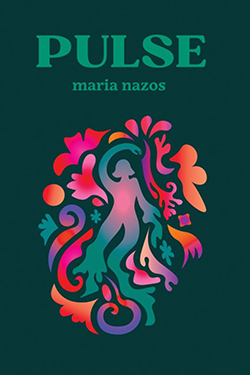
Across its sections, PULSE charts an emotional and geographic topography that is distinctly human. Nazos, who has long inhabited the thresholds between Greek and American cultures, between lyric and narrative, between the sacred and the secular, writes as if translation itself were a form of survival. Her poems bear the salt of two seas—the Aegean and the Great Lakes—and the tonal duality of a mind that dreams in more than one language. The result is a book that feels at home in multiple worlds yet beholden to none.
What distinguishes Nazos’s work here is her ability to fuse the intimate and the historical without sentimentality. A poem about the loss of a loved one may slide, almost imperceptibly, into a meditation on political violence or environmental collapse. Yet she never resorts to the easy equivalence of metaphor; instead, her art insists that the personal and the collective course through the same arteries. When she writes, “the world beats inside us / whether we invite it or not,” the reader feels both implicated and renewed.
Nazos’s formal control is invisible in the best sense; each poem’s architecture feels inevitable rather than designed. She moves through free verse, pantoum, and hybrid prose with the confidence of a musician who knows that tempo, not technique, carries the emotion. Repetition becomes her heartbeat, recurrence her survival instinct. Each poem is meticulously structured but never rigid; her enjambments breathe, her silences throb. In one sequence, a poem reads like a confession only to morph into an ars poetica; in another, a meditation on illness becomes an inquiry into the ethics of attention. The collection’s internal rhythm mirrors its title—steady, syncopated, alive.
Equally compelling is Nazos’s command of imagery. She gives us “the moon’s pulse over the Aegean’s shoulder,” “the wet gleam of asphalt after sirens,” and “a body learning the language of its own repair.” These are not decorative gestures but the tangible proof of a poet listening to the world at full frequency. Her diction balances eros and austerity; her syntax moves with cinematic pacing, tightening and widening its frame until even silence becomes eloquent.
To read PULSE is to encounter a poet at the height of her powers—technically assured, emotionally unguarded, and philosophically awake.
If the book’s central metaphor is the pulse, its deeper subject is persistence—the moral insistence of the body to go on even in the face of catastrophe. Nazos understands that poetry itself is a form of continuation, the echo of breath after loss. In that sense, PULSE joins the lineage of poets such as Louise Glück and Carolyn Forché—writers who translate survival into music, and whose work transforms witness into art. Yet Nazos’s voice is distinctly her own: Midwestern in its candor, cosmopolitan in its reach.
The later sections of the book deepen the personal stakes. Love poems, elegies, and self-portraits coexist with meditations on desire and faith. Here the rhythm slows but never falters. The poet, now fully awake to her own continuance, writes not from the wound but from its echo. These closing pages achieve what the best poetry can: they remind us that endurance, too, has a sound.
To read PULSE is to encounter a poet at the height of her powers—technically assured, emotionally unguarded, and philosophically awake. Nazos has written a book that confronts despair without yielding to it, that treats the act of attention as both resistance and devotion. In an age when distraction threatens to flatten our inner lives, PULSE restores the reader to the body, to rhythm, to the living music of care. Particularly now, in a world that seems to be hiding from the truth of seeing, Nazos finds the embedded premise that comes from seeing herself and others realistically but still compassionately.
PULSE is not merely a collection of poems; it is a testament to what poetry can still accomplish. It reminds us that even in the most fractured world, language remains a form of blood—carrying memory, carrying witness, carrying love forward. Maria Nazos has given us a book worthy of our deepest listening.

Rick Christiansen is the author of Bone Fragments (2024) and Not a Hero (2025). His work has received two 2025 Pushcart Prize nominations and he was a finalist for the RHINO Poetry 2025 Founders Prize. He is a finalist for a 2025 Rhysling Award. His poems explore survival, memory, class, and the residue of violence. He lives in Kansas City Missouri.
Recommended
A Review of Convergence: Poetry on Environmental Impacts of War

A Review of Stolen Flower by Irma Pineda, translated by Wendy Call