

The Lives of Monarch Butterflies: A Review of Wolves in Shells by Kimberly Ann Priest
The final words of Kimberly Ann Priest’s whip smart elegy to the traumas of love are these: “My mother died early morning October 27, 2021 in Texas.” A stained-glass reflection on the female monarch, milkweed, violent travel on the paths of intimacy, fierce resilience, and new forms of resurrection, when one completes this dazzling if haunting collection, we find Kimberly as daughter and Kimberly’s daughter as both daughter and granddaughter winglike, aloft, moving in awkward stairstep flight out from the chrysalis. Notably, female monarchs forgo the black stigmata males carry on their hindwings, and embody a more robust and tensile articulation of flight: they have darker, more pronounced black veining, are often more darkly colored as a whole, and fly lower to the ground, seeking milkweed and sanctuary for the creation of new life.
The respected theologian Rudolf Otto, one who predicted the rise of Hitler, said in The Idea of the Holy: “God dwells in thick darkness,” and therefore we must humble ourselves and in fact eat our own humiliation if we are to understand, repel, and overcome the ministrations of violence that plague not only our individual lives but the souls of the nations. Priest’s work resounds with the dark holy and draws us in to witness and listen, to partake and rise with her in speaking truth to power. Her voice is prophetic and vitally alive.
In “Elegy for My Daughter Who Has Never Known a Paradise” the daughter is “dark coat and seed” and the poet asks “…What plot of milkweed / will she harvest and weed?” In “The World Is Whatever We Choose to Make It” even the trees bear the monarch’s blaze: “flocked with bronze and burnt-orange hues.” A feminist power moves in the manner of O-Six, the alpha female wolf of the Lamar Canyon Pack in Yellowstone National Park, who lithely weaves her lupine musculature through the mystery of these leaves. In Yellowstone she fought off all and became the forebear of generations of wolves who run there now. The tragedy of her death by bullet rings through Priest’s collection, returning us to reverence and gratitude for life even in the wake of untold harm. Priest’s work contains illumined echoes of her own forebears in poetry—Audre Lorde, Sharon Olds, Mary Oliver—who each in their way, with Priest, denounce, heal, and transcend the wounds inflicted on them and on the women of generations past, present, and future.
Uniquely her own, Priest’s poems are finely tuned and reach a symphonic cadence. There is uncommon grace and great force in her lines, each poem made of formidable depth and a hard won hope that leaves its imprint on the reader like burnished gold inlaid in the palm of the hand.
Wolves in Shells shouts in unison with Lorde, “Caring for myself is not self-indulgence. It is self-preservation, and that is an act of political warfare”; sings with Olds, “it is forbidden to love where we are not loved”; and speaks in a quietly booming register with Oliver, “Someone I loved once gave me a box full of darkness. It took me years to understand that this too, was a gift.”
Such revolutions, moving from entrapment to freedom, from personal desolation to personal consolation, and walking from a living death into a wilderness of natural beauty resound with the etymology of chrysalis and butterfly: chrysalis emerging from the Greek khrusos or gold, and butterfly from the Old English referring to brimstone butterflies, smooth and light of wing.
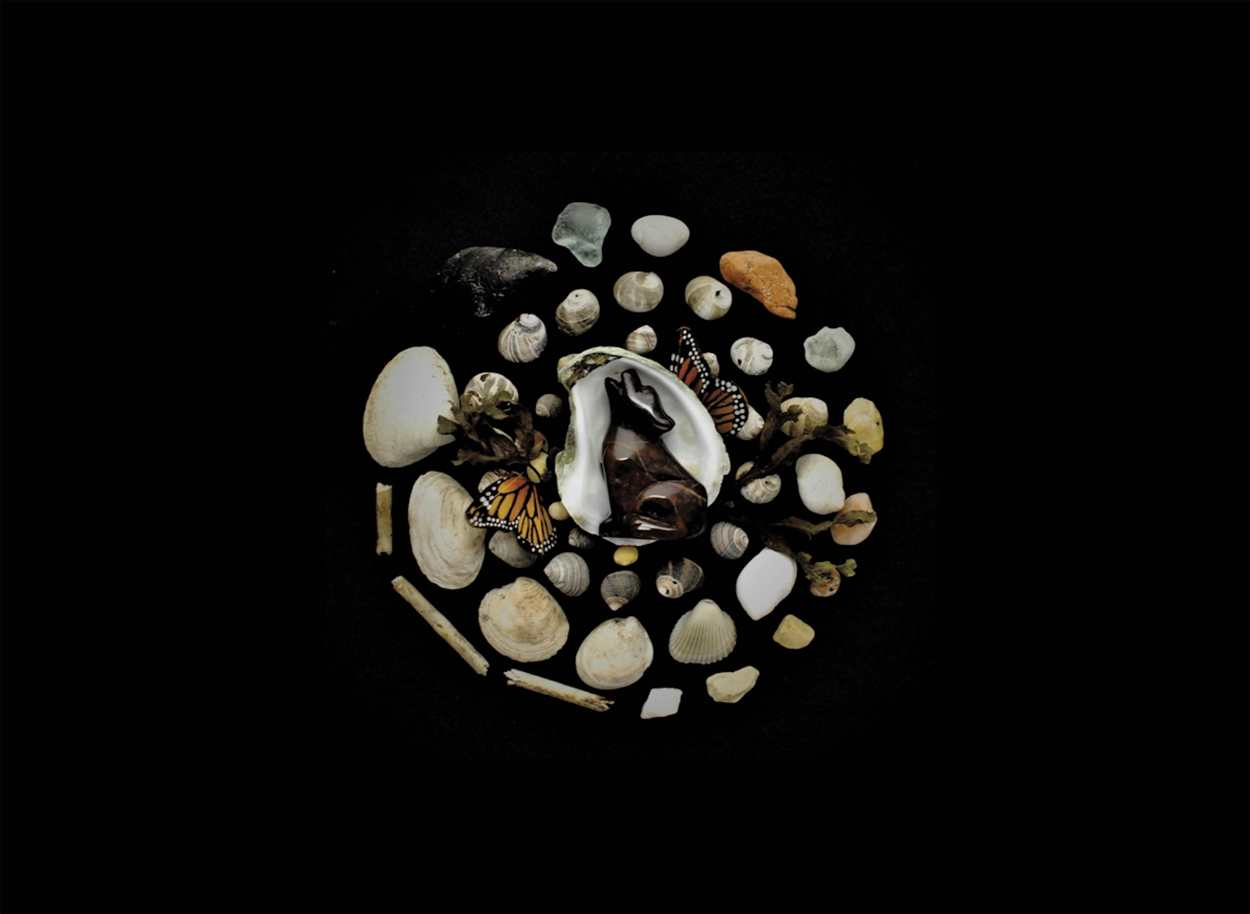
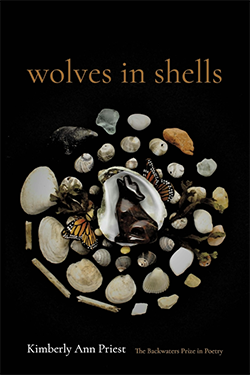
Priest’s shells that hold wolves appear throughout the collection, ringing in harmonic uplift with the painful yet celebrational chrysalis that surrounds the female monarch at birth. Notice the cover of this collection, a work of art titled Wolf Mandala, composed by the poet, and poised as a hinge to doorways of courage and discovery, doubt, fear, and grace for self and others.
In the opening poem of Wolves in Shells Priest envisions the wolf O-Six on a “patch of grass; wrinkles forming / at the sides of her eyes from age / and survival, relaxed; and the way / the howl lingers on and on.” Later, she names a central motif of the collection: “and now this. Home / is something to fight for until / it’s predator free. I wish this for / my daughter.”
The poems in Priest’s collection carry their epiphanies to us, changing forever how we experience life and the world.
The same wish appeared to me just a few years ago, being a father of three daughters and sitting with my own eighty-year-old father at the height of the Beartooth Range in southwest Montana inside the bounds of Yellowstone. There we received the infinite gift of 0-Six. Being raised generationally poor in Montana and having male forebears who were trappers, thieves, prisoners, trailer dwellers, moonshine makers, and bar fighters, my father and I are familiar with how the world eats and kills. We’ve witnessed winter become spring and found in death’s dominion the eye teeth of elk and their shed horns, a bear skull licked clean by maggots, and the hollow wing bones of eagles. These we’ve held in our hands and borne what seemed to us a sacredness, a holiness.
We leaned back against our packs on a south-facing slant among a broad valley with peaks arcing to 10,000 feet. We stayed silent among timothy grass, lichen covered rock, aspen, and pine, and listened to the haunting Priest conveys so vividly in her collection: wolf song. On that day many wolves carried forth with their noses lifted, hidden, composing an otherworldly throated anthem that met the valley midafternoon and continued unabated to dusk. These were the descendants of 0-Six, just as the poems in Wolves in Shells are also the descendents of O-Six.
Milton, writer of Paradise Lost, said, “Gratitude bestows reverence, allowing us to encounter everyday epiphanies, those transcendent moments of awe that change forever how we experience life and the world.”
The poems in Priest’s collection carry their epiphanies to us, changing forever how we experience life and the world.
Not surprisingly, the science of gratitude confirms the reverence and transcendence found in Kimberly Ann Priest’s collection, vibrant winner of the prestigious Backwaters Prize from University of Nebraska Press. In uniting art with our own journeys, and forming a bridge between art and science, Priest’s poems underscore some of the most refreshing and lovely findings of contemporary social science that record gratitude as the healthiest of all human emotions because it serves to counteract the four most toxic emotions: envy, bitterness, regret and depression. Can a poem, can a collection of poems, set us free to become more alive and more true? I find the answer in Wolves in Shells is yes.
May we fly with Priest’s monarchs, grateful for the discovery.

American Book Award winner Shann Ray teaches leadership and forgiveness studies at Gonzaga University, and poetry for Stanford and the Center for Contemplative Leadership at Princeton Theological Seminary. Czech American, he grew up near Lame Deer, Montana, on the Northern Cheyenne reservation.
Recommended
A Review of Convergence: Poetry on Environmental Impacts of War

A Review of Stolen Flower by Irma Pineda, translated by Wendy Call