



Translating Pain and Possibility: A Review of My Perfect Cognate by Natalie Scenters-Zapico
In My Perfect Cognate, Natalie Scenters-Zapico undertakes a fearless exploration of the spaces where language, identity, and lived experience intersect. She maps what is at once treacherous and tender. The terrain of motherhood, the body transformed by childbirth, and the emotional and cultural borderlands that shape both self and family. Her poems, written in the shadow of severe post-partum depression and amid personal upheaval, confront liminal spaces where meaning itself wavers: the mind haunted by inherited traumas and systemic violences, the body negotiating physical and emotional extremes, and the fraught, often unstable ground between Spanish and English, where words can fail as much as they can illuminate. Language in this collection is both refuge and instrument, a means of survival and a tool for probing what is difficult, painful, or impossible to name.
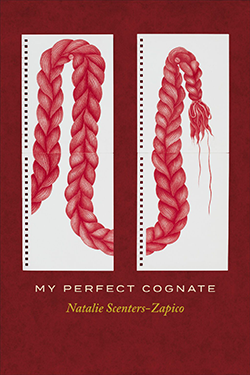
Scenters-Zapico’s innovation lies in her use of the cognate, a word that exists in both languages, often carrying related yet subtly distinct meanings, as a conceptual and structural fulcrum. The cognate functions as a mirror, reflecting identity, lineage, and history, offering a bridge over gaps between mother and child, self and society. Yet she complicates the notion of linguistic fidelity: the “perfect cognate” delivers clarity, the “true cognate” invites reflection and nuance, while the “false cognate” lays bare the fractures inherent in translation, migration, and systemic marginalization. This linguistic architecture mirrors the lived realities the collection interrogates: the dislocations and checkpoints of the US-Mexico border, the alienation and intensity of post-partum isolation, and the precarious balancing act of selfhood within a world structured by both intimacy and violence.
Through these cognate frameworks, Scenters-Zapico’s poems achieve a rare alchemy: they are at once deeply personal and expansively political, intimate and global. The borderlands she inhabits are simultaneously geographic, linguistic, and emotional, and her work reminds us that the spaces between languages, between mothers and children, between self and society, are not voids. They are charged with history, longing, and the possibility of connection. Each poem is a meditation on what is gained and lost in translation, a testimony to the power of language to contain, to fracture, and ultimately, to illuminate.
The bilingual interplay in My Perfect Cognate is one of the collection’s most compelling achievements. Scenters-Zapico navigates seamlessly between English, Spanish, and hybrid forms, creating a linguistic rhythm that is at once musical and unsettling, mirroring the complex terrains of identity, motherhood, and borders that she explores. This interplay is not ornamental; it enacts the very tension her poems seek to examine—the ways in which language can both connect and divide, clarify and obscure. In “Falso Cognato,” for example, she writes:
Language is a mirror I never tire of looking into. Every day I fall headfirst into its red. Spanish is a trap. English is a diversión. One makes me the most beautiful woman, the other tells me to shut my snout, ugly dog.
Language itself becomes an active participant in her negotiation of selfhood. The juxtaposition of Spanish and English, of terms of beauty and insult, reflects the push and pull of domestic and social expectations, and the contradictory forces shaping her identity as a mother, a woman, and a child of the borderlands. Sacred and domestic gestures intertwine: the meticulous care of her baby, the embroidery of virgin medals, the lighting of candles are interwoven with linguistic play, showing how spiritual, bodily, and linguistic labor coexist.
English and Spanish, sometimes perfectly aligned, sometimes disrupted, enact a negotiation of meaning akin to the poet’s negotiation of her own body, identity, and motherhood.
In “En Cognato,” Scenters-Zapico turns her unflinching gaze to the body and its transformations, recording the physical and emotional realities of motherhood with precise, often stark imagery:
Pregnancy turned my thighs into two gray continents that rise in the pool. The water’s chlorine stench, an animal with apetito that pushes my shirt against my chest … I have no interest in being beautiful again. I’ve given up the magia of desire for the metal of disgust.
These lines reveal a body simultaneously intimate and estranged, a domestic space rendered through both sensory detail and emotional resonance. Medical interventions, including ultrasounds, diagnoses, surgical procedures, intersect with maternal labor, forming a landscape in which tenderness and ferocity coexist. The linguistic hybridity mirrors this lived reality: English and Spanish, sometimes perfectly aligned, sometimes disrupted, enact a negotiation of meaning akin to the poet’s negotiation of her own body, identity, and motherhood.
Across both poems, language itself is a site of survival, reflection, and translation. Hybrid forms, false cognates, and bilingual shifts do more than capture the translingual experience. They reflect the constant navigation of borders both external and internal. In this sense, Scenters-Zapico’s engagement with language parallels her engagement with life: the lines between self and other, mother and child, English and Spanish, domestic space and systemic constraint are porous, and it is within these liminal spaces that the poetry finds its power, its urgency, and its music.
One of the most striking achievements of My Perfect Cognate is the way Scenters-Zapico elevates the intensely personal into a profound political statement. Her poems never linger in sentimentality; rather, they interrogate how language, law, and societal expectation intersect with intimate life. In the poem “HR 7059 in Cognates,” for instance, she takes the language of the 2018 “Build the Wall, Enforce the Law Act” and renders it in the frame of her translingual world:
The cognate hides in plain sight. Little spies everywhere, no sense without them. Legislation of barbarous imperialism in dull black ink—the letters remain the same. It is the order of letters that renders meaning.
Through these lines, Scenters-Zapico reveals that even words meant to be shared, “understood across Spanish and English,” carry violence, exclusion, and historical weight. The act of parsing legislation through cognates—perfect, true, and false—uncovers the way policies like HR 7059 can embed systemic harm in familiar terms. The poem transforms legal language into an intimate reflection on displacement, belonging, and linguistic betrayal, reminding the reader that language itself is not neutral; it is implicated in power, borders, and bodily realities.
This capacity to merge the personal with the political extends throughout the collection. In sections like “Falso Cognato” and “En Cognato,” Scenters-Zapico moves seamlessly from post-partum reflections to border-crossing narratives, from ritualized domestic acts to interrogations of immigration and empire. For example, in “Falso Cognato” she writes of her maternal devotions:
I tie a ropa embroidered with medals of pregnant virgins around my waist… I wash my armas in wine to rid myself of salt. I am trying to be holy & gracioso. I am trying to become full as a used car lot with a faded sign. Where is the éxito? I want to recordar this ritual, so I write it longhand in a bible kept in my librería of miniatura books.
The intimate, including her prayers, bodily labor, and maternal anxieties, is inseparable from broader social and spiritual contexts. The careful attention to ritual, devotion, and domestic space resonates with the same precision and interrogation that she applies to political texts, demonstrating how personal experience and societal structures are entangled.
The architecture of My Perfect Cognate, from maternal reflection to bilingual experimentation and border-crossing inquiry, reflects eight years of emotional and linguistic labor. Scenters-Zapico shows poetry’s power to navigate complexity and contradictions. Her language is precise, inventive, tender, and fierce, holding body, identity, and history simultaneously.
In seeking her “perfect cognate,” a word that bridges languages, mothers, and selves, Scenters-Zapico reminds us that the spaces between words, between languages, and between lived experiences are not voids. They are charged sites of revelation, resistance, and profound beauty. The collection insists that even in misalignment or mistranslation, meaning emerges; in the cracks between words, human experience persists, persists with force, and persists with a quiet, unwavering dignity.

Daniel Naawenkangua Abukuri (he/him) is a Black poet and prose writer from Ghana. His work has appeared or is forthcoming in Transition Magazine, The Malahat Review, Colorado Review, Chestnut Review, Orion Magazine, Minyan Magazine, Protean Magazine, Decolonial Passage, Berkeley Poetry Review, and elsewhere. He is a nominee for the Best of the Net, the Pushcart Prize, the BREW Poetry Award, and the 2026 Caine Prize; the first-place winner of the African Writers Award (Poetry); the winner of Poetry Archive Now! Wordview 2025; a finalist for the 2025 Adinkra Poetry Prize; and runner-up for the 2026 Cambridge Poetry Prize. He is an Obsidian Foundation Fellow alum and was featured in the Obsidian Foundation Showcase with The Poetry Society.
Recommended
A Review of Convergence: Poetry on Environmental Impacts of War

A Review of Stolen Flower by Irma Pineda, translated by Wendy Call