

Review Of A Little Feral
Rumor has it
this woman birthed
a voice the size of her life.
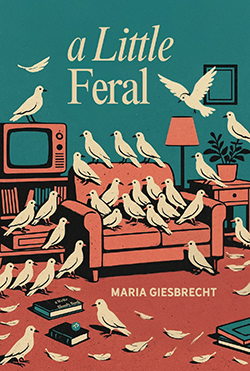
And make no mistake: Life handed the speaker some lemons. Lucky for us, they are familiar ones: shitty dad, depression, religious trauma, boy trouble—the works. Luckier still, it is my great pleasure to report that A Little Feral—Maria Giesbrecht’s sometimes snarling, sometimes purring, always reaching debut from Write Bloody Publishing—is a tall, delicious glass of lemonade.
At her best, Giesbrecht manages to offer up an astonishing (because varied, brave, vivid) portrait of emergent womanhood, netting it neatly in the world of particular phenomena (the corners of an apartment, a lover’s truck bed, the never-taken road to Oaxaca) and applying at regular intervals enough cheek and candor to rival the Cheshire Cat. Let me show you what I mean:
I’m under the moon
for you. I hate this
bony, itchy life — fucked
as a fallen feather —
for you. I’m thoroughly
unimpressed, devotedly
pissed and breaking
like a forced breath
for you.
This clever nine-line enumeration of inversions and reversals is entitled “How to Write a Sympathy Card.” How good to be with a poet of fresh subversions.
A Little Feral is not, of course, all fun and games and repartee. As the title suggests, we’re dealing with a speaker who is seeking foremost to liberate—or re-wild—herself from various domestic conventions and their accompanying expectations. I do not think it hyperbolic to suggest Giesbrecht is literally poem-ing her way to the embodied freedom of an integrated self. The book’s moments of levity are countered (and helpfully balanced) by poems of gravitas; whether erotic, metaphysical, or (RIP John Donne: You would’ve loved Maria Giesbrecht) both. Take the tender, evocative “Farming”:
I said no blurry lines we’re getting married
after this a truth we bit between teeth
a gag a silencer a prayer
do you remember how you stole
the turquoise sky and slipped it
between my thighs fed me the word yes
and I lapped July air to stay there
with you I ripped the grass
with my toes and the earth yelped —
The stakes of this poem, and many others like it, are high—physically, emotionally, and even sonically, thanks to the internal chiming of sky/thighs and prayer/air/there. Speaking of prayer, A Little Feral is haunted (or is it enchanted) by an animating paradox that goes something like this: God is impossible to hold onto/God is impossible to release.
Giesbrecht has been outspoken about her departure from a strict Mennonite upbringing, and while many of her poems can be understood as a breaking away from inherited faith, nebulous encounters with divinity nevertheless unfold in each of the collection’s five sections, often coming to a perplexing, irresolute climax. With a title that doubles as the first line, my favorite of these, “I Think I Pulled a Little God from My Mouth,” opens section V:
is what she said
the night they found
her throat in the alleyway
behind Home Sense, rolling
around in vernix
and blood. No time
to call a doctor,
her jaw had simply hinged
open like a red tulip
on autopilot in April.
Rumor has it
this woman birthed
a voice the size of her life.
Though I’m not always entirely confident about Giesbrecht’s handling of enjambment for example—why not the more syllabically balanced “this woman birthed a voice // the size of her life”?—startling, juxtaposed images and ambiguous conflict make for exceptionally memorable reading. This would be true even if the tides of faith/nonfaith didn’t number among A Little Feral’s core preoccupations. In section III, an enumerative poem names “Places An Atheist Doesn’t Exist.” In IV, “Aftertaste” opens “The end of a good god lingers // like a fishbone stuck in the back // of a throat.” Lingering seems to be the operative word when it comes to the speaker’s fraught relationship with spirituality—a tension that will be familiar (and no doubt comforting) to many readers traversing similar landscapes.
A Little Feral is to be admired for—among other things—the risk of its immense vulnerability, a necessary magic in the luminous spell it casts. Generally speaking, private experience is successfully transformed into a compelling invitation to be enriched or provoked by the specific lens of the speaker, as in the ending of breezy, colloquial “Because I Don’t Have Spotify Premium,” one of the collection’s many prose poems:
For one song, God
and I, we’re together again, cutting up the dance floor of my soul.
We sway until my feet are bloody until a Coldplay song comes on
and saves me.
But personal experiences and the feelings they evoke are not by themselves adequate to the emergence of compelling poetry. As a writer of similar preoccupations to Giesbrecht (and overall courter of risks, literary and otherwise) I’m hugely motivated to notice—especially because of the implications for my own work—where these risks pay off, and where the bat misses the ball. Giesbrecht has a good batting average in A Little Feral. It’s one of the book’s defining triumphs; a fact that makes the few strikes lurking among many home runs all the more noticeable. When private experiences relayed in a poem fail—for whatever reason—to turn the corner into invitation, or expand outward enough to tap some universal vein, the page can feel subsequently clammy or stale, the reader left with a speaker gazing too long and hard in the mirror. A few of Giesbrecht’s poems risk stumbling into this pitfall, like “Self-Diagnosis,” which ends by inexplicably echoing, without italics, Plath’s ubiquitously quoted triple “I am.” While there’s nothing wrong with incorporating a beloved line, this one feels haphazard and detached. The demerit extends to the editor, who ought to have at least italicized “I am,” or cited The Bell Jar in the book’s notes.
Because of her influencer status and significant contributions to the poetry community—she founded and maintains the online community and publication Gather—many readers are extra curious about Giesbrecht—a stranger to me before this piece—and her immediate literary circle. Media visibility and success can surely become its own repressive echo chamber. Do people tell you the truth, or do they offer lip service with hopes of attaching in some way to your ascendent star? How does the legacy of literary criticism mesh with a consumerist machine always calibrated to cash in? Murky questions, but—in an increasingly algorithmic age—important ones.
There can be no doubt that Giesbrecht has abundant poetic sensibility, ability, and tenacity. She also has something rather more wild-eyed and toothy: a demonstrable willingness to fly in the face of convention. Perhaps this is why A Little Feral was Write Bloody Publishing’s 2025 Jack McCarthy Book Prize winner. The prize seeks work that "moves people, changes lives, and deserves a beautiful home on paper."
My very favorite feature of A Little Feral is one that might be easily overlooked. To an attentive eye, though, it’s a masterstroke. Future readers: Note the all-star lineup of women with whom Giesbrecht puts herself and her book in conversation and cahoots, as each section opens with a carefully selected, synchronic quotation from 1. Jane Hirshfield, 2. Virginia Woolf, 3. Anne Sexton, 4. Brandi Carlile, and 5. Sharon Olds. I want to be in the room with these women, each feral in her own right. And I’m certainly glad I entered the room Giesbrecht’s voice opened for us with this striking debut, a voice that is indeed—and what a pleasure it is—the size of her life. To close, we’ll hear from Maria, who generously agreed to field a few touchpoint questions I hoped might offer readers deeper communion with her work.
Haley Hodges: Readers of A Little Feral will see that doubt and faith have shaped your poetics in tender and particular ways. Is wrestling with God/god/the Divine still a generative force in your writing life, or is it something you feel you'll move on from?
Maria Giesbrecht: When I finished the manuscript, I vowed to never write another god poem in my life. And then I betrayed my own commitment a few days later, ha! All that to say, I recognize because I was so enmeshed in religion for the first half of my life, the untangling truly is far from over. How that will show up in my art might change! I’ve recently started writing and publishing short fiction with similar themes. It’s another entry point into the wrestling match, which feels honest and good for me right now. But, another whole manuscript of god poems? Likely not anytime soon.
HH: Our age is a digital one. That can be weird for poets. Do you feel that running an Instagram ecosystem is ever in conflict with your needs as a writer, or do you prevent those circles from being concentric in your inner life/world? Should poets seek to cultivate a digital presence?
MG: Indeed very strange. I hold it all loosely. When it pleases me to do so, I cultivate the online space. But once it stops, I stop. One exception has been with promoting my book, A Little Feral. As my publicist and I were coming up with a plan for PR, of course social media is included. However, we created other plans too: guest essays in top publications, interviews, podcasts, etc. so we weren’t relying solely on one outlet. This reduced the pressure immensely to sell on social media. (To be honest, I’m really excited to stop linking my preorder link in my stories, Lol.)
I think poets should use desire as a compass. Do you truly want to post your poems online? Or does submitting to lit mags excite you more? Reading at open mics? Nothing is sustainable if true desire isn’t present. There are so many different paths to success (whatever that means) as a poet. Some of my favourite poets have 87 Instagram followers and sell thousands of books a year. You just have to choose what aligns with your desires and then run fast and hard toward that.
HH: What advice (if any) would you offer female-identifying writers who want to explore their eroticism poetically? I'm thinking especially of women conditioned by environments in which female sexuality and desire triggered a chain reaction of stigma and judgement.
MG: Oooof. I grew up in purity culture and so some of my early erotic poetry definitely felt sinful as I was writing it. I’m not sure I have any particular advice for navigating that, or that I’m qualified to give it. I will say that the act itself of writing, without sharing, was and is a safe space for me to explore. The page never judges, never tells. We can keep our poems in a drawer for as long as we need to. Or forever.
Some friends I know publish under a pen name. If there is still a real risk of safety, emotionally or physically, this can be a way for poets to write without censoring themselves.
HH: What voices had a primary role in shaping the landscape of your poetic imagination?
MG: Ocean Vuong’s book Time is a Mother helped me to see how poetry can be both accessible and also very craft driven. His lines are surprising, precise, and yet never purposefully shut out the reader. I want to do the same with my poems. Isabelle Correa, a dear poet friend of mine, says she “wants the reader that wants her,” and I couldn’t agree more. I want my poems to be well-read and also win awards. I feel that poets who post their work online have long been labelled “instapoets” and thus shunned by the more “literary poets.” I think this is baloney. I want to do both. I’m not picking sides!
Haley Hodges received her MFA from Seattle Pacific University in 2025. She holds additional qualifications in music and theology from Hope College, Shenandoah Conservatory, and Oxford University. Her work has been featured in Cassandra Voices, Only Poems, Luna luna, t'ART, Reformed Journal and elsewhere. Her first book of poems, Eros Rex, was released with Orison Books in 2026. She lives in rural West Virginia.
Recommended
A Review of Convergence: Poetry on Environmental Impacts of War
A Review of Stolen Flower by Irma Pineda, translated by Wendy Call