



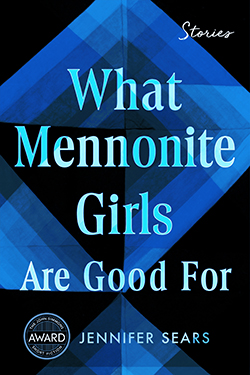
A Review of What Mennonite Girls Are Good For by Jennifer Sears
“Faith Is Just Another Sorrow,” the closing story in Jennifer Sears’s What Mennonite Girls Are Good For, is narrated by a man vacationing in Santos, Brazil, with his children and their families. He stands alone, “his cane anchored in the iridescent palm of an upturned shell,” as he observes one of his granddaughters, Ruthie, playing in the surf. Ruthie is only in elementary school, but the grandfather believes he can already see that she is “so eerily like him.” Ruthie is, as he puts it, “a physical child demanding physical truths,” and he worries that she “might mistake her difference for deficiency,” creating a sense of estrangement that proved fatal for one of his siblings, who took his own life.
Grandpa may or may not be correct, but Ruthie does spend most of this short story collection striving to compensate for a gut feeling that she is not enough. The “physical truths” for which Ruthie yearns lead her to search for answers in self-destructive endeavors, such as modeling for a child pornographer and starving her body to an anorexic state. Perhaps Ruthie’s life choices are an attempt to be seen against the backdrop of a conservative religious culture that too often pretends that bodies, especially women’s bodies, don’t exist—or exist only to be ignored, controlled, martyred, or disciplined.
A winner of the John Simmons Short Fiction award and blurbed by literary giants such as Tim O’Brien and Mary Gaitskill, this collection of intertwined stories follows Ruthie mostly chronologically from her childhood as a missionary kid in Paraguay to her adult life with a chosen family living in, as she puts it, a “prissy New England town.” Ruthie, the opposite of prissy, is a survivor, and while these stories address dark topics, their honesty, humor, and powerful sense of a will to live make them a rewarding and surprisingly joyful read.
Sears’s prose is itself physical, even muscular, propelled by Ruthie’s perennial frustration as she grows up with a lack of good answers about desire and sexuality. The third-person plural “they” narrates the opening story, and focuses on a group of young “missionary girls,” including Ruthie, working to navigate their new world and their growing bodies in Paraguay. This limited but mesmerizing perspective includes a lot of enthusiastic exclamation points (“These girls know how to baptize each other!”), as well as lush details to bring readers into the awe and overwhelm of the story’s collective, youthful point of view: “flowers shaped and colored like strings of toucan bills, ferns and palms that shower the air with green, and trees with trunks shaped like enormous bottles burst into bloom for one day, their white petals covering the ground by nightfall.”
Sears expertly shifts stylistic gears to keep her readers engaged, moving from rich passages like the above, to bare-bones phrasing that echoes literary modernist precursors such as Hemingway. “Like missionary children everywhere,” writes Sears in that same opening story, “these children have learned to love quickly and to expect sudden farewells.”
Also like Hemingway, the unspoken can drive these stories as much as if not more than what the characters say aloud. The story “You Can Be Madonna If—” explicitly alludes to Hemingway’s famous “Hills Like White Elephants,” which sketches a couple discussing whether or not she should have an abortion, a dilemma referenced so obliquely that the reader will miss it if they blink. In Sears’s story, a high-school-aged Ruthie and her ex, Luke, visit a “clinic” that aims to scare pregnant youth out of undergoing the procedure. While Luke, appalled, immediately names the propaganda they’re forced to watch (“‘This is shit,’ Luke said. ‘We’re in the wrong kind of place’”), Ruthie’s reaction is to mentally extract herself. She remembers a bird’s nest she saw outside when they arrived, then spins a twisted but lovely tale of human babies hatching from the eggs: “Each one contained a tiny human fetus, growing like the one on the video. Their tiny fingers opened and closed. Their big heads pushed against the insides of their shells, their strange wide mouths opening upward like baby birds.”
The bulk of the stories in this collection are told from Ruthie’s similarly mesmerizing, off-kilter perspective, at first in a third-person limited “she,” and later in a first-person “I” as Ruthie grows up and gains autonomy. Exceptions are the opening “we” of the missionary girls, the closing “he” of Ruthie’s grandfather, and a story called “The Order” at the end of section one. This story also uses the limited third-person “she,” but shifts the perspective to Ruthie’s mother—referred to only as “the woman.” “The woman” and her husband, Ruthie’s father, are on their way to the hospital to visit their frail ghost of a daughter, anorexic and too weak, perhaps, to continue to carry her own narrative. Sears harnesses the point-of-view shift with characteristic expertise: readers witness “the woman” simultaneously enveloped by her own thoughts and hyperaware of the world around her.
Such images are designed and pieced and sewn into place by this masterful writer.
Sears also gently chides readers (myself included) hoping to find a “reason”—a single reason, which is always too pat, too simple—for Ruthie’s descent into self-starvation. When “the woman” arrives at the hospital with a beautifully wrapped package for her daughter, she imagines the judgmental clinical notes that the gift will likely inspire among the nurses: “Gold paper, ribbons, silk,” she pictures them writing, “mother preoccupied with beauty, with looks” (66). Readers learn that the package contains, however, a “loosely knit sweater that reminded [Ruthie’s mother] of a cocoon”—in other words, a gift the opposite of superficial, as close to a hug as a box can hold. Clearly, the problem isn’t the women in the book, but the cultural structures and expectations that have brought both Ruthie and her mother to this point of crisis. Ruthie’s father stays silent throughout the story, only ever responding to the queries of “the woman” with “a shrug,” “What?” or “Dear.”
The press for this book cites a pull between “the cost of abandoning one’s cultural heritage, and the complicated longing for return,” but in her journey of survival—despite her grandfather’s assessment that “she won’t make it”—Ruthie doesn’t actually seem to long to “return” at all. In the penultimate story, Ruthie at last finds the off-ramp for her self-destructive cycle by instituting a regular gathering with chosen family. Yet this book is by no means a screed against religious community. The collection also makes clear not only that her parents love and support her the best that they can, but that misogyny and patriarchy aren’t limited to communities like hers. Ruthie’s process of freeing herself provides her with the tools she needs to survive a world beset with similar pitfalls.
Epigraphs by two giants of Mennonite literature—fiction writer Miriam Toews and poet and essayist Julia Kasdorf—open the book. Both are known for speaking the truth about destructive gender dynamics, especially within the more conservative branches of Mennonite culture. Toews most recently hit the arts headlines with the film version of her novel Women Talking, which won the Oscar for Best Adapted Screenplay. Toews wrote the novel as what she calls an “imagined response” to the true story of women in a small, rural Mennonite community in Manitoba being serially drugged and raped by a group of their own men. The community’s elders dismissed the women’s accounts of their experiences for almost four years until local police were finally called in.
Lest you think Sears grew up wearing long dresses and a head covering, however, she seems most closely aligned with Kasdorf, who left her progressive Mennonite college in Indiana (Goshen College, where I currently teach) to finish not just her BA but her PhD at NYU. Sears, like Kasdorf, made her way from Indiana to New York City, where she is now a professor at New York City College of Technology.
A significant connection between Kasdorf and Sears is their use of images of women’s traditional forms of creative expression, whether cooking, gardening, or sewing. “In the Mennonite communities I come from,” Sears explained to Electric Literature last summer before the book’s release, “quilts are communal works of art meant to be used.” Sears repeats such images, threading them through the stories like basting on a quilt. A papier-mâché angel dissolved into the kitchen sink in one story appears freshly made in the next story’s flashback, its glue still wet. Such images are designed and pieced and sewn into place by this masterful writer. Ruthie, similarly, selects and pieces together her life until it becomes enough—even more than enough.

Jessica Baldanzi’s poetry, memoir, and critical essays have appeared in Booth, Genders, The Shore, Two Thirds North, and Exposition Review. She blogs about comics and graphic novels at commonscomics.com, and her book of cultural criticism, Bodies and Boundaries in Graphic Fiction (Routledge), was released in paperback in 2024. She teaches writing, comics, literature, and theory at Goshen College—a small but mighty liberal arts college in Indiana—where she chairs the English and Spanish departments.
Recommended

A Review of Convergence: Poetry on Environmental Impacts of War

A Review of Stolen Flower by Irma Pineda, translated by Wendy Call