


Kronos in the Bardo: A Review of The Disappearing Act by Maria Stepanova
Feminized exile literature emerges from a cannibalistic, masculine state
Sometimes on a train you can pretend that you are a nonentity. The landscape whizzes by quickly enough that you musn’t comprehend it; the colors inside the train car are all respectful blues and silent grays. If you’re lucky, no one speaks to you. Russian author Maria Stepanova understands this well: in her new novel The Disappearing Act, whose stunning translation was published by New Directions in February, she describes “six quiet hours on the train, during which time … it would be as if she didn’t exist.” This desire for self-erasure, and the tortuous knowledge that doing so would be giving herself up to the oppressive powers from whence she flees, haunt the spectral novella, which traces a very Stepanova-like character as she attempts to shake free of her past.
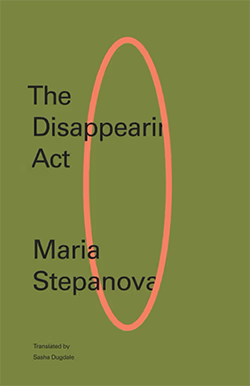
Stepanova was forced to leave her native Russia in 2022, shortly after the country’s full-scale invasion of Ukraine and a few months shy of her fiftieth birthday. Soon thereafter, by way of coping, she began writing about her departure. Ought she have stayed? What, now, would she do? Was, now, there anything to do at all? The text that emerged was not quite fiction, and not quite not: The Disappearing Act, the masterful translation of which was published by New Directions last month under translator Sasha Dugdale’s steady hand, occupies a purgatorial space between the two literary modes as its author struggles to render reality in a way with which she can live. It is a wonderful little book, and a frightening one, too.
Stepanova joins an ever-expanding cabal of unsmiling novelistic greats. The Russian exile text is nothing new: Nabokov, Bunin, and Brodsky made their respective exiles into tenets of literary excellence, turning their departures from the patria into reflections on selves cleaved in two. Nabokov and Bunin fled the Bolsheviks; Brodsky, Brezhnev’s censorial regime. All three manifested their literary selves out of the stark absence of a homeland. Edward Said, a famous exile in his own right following 1948’s Palestine War, laid out in his seminal text “Reflections on Exile” that “habits of life, expression or activity in the new environment inevitably occur against the memory of these things in another environment. Thus both the new and the old environments are vivid, actual, occurring together contrapuntally.”
This manifests for Stepanova both as an oneiric nostalgia and as a crippling guilt, one that prevents her from moving forward or returning from whence she came. “The beast,” as she calls it, is the masculinized state from which Stepanova has fled, but she cannot keep herself from missing its small sweetnesses. She is paralyzed by her very entanglement with the beast; she cannot rid herself of it, and no longer can she exist within its shadow. Thus it begins: M, a writer who has lived in the city of B since her homeland turned hungry eyes on its neighboring state, struggles to cobble together an existence devoid of a sense of belonging. She can no longer write, or make friends, or reach her family. On the way to a literary festival elsewhere on the continent, she is stranded alone in an unfamiliar town. She wonders if this new third place might be a final end point, if she might make herself anew; the process turns out to be more laborious than she had once imagined. In this slim, lightly anonymized piece of autofiction, Stepanova describes the self-sundering wrought by her departure from her homeland, and the impossibility of separating herself from its evils and its nostalgic pull.
In her work, Stepanova asks a brilliant question that may well apply to our country, too: what are the daughters to do when the father eats his own?
M’s exodus, however, contains an additional dimension: she is a woman, and the “beast,” the country from which she flees, is masculinized. She attempts to start anew, but is held back by inevitable, and inevitably sexualized, connections to the self she inhabited before. M keeps running into a beautiful, well-kempt man she first saw on her train ride; he eventually invites her to travel back to B with him. She agrees; she feels rage. The man “really didn’t know who he was dealing with: not, in any case, with ‘the novelist M,’ but with a new being, just M, or maybe A, still fresh and instinctive, and ready for adventure.” The masculine tries to pull M back to her old identity, one held in the man’s strong pale eyes and his large clean hands. He is not Sonya Marmeladova with her selfless love, nor even the textual women inspired by Nabokov’s own Véra. He is no one, really, of note; and yet his presence, his knowledge of M, immediately becomes a force of oppression so severe she wonders if she must change her entire sense of self. He brings her closer to the beast. In response, M throws out her clothing, changes her name, attempts to join the circus, hides from her future by denying its existence. She attempts to unmake herself.
Russian exile literature has resurged in popularity in the past decade due to the war in Ukraine and the rise of authoritarianism in the country. So, too, has the desire by the Russian state media to cast the country in strictly masculinized terms. The English translation of Stepanova’s novel comes at a time when Americans confront the same issues. In the last decade, a hegemonic masculinity has resurged in tandem with a series of increasingly interventionist—and increasingly sadistic—foreign policy forays. Now we are in Venezuela, now Iran. Now, inexplicably, we are curling a sharp talon toward Greenland. Now the Trumpian beast flicks its toupée and turns inward: it bares its teeth at protesters and claws at the justice system. It gobbles up Roe v. Wade and licks the bones clean. It takes a great big beastly shit on our voting rights. As the beast grows in size, its resemblance to the one Stepanova describes becomes unmistakable. The distinctly gendered form of self-cannibalization Stepanova and her forebears describe is now taking place in our own hypermasculinized autocratic state. In her work, Stepanova asks a brilliant question that may well apply to our country, too: what are the daughters to do when the father eats his own?
“It seemed as if the only way to get rid of the beast was to get rid of oneself,” Stepanova writes toward the end of her novella, “or to remain silent forever to avoid inadvertently speaking in the voice of the beast.” The apophatic becomes the only safe mode of self-reference, and the more things M is not, the more she must rend herself from, the sparser she becomes. By the text’s finish, inevitably, M is no longer. Her name is now A. She has no phone, no possessions, no future. She has ended herself in order to survive. She finds something on the floor: a cigarette butt, a product finally so deformed as to be devoid of the packaging she once bemoaned for its depictions of suffering. She takes the cigarette, doesn’t have to look at the picture of death it usually comes wrapped in. Morning comes.

Miranda Wollen is a writer and editor living in New York. You can find her online at @mirandakwollen.
Recommended
A Review of Convergence: Poetry on Environmental Impacts of War

A Review of Stolen Flower by Irma Pineda, translated by Wendy Call