

A Review of When We Were Gun: A Narrative Poetry Cycle by Deborah Schupack
The twentieth century photographer Henri Cartier-Bresson wrote of the “decisive moment” in his pictures—the moment that captures an essence. The “decisive moment” in literary texts indicates that moment when everything merges and changes. For example, Romeo and Juliet is just a play about the forbidden romance of sleep-deprived teenagers until the fateful moment when Romeo kills Tybalt. From that moment, there is no going back. The new poetry collection, When We Were Gun: A Narrative Poetry Cycle by Deborah Schupack, winner of The Louisville Review’s 2024 National Poetry Book Contest, captures a decisive moment that has become too common in contemporary America – a senseless school shooting.
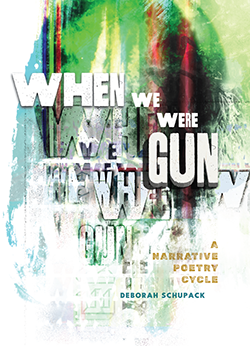
When We Were Gun is a suite of poems in three parts—“Before,” “During,” and “After”—taking place on the day of a school lockdown and shooting. The first part (“Carnival of the Animals”) takes place as parents gather one morning to endure a school concert, “one / more intrusion into our day.” Schupack’s use of the first person “we” brings immediate familiarity and participation in the events of the day. “We” glance at our program “to count / the number of songs we were up against …” As the book proceeds, the “we” becomes clearly female as “we” compare “Our Husbands” to other husbands, other marriages.
In the introductory poem, “Carnival of the Animals,” as the parents gather in the multipurpose room, Schupack evokes an Anytown, USA, with entertaining and familiar snapshots of people we can all recognize. Boisterous Buddy Sandoval takes a seat, accompanied by his wife, Jacquie (“Patience of a saint, that Jacquie Sandoval, we whispered”). The children enter, bearing their instruments, and within the crowd of young musicians, individuals begin to emerge. Ryan Liu, the school’s “one prodigy,” apparently the only true musician in the bunch, becomes an early standout and a name we will be reminded of in events that ensue. The concert ends abruptly with a power failure (a troubling detail that piques curiosity), sending the students back to their classrooms and their parents back to their daily lives.
The second section, “During,” begins outside the school building (“Police Line: Do Not Cross”) as “we,” the parents, return to the school, now in lockdown. It is in these substantial middle poems that Schupack’s cubist construct soars as the pieces flow from the parking lot to the classrooms to the civic building where the parents are told to wait. “Please we will update you there. / We will return your children to you there.” The poems now occasionally perch on the mindset of Ryan Liu, sheltering with Eva Lapham and Scottie Sandoval, under a table and too close to a door. A plaintive refrain—“Ryan please explain”—is introduced as Ryan listens carefully for the PA to release them to resume third period. But “the PA says nothing” and Ryan wishes Scottie would whisper something besides gun gun gun.
Schupack’s relentless flow of words and images creates and sustains a harrowing tension that recalls all those tidbits we encounter in every tragedy of this nature, captures the rumors and theories that circulate among the parents as they wait. Helicopters hover, sirens scream, and firefighters sweep into the civic building to comfort the parents, circling them “like border collies / nipping at us with assurances” until a parent finally tells them to stop, “You’re scaring the hell out of us.” A waiting father, one of the least likely to have health issues, collapses with a heart “episode.” Meanwhile, Ryan Liu’s mind never stops working out mathematics factorials and possibilities, just as he never stopped playing his violin when the power failed, and a lone child runs out of the school doors, toward parents in waiting.
In “Bird’s Eye View (One),” three red-tailed hawks circle overhead and “we” focus on one, asking forgiveness “on the slight chance that it was the hand / of God made manifest.” As the manifest hawk continues in its circuitous path, there is concern about whether it is protector or predator. “See me, some of us dared / taking a gamble / betting on protector.” Schupack does not delve into outcomes during the event. Four pops are heard.
By the time the poems get to the section labeled “After,” we are still not sure exactly what has happened. Children begin to return to parents who realize that “We no longer knew our before.” Tension remains taut as parents try to find their children among those returning. “The children kept coming / not ours / and still not ours.” A mother, not remembering if she did the laundry last night, tries to remember what her child wore to school this morning. Husbands, leaving the scene, boastfully maneuver their cars out of tight spaces “in a brilliant imitation of before.”
When We Were Gun is Deborah Schupack’s first book of poetry. Her previous books are two novels, The Boy on the Bus (2003) and Sylvan Street (2010), and Relentless (2022), a nonfiction account of the Covid crisis. By choosing poetry to examine the plague of gun violence in American schools, she has chosen to find the essence of such events—how each is unique and distinctive, but ultimately each is the same. Schupack’s focus on the victims—especially on the parents, her choice to keep the details of the violence as a demi-presence, and her agile ability to transition quickly and forcefully from tableau to close-up lend a poignancy and credibility to the poems’ progression that can only be fully captured by the witness of poetry. Given the subject matter, one hesitates to call When We Were Gun an “enjoyable read,” but it is always a compelling and urgent one.
Gun violence in its most reprehensible form—violence against children in schools—occurs at a rate that becomes numbing in a nation that has turned the willful misinterpretation of a Constitutional amendment into a political movement. Deborah Schupack does not delve into the politics and statistics of the problem; instead, she reveals the human toll and reminds the reader of the human tragedy. All of us are damaged by gun violence; with When We Were Gun, Schupack makes the problem personal and the victims real, transcending empty self-serving political discourse.

Edward Journey frequently reviews books for Alabama Writers’ Forum and his essays regularly appear in the online journal Professional Southerner. Following a far-flung career in professional theatre, he spent two decades as a professor of theatre and performance in Alabama. His work has been published in Arkansas Review, First Draft, Southern Theatre, Theatre Symposium, and other publications. He now writes from his home in Birmingham.
Recommended
A Review of Convergence: Poetry on Environmental Impacts of War
A Review of Stolen Flower by Irma Pineda, translated by Wendy Call