


Beloved Language and the Language of Love: A Review of John Poch’s The Future of Love
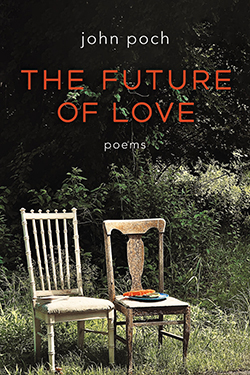
“A love poem must love the language,” writes John Poch, “even more than the poet loves the beloved.” The aphorism appears in his Notes on the Poet: A Little Book of Criticism (Measure Press, 2023), and is put to practice in his new book of poems, The Future of Love (Slant Press, 2026). True to its title, and its intent, Poch’s eighth collection of new poetry is manifestly a collection of love poems, written over two decades for the author’s wife, Meghan. As Poch asserts elsewhere in Notes on the Poet, “The muse is an actual person, not some fantasy of romantic poets.”
While The Future of Love is written to and for an actual muse, its poetry arcs outward, toward the reader, loving its own language with a lively sense of play, as in a slyly alliterative passage from a characteristic poem, “Song of Catalunya.”:
A flag of scarlet saffron strands bleeds gold
into paella. Years of olive oil have seasoned
this pan the patina of any old gold altar
in a poor church. But outside, the blue-green
sea salt thirst breaks patiently mountains
to stone to sand, and anyone sane wants
to start a shell and sea glass jewelry shop.
This piece is characteristic too, in that most of the book’s poem’s take place in Spain, specifically Andalusia, more specifically Seville, where the Poches lived during much of its composition. While the landscape of these place-poems suggests relationship to the work of Federico Garcia Lorca, Poch’s poetry also traffics in the romantic surrealism of Pablo Neruda, while its palette of colors, flavors and aromas could come straight from the biblical Song of Songs. There is a loveliness to these love poems, lushly flavored with dates and almonds and figs, scented in hyacinth and orange blossom, tinted pink, vermilion and lavender.
You govern color, the fuchsia bougainvillea,
the pink, the orange of dying fire all hung over
my morning walk like new dresses teasing
the ravishing girls to give up their studies and run.
Akin to the Song of Songs, too, is the manner in which these poems contend with the parallels and divergences between eros and agape. In “The Razor,” the poet nurses an absence of his beloved while walking the streets of Seville:
From your subtle face, the one I come back to, comes
the breath of love, and it turns the earth casually
like a bracelet of kisses all along the arm of faith
continuing.
The poems of The Future of Love link arms with both faith and conjugal love from the outset of the book, which begins with “Please,” a poem that officiates the marriage of the sensual and spiritual which is to follow:
If you could unroll
the fingers of my hand
from its fist of hardship,
you would see a map of lines,
or a tough palm and tougher prints
destined for turning Bible paper
late night by lamplight.
You might sense cinnamon.
Sugar in the cut wood of juniper.
Most of all, the poems here are poems in love with poetry, that love their own language, that will worry a verb just for the joy of it.
It is this examination of faith in marriage that gives Poch’s poetry its grit and darkness, and like the work of Gerard Manley Hopkins, the poems here are seldom merely beautiful, shapely and beautiful though they are. “Because we’re all headed toward the grave from the moment we’re conceived,” Poch has said, “… we need to make the most of the love we have in this life but also realize that there’s a more ideal love offered as a gift beyond eros.” Poch’s original title for the book was Dark Cathedral, after the Catedral de Sevilla, and like much of his previous work, matters of religion are never far from its surface. A typical poem here will arrive at or derive from an exacting image before concluding with a turn toward the church, as with another of the Seville poems, “The Plaza of Good Success”: “When you are quiet, the missing jewel of the finest pendant, / the memory of your voice fills my hair with metal filings, / and each church I pass is a magnet that loves arches.” The reader need not share Poch’s faith to share in the sensation he describes, but will recognize that Christian apologetics form one component of the project.
The Future of Love is a fine-cut jewel of a book, however, of which faith is but one facet. These are poems of place, in which the beloved is associated architecture (“With a horseshoe arch / on a horseshoe arch, I will invent a doorway / worthy of her shoulders”), and they are poems which sharply observe the quiet moments of a relationship, as in a striking little stanza from a poem entitled simply “Marriage”:
In the corner, a white wicker rocker
ticks. The world
does not continue exactly.
Where you have been, it shimmers.
Most of all, the poems here are poems in love with poetry, that love their own language, that will worry a verb just for the joy of it, like the playful opening stanzas of the title poem: “Our bodies turn us on, / turn on us // like Turner’s / skies from seas / turn over // until waves go whitecap.” The title poem, composed of three-syllable lines, is the only piece here which overtly adheres to formal poetics, mostly favoring what the author has termed “wilder rhythms and lines.” Readers familiar with Poch’s skillful poetics, however, will find within these free-verse love poems the sturdy bones of form, along with a healthy indulgence in the pleasures of meter and rhyme, like the giddy internals to be found in the concluding stanza of “Pennilessly”:
enraptured as our children were
that spring practicing with laughter
the disaster plan, clattering
the emergency ladder.
The future of the love poem is in good hands with The Future of Love, which seeks, according to Poch, to rescue the tradition of love poetry from the banal and reclaim it for literary poetics in the tradition of Dante, Neruda, Lorca, and Hart Crane. “Sure, you find tired emotional Instagram verse all over the internet, but actual poets are after a unique way of saying things,” Poch has said. “Eros is one of the great mysteries of life. Probably one of the only ways to really get at this human love, to think about it in language honestly, is through the art of poetry.” To my reading, this collection of forty-three poems, lovingly selected and thoughtfully ordered, and lyrically vivid throughout, more than hits its mark.

A graduate of the University of Northern Iowa’s Languages and Literatures program, Brian Pals reads and works in Cedar Falls, Iowa.
Recommended

A Review of Convergence: Poetry on Environmental Impacts of War

A Review of Stolen Flower by Irma Pineda, translated by Wendy Call

A Review of Ghost Hunting Glaciers by Michael Garrigan